
(Kitco News) – While Q2 was the worst quarter for gold in 12 years, with spiking energy prices raising inflation expectations and introducing the possibility of rate hikes, central bank demand will help gold finish the year on a positive note, according to the new quarterly gold outlook from Invesco.
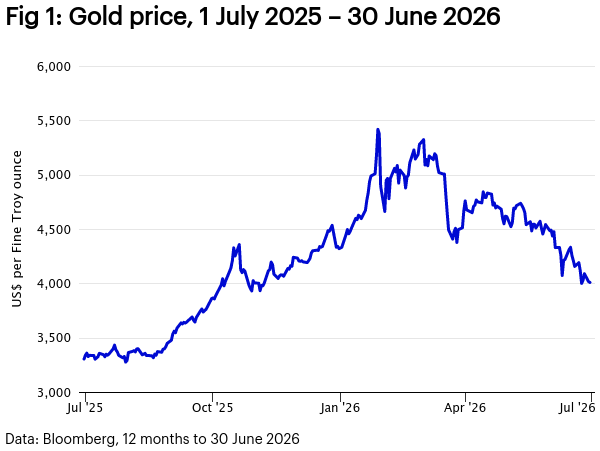
“The gold price fell by 14.1% in Q2, more than erasing its gains from Q1 and leaving it over $1,500 an ounce off the all-time intraday high set in late-January this year,” wrote Sam Whitehead, Head of Alternative and ESG ETF Product Strategy, Benjamin Jones, Global Head of Research, and David Scales, Senior ETF Investment Editor. “Volatility picked up in April, but most of the decline in the gold price occurred over the following two months. On 24 June, the yellow metal dipped just below $4,000 an ounce for the first time since November 2025. Gold spent the following days bouncing around that psychologically relevant level and ended the quarter at $4,008.”
The authors said this constituted the worst quarter for gold since Q2 2013, when the price fell by 22.7%, but pointed out that these kinds of pullbacks “are not uncommon when any market has risen so strongly for a sustained period, and this latest price correction might prove healthy given gold is still up by 21.3% over the past 12 months.”
They warned, however, that downside risks to the gold price remain. “The next few months could be pivotal for gold, as we watch to see how the Fed reacts to inflation – and whether inflation is sticky or comes down with lower oil prices – and if the US Dollar firms further versus other major currencies,” they said. “Higher interest rates and a stronger USD are generally negative for gold, as the former increases the opportunity cost of holding a non-yielding asset and the latter makes gold more expensive for international (non-US) investors.”
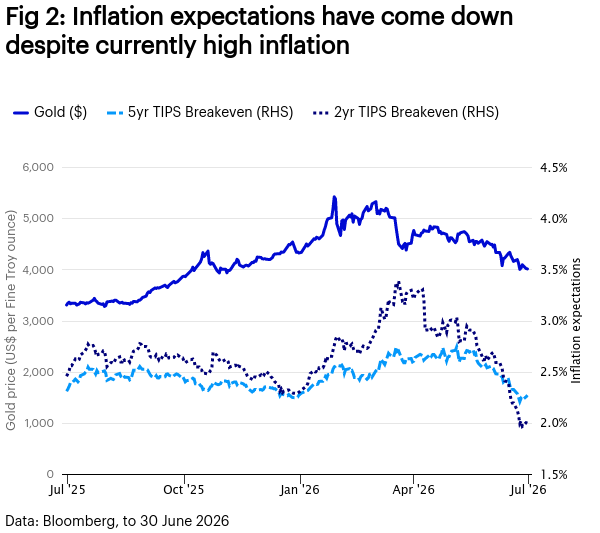
The authors wrote that several headwinds drove the gold price lower during the quarter. “Inflation emerged as a threat that could potentially linger beyond what was previously being priced in, which means interest rates could stay higher for longer,” they said. “The US Dollar strengthened, though only a little, partly in reply to the revised interest rate outlook and, lastly, some of the geopolitical risk premia was removed from the perceived ‘haven’ asset as the market seemed convinced that negotiations between the US and Iran were progressing towards a satisfactory outcome.”
They noted that the conflict’s impact on energy prices resulted in a market focused on inflation. “The longer the conflict continues, the more lasting the impact on inflation not just on oil prices but knock-on effects more broadly,” they said. “WTI Crude ended the quarter at $70/barrel, an indication the market expects supply to resume.”
The authors said easing inflation expectations indicate that the broader market believes the recent inflation will be brought under control. “The question is whether the market is being overly optimistic, given recent actual inflation readings and with the US-Iran situation still potentially volatile.”
They pointed out that PCE inflation hit 4.1% in May, the highest level since April 2023, driven mainly by elevated energy prices, but core PCE, which excludes food and energy, also reached 3.4%, the highest reading since October 2023. “The FOMC, under new Fed Chair Kevin Warsh, had sounded a warning to the market in the minutes following the committee’s April meeting, saying it would “deliver price stability” after inflation has remained above the target 2% rate for five years running.”
The Invesco analysts said the recent gold price correction could be seen as a reasonable response “to the rise in inflation expectations, the Fed’s more hawkish view on interest rates and the recent strength in the US Dollar.”
“The USD eased at the beginning of the quarter but spent most of the period gaining against its major trading partners,” they said. “A stronger USD makes gold more expensive for international (non-US) investors and consumers, which tends to reduce demand from those important segments.”
The authors noted that after a general expectation of further rate cuts, interest rates are now forecast to rise in 2026.
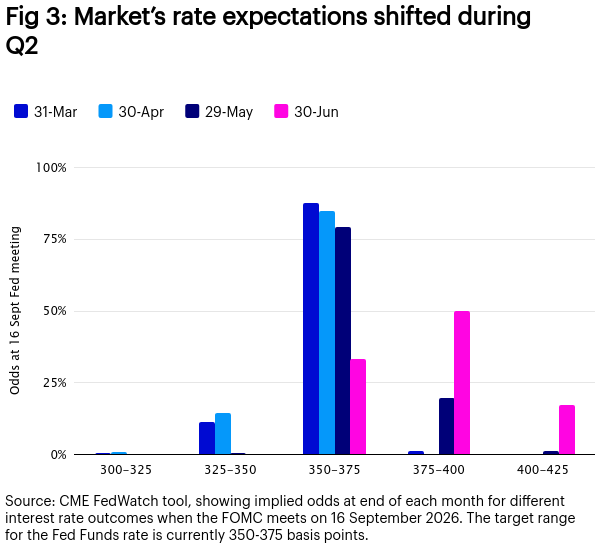
“Earlier this year, the futures market had been predicting Fed rate cuts in 2026, with the only question being how many,” they said. “The CME FedWatch tool was showing practically no chance of a rate hike this year. The inflation pressures mentioned above then shifted the market’s expectations, with the Fed under new Chair Warsh seemingly more committed to addressing the persistence of above-target inflation, with hikes firmly on the table.”
By the end of May the market was pricing in virtually no chance of a cut in 2026, and began entertaining the possibility of rate hikes.
“When the quarter ended, the market was placing a 33.7% probability of a 25 basis-point increase at the end of July and at least one rate hike (67% chance) by the time the FOMC concludes its September meeting,” they wrote. “The CME FedWatch shows an 83% probability that interest rates will be higher than they are now by the end of the year. Higher interest rates are negative for gold, as it increases the opportunity cost of holding the non-yielding gold asset.”
But despite the rise in inflation expectations, the potential for rate hikes, and the yellow metal’s recent weakness, Invesco maintains a constructive outlook for gold in the second half of 2026.
“[W]e believe much of the structural support for gold remains largely intact,” the authors said. “Central banks look set to continue buying gold to diversify their reserves. The World Gold Council (WGC) reported that a record 45% of central bankers responding to its latest survey said they expected to increase their gold reserves in the next 12 months, while 89% expect gold central bank reserves to increase globally over the coming year.”
They noted that this structural support was reflected in their recent Global Sovereign Asset Management Study, “in which a majority of central banks reported increasing gold allocations over the past three years, with concern over global volatility, inflation protection, and geopolitical uncertainty now among the leading drivers of ongoing gold purchases.”
But while central bank demand is largely price-insensitive, they said, investment demand is sensitive to price momentum. “Rising prices may attract flows into an asset, but falling prices can sometimes encourage selling, particularly when an investor can lock in a profit and needs to access liquidity to reallocate elsewhere,” the authors wrote. “Retail purchases of coins and small gold bars were a strong source of demand throughout the long-term gold rally, and it will be important to see how they respond to the correction.”
“For retail and professional investors, the case for including gold in a portfolio is not based on a single consideration, such as using it only to hedge geopolitical risk, although historically gold has performed this role relatively well,” the Invesco analysts concluded. “Rather, gold can be a useful diversifier as it tends to have low correlation to most assets, especially equities. Gold is a unique asset as it has no issuer, no credit risk, and a long history as a store of value when confidence in currencies, institutions, or market plumbing is questioned.”
