
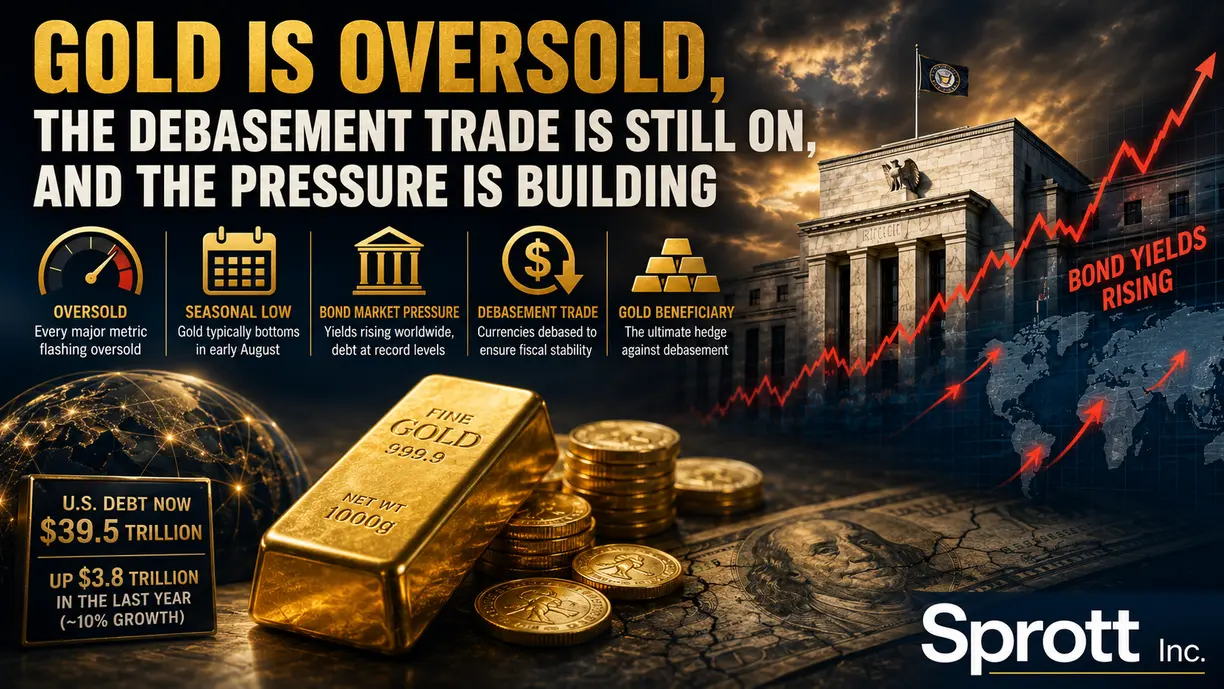
(Kitco News) – Gold is massively oversold by every meaningful metric and is likely to set a cyclical bottom before September, while currency debasement is the fundamental driver that will push gold to its next all-time high, according to Paul Wong, managing partner and market strategist at Sprott Inc.
In a recent interview, Wong told Kitco News that gold tends to find support when prices fall to 90% of the 200-day moving average – and we've well overshot that at this point – but there are other reasons to expect a rebound by late summer.
“It looks pretty remarkably similar [to previous pullbacks]” Wong said. “The percentage below the 200-day moving average, that's just a technical measure. Internally, I have five or six other measures that show minus two or minus three standard deviations oversold. I tend to think about things more in terms of probabilities: where are you on the distribution curve probabilities? Are you oversold? Give me a number. According to this measure, it's minus two standard deviations. According to this measure, it's minus two and a half, minus three, whatever. Add them all up, and what does it mean? It means that it's harder and harder to push down the price of gold. That's what the probability says.”
Wong said gold prices will still need a catalyst to break higher. “What is it going to get to spark it back up? That's the whole thing,” he said. “But in terms of selling action, minus two standard deviations oversold positioning, CTAs have gone to flat, CFTC positioning in terms of longs is back at the 2018 levels. In terms of ETF holdings, they sold off a little bit, but not a lot. If you look at China ETF holdings, all the ETF [holdings] that came out of Europe and North America have been more than absorbed by the ETF growth in China.”
“I've built up all these indicators over the years, so I fire them all up, and if all of them are saying minus two standard deviations or lower, then chances are it's oversold.” Wong said. “It doesn't mean it's the low, it just means the bulk of the selling is probably done. And now you're switching to look for an entry point, or if you're a massive fund, you just start buying, and on down dip days when it drops 1% or 2% on some news or whatever, you just buy a little bit more.”
And if the yellow metal’s recent and dramatic pullback is close to the bottom, then gold’s seasonal weakness can actually be viewed as an entry. “Usually gold bottoms in the summertime, usually around early August is the average seasonal low,” he said. “It can be late, last year was at end of August with Jackson Hole, when the market realized the Fed's not going to raise rates in the face of any inflation.”
“Next thing, gold runs from $3,600 up to around $4,500 before it crashed.”
Wong said the same dynamic is likely to play out again this year. “Probably sometime in August, whether it's Jackson Hole or something sooner, or something blows up in the Middle East, or the bond market goes bonkers,” he said. “There'll be some sort of event, a catalyst, that all of a sudden sparks gold up again.”
Bonds are the true battlefield, and gold is the ultimate beneficiary
Looking ahead at the upcoming FOMC meeting – and the likely trajectory for the Fed rate over the balance of 2026 and beyond – Wong said the bond market is the real battlefield.
“Ultimately, it's the bond market that decides,” he said. “Right now, you pull up any bond chart, it doesn't matter whether it's U.S., Germany, or Japan, all bond market yields are looking like they're heading higher. They want to head higher. You’ve got a grumpy bond market everywhere. Anywhere in the world, bond markets are not happy. Any sense that the Fed will change how inflation is calculated to keep rates well below the rate of inflation, bond markets are going to probably rebel.”
“The problem you have is that US debt is now $39.5 trillion. It's up $3.8 trillion dollars in the last year or so,” Wong explained. “That's close to 10% growth in debt. Rates are rising. Your interest expense is now greater than your military. Those are deficit-busting numbers. You can see that there's absolutely zero desire from any party in the US to address debt. If anything, the era is swinging more and more populist in the States. The cost of living is through the roof. People are very grumpy. They're very unhappy. The massive wealth divide is just stunning, and that's typically inflationary.”
And outside of the United States, it doesn’t get any better. “You look at what's going on globally, we are de-globalizing, so that means duplication of everything,” he said. “You're reshoring everything, that's duplication of supply chains. It's duplication of demand for commodities across the board. You're building inventories because nothing is safe anymore. After this Iran war, everyone's going to be stockpiling energy. Storage is going to go up. You're going to build more [nuclear plants], you're going to build more solar, because those are renewables, and those are secure. Even metals, they're going to be stockpiling more. Meanwhile, governments around the world are changing. They're charging more, they're taxing more, they have more export controls. Everything is going to go up in price.”
In the face of these relentless global price pressures, the Federal Reserve’s powers are very limited.
“What can the Fed do? Not a lot,” Wong said. “They can talk a lot. They can try and give confidence, which is what I think Warsh accomplished in June – which sank gold markets – he came out quite forcefully saying sustainable inflation is not going to happen."
The simple reality is there's just so much pressure building in the bond market, Wong said, which forces central banks to make a clear choice. “You're going to have to give up something,” he said. “Either you lose control of the bond market – but you can't because you have to keep financing the debt – or you debase the currency.”
“That's the heart of the debasement trade. It's still on, it's still there, and the pressure's still building.”
Wong said this is the real reason why gold prices will need to rise: not because the yellow metal becomes the hot new investment trend, but simply because all fiat currencies will be steadily debased to ensure fiscal stability.
“Inflation is rising, your debt and deficits are rising, yields are going to go up,” Wong said. “You're moving closer and closer to the tipping point in terms of what the bond market will allow. You're going to get a rebellion in the bond market, and you’ve got to keep the bond market happy. And [currency debasement] is your only release valve. Really, that's the bottom line.”
