
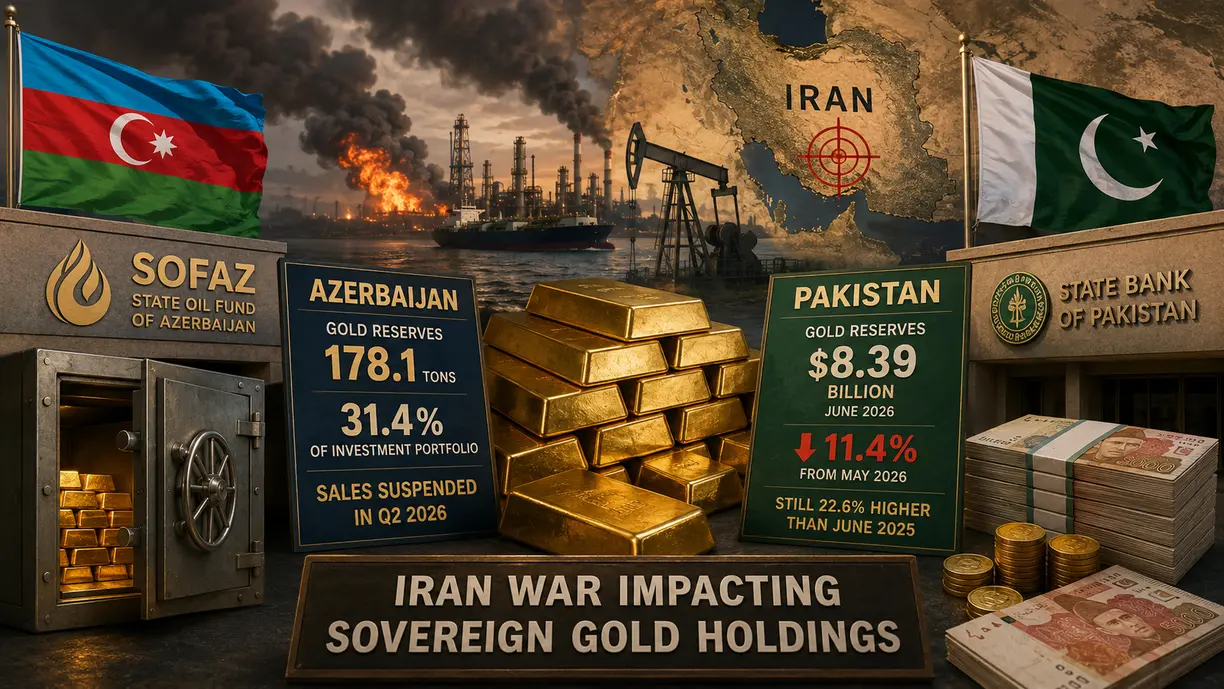
(Kitco News) – The Iran war continues to impact the gold purchases and sales of central banks and state entities, destabilizing one of the pillars of the multi-year gold rally.
On Thursday, the State Oil Fund of Azerbaijan (SOFAZ) announced that they had suspended selling gold in the second quarter of 2026. The fund's gold reserves totaled 178.1 tons as of the end of June, with the yellow metal representing a 31.4% share of SOFAZ's investment portfolio.
"As a result of the U.S.-Iran conflict that began in the first quarter of 2026, high volatility was observed in global financial and energy markets, and the war had a negative impact on all investment directions,” the SOFAZ report stated. “During the second quarter, prices for various financial instruments recovered, achieving positive returns, while gold made a negative contribution to total assets under management.”
“The price of gold increased sharply at the beginning of the first quarter, driven by structural factors such as the weakening of the U.S. dollar and investors' shift from government bonds and currencies to real assets,” the report noted. “However, prices declined sharply at the end of the first quarter, and this decline continued in the second quarter against the backdrop of rising real interest rates.”
And Pakistan's gold reserves fell by over 11.4% from May to June, according to monthly data released by the State Bank of Pakistan (SBP). The country’s gold reserves, which include gold deposits and swapped gold, stood at $8.39 billion at the end of June, down from $9.47 billion in May, though they were still 22.6% higher than the $6.84 billion in June of 2025.
Total SBP reserves, which include the impact of forward and swap obligations, rose to $18.5 billion in June compared to $17.27 billion the previous month, representing an increase of $1.23 billion or 7.1 % month-over-month, and $3.86 billion or 26.4 % on an annual basis.
The Iran war has had a significant impact on global gold reserves, particularly in emerging market economies where higher oil prices have driven some central banks and state entities to curtail purchases, while others have been forced to sell their bullion reserves outright to fund energy purchases or to support their currencies.
In March, Turkey’s central bank announced that its gold holdings declined by more than 118 tonnes as the country struggled to support its currency. According to reports, this is the biggest drawdown in Turkey’s gold reserves since 2013.
The central bank has said that it has sold some of its gold but has monetized most of it through swap agreements. It has used this liquidity to buy lira and other foreign currencies to support its economy.
Russia has also been a major seller of gold this year as it struggles with a massive budget deficit caused by the ongoing costs of the Ukraine war and the impact of international sanctions. On July 20, the latest data from the Central Bank of Russia (CBR) showed Russia’s gold reserves declined by 1.4 million ounces, or 43.5 tonnes, since the start of the year.
Russia’s sovereign gold reserves stood at 73.4 million troy ounces, or 2,282 tonnes, as of the start of July, the CBR said. The central bank estimates Russia’s gold holdings are valued at $299 billion.
This marks the sixth consecutive month that Russia’s official gold reserves have dropped, and the decline has been dramatic. In April, the CBR revealed that Russia's gold reserves recorded the sharpest drop in a quarter century.
