
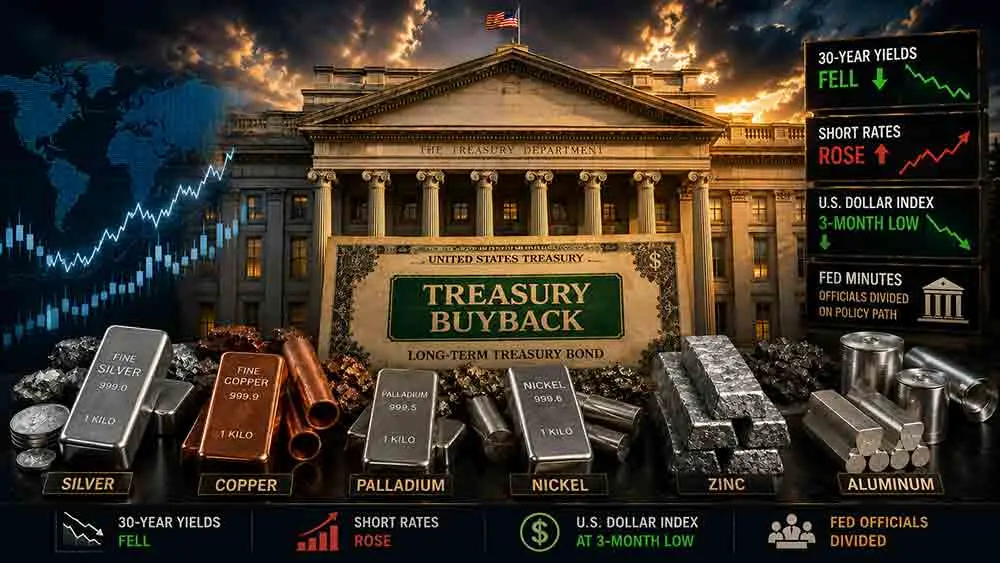
(Kitco News) - Thirty-year yields fell, short rates rose, and the dollar hit a three-month low. The Fed's minutes, out the same afternoon, showed officials arguing to go the other way.
The U.S. Treasury moved Wednesday to hold down its own long-term borrowing costs.
Gold went up 4%.
The metal added $185.50 to $4,518.90 on the Kitco spot chart, touching $4,524.50 and clearing a level it has spent weeks underneath. The dollar fell to its weakest in three months.
Silver came along for 5.34%, to $66.57. Palladium added 4.18%.
Platinum outran them all, up 6.14% to $1,815 with a session high of $1,830. It has quietly been the strongest metal on the board for most of the year, and Wednesday didn't change that.
What the Treasury did
Two weeks after publishing its buyback schedule for the quarter, the Treasury said Wednesday it is "increasing, by at least double, the size of liquidity support buyback operations" for securities dated from the 10-year to the 30-year sector, according to the department's statement.
Treasury framed it as maintenance.
The increase "reflects Treasury's desire to provide greater liquidity support in longer-dated nominal sectors where there is consistent strong sponsorship from market participants," the statement said.
The bond market read it as intervention.
Thirty-year yields fell as much as 10 basis points to 5.18%, backing away from their highest level since 2007. Ten-year yields dropped six basis points to 4.65%.
The front of the curve went the other way. Three-month, six-month and two-year yields all rose on the session.
The debt didn't get cheaper. The curve changed shape.
An old maneuver, a new department
Treasury didn't say how the buybacks will be funded. It normally covers fluctuating needs by issuing bills.
Buying back long-dated debt and replacing it with short-dated paper in order to pull down long rates is not a new idea. It's the mechanic behind Operation Twist, which the Federal Reserve ran in the early 1960s and again after the financial crisis, buying the long end and funding it at the front to flatten the curve.
The difference this time is which building is doing it.
The scale, for now, is modest. According to Treasury's published calendar, the larger operations don't begin until Sept. 9, and the existing schedule through Nov. 4 indicated up to $14 billion of buybacks in the 10-to-30-year sector. Doubling that adds roughly the same again, into a market that turns over hundreds of billions of dollars a day.
A signal rather than a flood.
The market took the signal anyway.
Two directions at once
So Wednesday produced both at once. A central bank record showing policymakers pressing for higher rates, and a Treasury announcement designed to pull long rates lower.
Two arms of the same government, working opposite ends of the same curve.
Traders sided with the Treasury. According to CME FedWatch, futures pricing implied roughly a 36% chance of a September increase as of Wednesday morning, down from more than 70% at the end of July.
Two more levels, and a Friday deadline
James Dima of StoneX laid out two tests in emails to Kitco News on Wednesday, both on the December gold futures contract.
The first is the 50-week moving average at $4,540, a level gold fell through on the way down.
"The 50 week average at 4540 was negatively violated in May," Dima said. "A close above on a Friday, weekly data measured off end of week settlement, is needed to spark renewed momentum buying interest."
The second sits higher.
"In terms of daily data the 200 day average lies at 4625, with a close over providing similar buying interest," he said. "Therefore, there is still potential fresh buying to be seen on strength."
December futures traded through $4,540 intraday Wednesday. Dima's test isn't the touch. It's Friday's settlement.
It's the third key level cited to Kitco News this week. Saxo Bank's Ole Hansen picked out $4,500 in an interview Tuesday, when gold was closer to $4,390 and having a poor afternoon. Above it, he said, the road opens toward a revisit of $5,000 before year end, with conditions attached including an end to the Iran conflict and cooler inflation. On the downside, he wants $4,200 to hold.
One of the three has now gone.
The industrial side didn't join in
Base metals went the other way. Copper fell 0.85%, nickel 1.62%, zinc 0.80% and aluminum 0.66%.
Wednesday's bid was for the metals people store, not the ones they use.
And aluminum had a reason
Aluminum's decline came with news attached.
President Donald Trump told reporters Wednesday he was considering reducing tariffs on Canadian metals, which currently sit at 50%.
"We may bring some of the tariffs down to a level where other countries are, because Canada was paying a higher tariff," he said.
Bloomberg reported Wednesday, citing people familiar with the matter, that a tentative deal would lower the rate on certain Canadian steel and aluminum exports to 25%, though the terms are not final and are not expected to apply across the board. A deadline falls Friday.
The stakes in aluminum are unusually large. Canada is the biggest single source of American aluminum imports and supplies roughly half of U.S. consumption. A lower tariff means cheaper metal landing in a market that can't supply itself.
Equities didn't wait for an announcement. Algoma Steel jumped as much as 24% in Toronto. In the U.S., Century Aluminum fell 11% and Nucor dropped 8.9%.
It lands in an odd week for the metal. London Metal Exchange aluminum inventory has just fallen to its lowest since 1990, and almost all of what's left is Russian material that American and European buyers aren't permitted to touch.
Cheaper Canadian metal, arriving into a market with almost nothing available on the exchange of last resort.
Friday carries two of the week's answers: The gold settlement Dima is watching, and the tariff deadline.
Kevin Warsh delivers his first Jackson Hole address as Fed chairman a week after that.
See live precious metals prices for gold, silver, platinum and palladium — in USD, CAD and 12 more currencies.