
(Kitco News) – Gold prices are coming off their recent lows on Thursday morning after the Philadelphia Federal Reserve's manufacturing sector survey improved beyond expectations this month.
The regional central bank said its manufacturing business outlook for August came in at 47.4 – a five-year high – after a reading of 41.4 in July. The data was far better than expected, as economists were looking for a reading of 25.0 this month.
“Responses to the May Manufacturing Business Outlook Survey suggest an overall expansion in the region’s manufacturing activity,” the report said. “The indicators for current activity, new orders, and shipments all remained above their nonrecession averages this month, and the employment index rose to a multiyear high. Price increases were less widespread this month, but both price indexes remained elevated.”
“The survey’s broad indicators for future activity jumped higher and suggest widespread expectations for growth over the next six months,” they added.
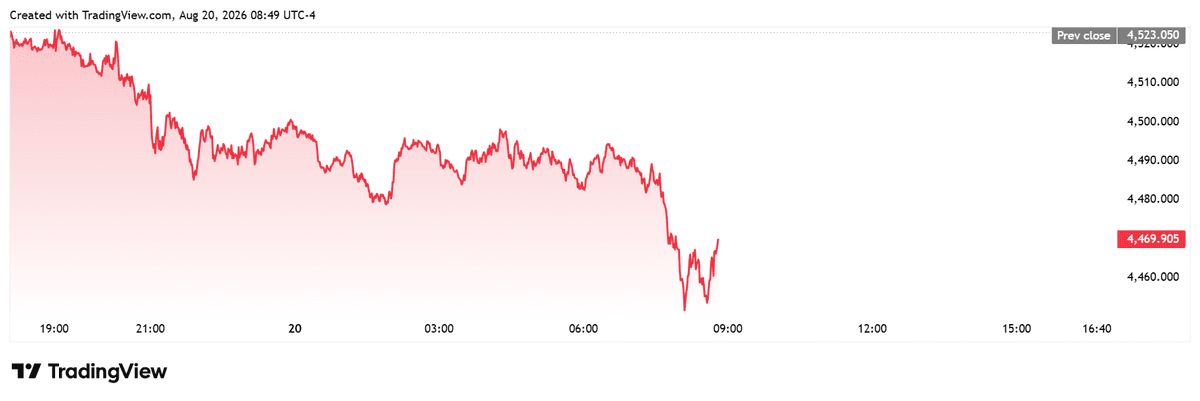
Gold prices were trading near session lows but saw a bounce in the minutes after the 8:30 am ET release. Spot gold last traded at $4,470.09 per ounce for a loss of 1.17% on the session.
The current conditions indicators improved on balance this month, driven by strong gains in employment. “The diffusion index for current general activity rose from 41.4 in July to 47.4 in August, its highest reading since April 2021,” the report said. “Nearly 57 percent of the firms reported increases in activity, while 10 percent reported decreases; 29 percent of the firms reported no change in activity. The current new orders and shipments indexes both declined but remained above their long-run nonrecession averages. The new orders index fell 7 points to 30.1. Almost 46 percent of the firms reported an increase in new orders, 16 percent reported a decrease, and 36 percent reported no change. The shipments index declined from 33.7 to 27.7 in August.”
“The employment index rose 18 points to 27.9, its highest reading since April 2022,” they noted. “Nearly 33 percent of the firms reported an increase in employment levels (up from 13 percent last month), 5 percent reported decreases (up from 3 percent), and 62 percent reported no change (down from 83 percent), the lowest share in two years. The average workweek index rose from 14.0 to 26.5.”
The Philly Fed report also showed price pressures easing from July.
“Both price indexes declined this month to their lowest readings since February but remained above their long-run nonrecession averages,” they said. “The prices paid index fell 13 points to 40.9 in August. Nearly 41 percent of the firms reported increases in input prices (down from 54 percent last month), while none reported decreases (unchanged); 59 percent reported no change (up from 46 percent). The current prices received index declined 10 points to 17.7. More than 21 percent of the firms reported increases in the prices of their own goods, 3 percent reported decreases, and 74 percent reported no change.”
The survey’s broad indicators for future activity indicated firms continue to expect growth.
“The diffusion index for future general activity climbed 39 points to 73.6 this month, its highest reading since August 1983,” the report said. “Almost 75 percent of the firms expect an increase in activity over the next six months (up from 52 percent last month), far exceeding the 1 percent that expect a decrease (down from 17 percent); 22 percent expect no change (unchanged). The future new orders index increased 31 points to 66.0, and the future shipments index rose 24 points to 63.5, each reaching its highest reading in more than five years. The firms continue to expect increases in employment over the next six months, and the future employment index rose 6 points to 35.4, after declining for four consecutive months.”
“Both future price indexes moved higher above their long-run averages, mostly offsetting last month’s declines,” they added. “The future prices paid index moved up 6 points to 62.9, and the future prices received index rose 18 points to 59.8. The index for future capital expenditures increased 18 points to 48.2, its highest reading in 53 years.”
