(Kitco News) – The Federal Reserve’s annual symposium in Jackson Hole, Wyoming will offer new chair Kevin Warsh the opportunity to lay out his vision for the central bank – and to address some early missteps and omissions, according to Natixis.
Economists Christopher Hodge and Selin Aker wrote in Natixis’ Jackson Hole preview that Fed Chair Kevin Warsh has his work cut out for him at this week’s Fed symposium.
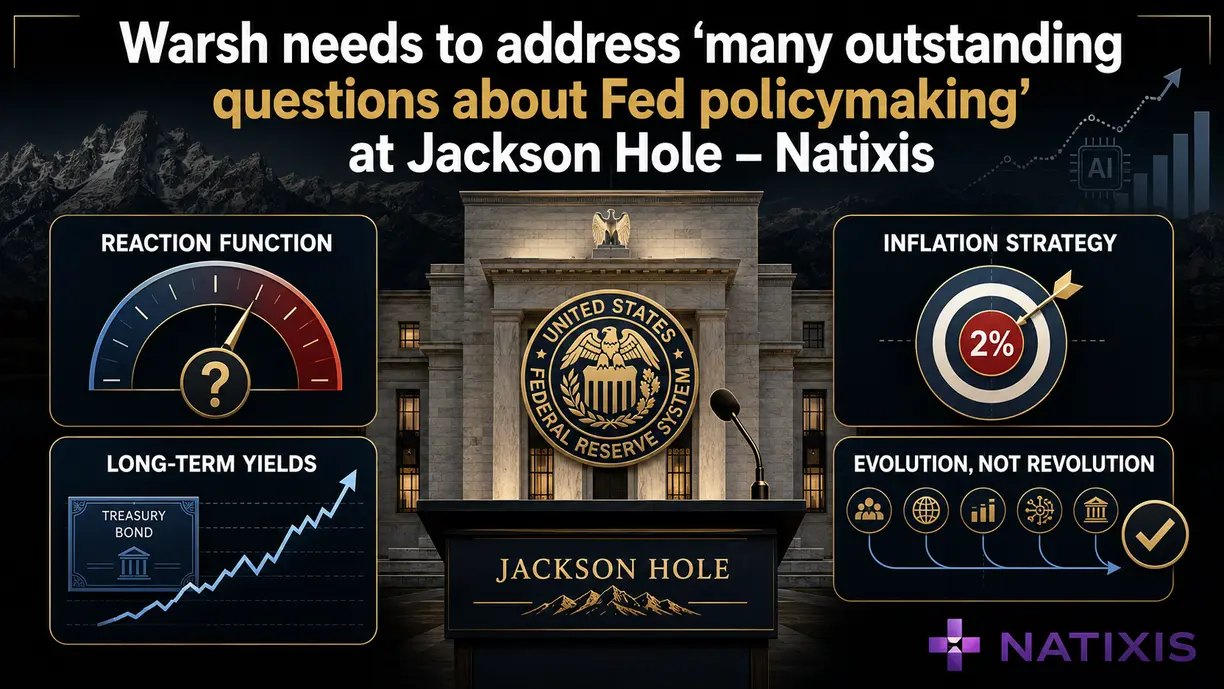
“With long-term Treasury yields pushing toward multi-decade highs, some have pointed to the shaky July FOMC press conference and uncertain reaction function under Warsh’s leadership as contributing factors,” they said. “Thus far, Warsh has focused more on potential structural changes to the Fed and has eschewed forward guidance of any kind. He has also touted the ‘big picture’ issues that will shape the long-term trajectory of the economy and, in turn, policymaking.”
“While it’s certainly appropriate to contemplate these lofty, ivory tower issues, investors now are looking for something more grounded - a clearer sense of the Fed's reaction function and reassurance that the central bank has a credible plan for returning inflation to target,” they added. “We do think he will speak to the ‘big picture’ issues and the Fed’s task forces but will also ultimately give the market some of what it’s looking for as well.”
Hodge and Aker said the common thread that runs through Warsh’s communication since assuming the chair is his focus on the supply side of the economy, and they expect that to remain the focus in Wyoming.
“Warsh has been notably constructive on US productivity, arguing that the recent improvement began even before any meaningful boost from artificial intelligence,” they wrote. “If productivity accelerates, the economy could theoretically grow faster, wages can rise faster and unemployment can remain lower without producing the inflationary pressure a conventional Phillips-curve framework might predict.”
“We don’t think Warsh will opine on the timing or magnitude of such structural shifts, but the implication that we would draw is that Warsh could be reluctant to impose yesterday’s estimates of these relationships on today’s economy,” they said, adding that “it would not be surprising if he expressed some skepticism about previous policy assumptions and generally struck an anti-doctrinaire approach.”
The Natixis economists said the Fed chair will also need to address some of his statements from the July FOMC.
“Warsh highlighted the increase in real and nominal yields in the intermeeting period and added that even though the Fed kept rates on hold, that ‘markets have done quite a bit,’” they wrote. “Similarly, Warsh said that ‘market participants are learning to play the ball, not the referee—and market prices will continue to respond in the direction and magnitude they see fit.’ Taken together, these statements could be interpreted as Warsh saying that tighter financial conditions could substitute for Fed action or that the Fed lacked agency in the fight against inflation.”
They also pointed out that “even while repeatedly reiterating the commitment to bring inflation down to target, Warsh failed to articulate a strategy for doing so.”
“[W]e think Warsh and the Fed would benefit from a clear and unambiguous statement that clarifies that if inflation stays high, the Fed will act and the policy rate will be the tool.”
Hodge and Aker are also hoping to get some clarification on the role and scope of the Fed’s five new task forces.
“It would be helpful if Warsh, without front-running the results of the work of the task forces, added some color in terms of the magnitude of the changes that could be coming down the road,” they said. “We suspect that the task forces will be used to hone and improve the status quo on the margin and not to enact wholesale changes. With this uncertainty present, clarifying that an evolution (not a revolution) is in store, would help to address one of the many outstanding questions about Fed policymaking.”
