
(Kitco News) - Looking beyond the recent volatility, gold has seen extraordinary gains in the last two years, and according to one fund manager, after the recent correction, the precious metal is ready to resume its long-term uptrend.
In an interview with Kitco News, Larry Lepard, Managing Partner at Equity Management Associates, said that although gold’s months-long correction is an indication of a maturing market, prices are nowhere near a top.
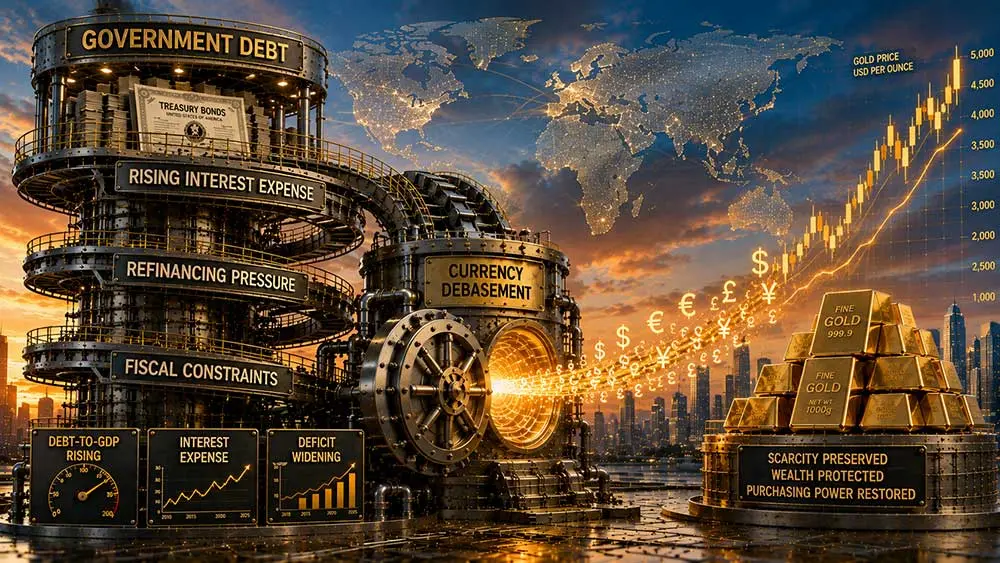
He explained that the global monetary system is only beginning to confront an uncomfortable mathematical reality: governments have accumulated too much debt to fight inflation the way they have in the past.
Although Federal Reserve Chair Kevin Warsh entered the year with a reputation as an inflation hawk, Lepard said monetary and fiscal constraints will ultimately dictate policy.
As he was preparing to take over as head of the U.S. central bank, Warsh had talked about shrinking the Federal Reserve’s balance sheet, which would imply tighter monetary conditions. However, Lepard said the new Fed chair will eventually be “forced to confront the math.”
“The math is not going to work for him,” he said.
Lepard added that there is a growing disconnect between the prevailing monetary policy narrative and the underlying fiscal reality.
“There’s the narrative and then the mathematical facts,” he said, pointing to increasingly large government deficits.
Lepard said this distinction is critical for gold investors. Even after the precious metal’s dramatic rally, he sees the fundamental forces driving the market as largely unchanged.
The problem, he said, is that policymakers no longer have the flexibility they had during the inflation crisis of the 1970s and early 1980s.
Former Federal Reserve Chair Paul Volcker ultimately broke that inflation cycle by pushing interest rates high enough to generate deeply positive real yields. However, Lepard noted that U.S. government debt was roughly 30% of GDP at the time, compared with around 120% today.
“I don’t see how we get out of this without either very high inflation for a bunch of years, kind of like South America, and maybe that’s the outcome, or just an outright failure leading to a monetary reset,” he said.
Higher interest rates are particularly problematic in the current environment because they increase the government's debt-servicing costs, which in turn increase deficits and require even more borrowing.
Lepard described that dynamic as a potential fiscal “doom loop”: higher rates increase interest expenses, larger interest expenses widen deficits, governments issue more debt and the additional supply creates still more upward pressure on borrowing costs.
“That’s really how currencies fail,” he said.
Against that backdrop, Lepard sees currency debasement as the politically more likely response.
Faced with the choice between allowing excessive debt and leverage to unwind through defaults and economic contraction or creating more money to support the financial system, he expects policymakers to choose the latter.
“Given the choice of print or crash, they will print,” he said.
Even stronger economic growth may not provide an easy escape. Lepard acknowledged that artificial intelligence could generate meaningful productivity gains, but he doubts those gains will arrive quickly enough or be large enough to overcome existing fiscal imbalances.
Growing out of the debt burden would also require significantly higher nominal economic growth, which he argues would almost inevitably be accompanied by inflation.
If bond investors recognize that governments intend to inflate their way out of their debt burdens, Lepard said that realization itself could push yields higher and force policymakers to intervene.
For gold, that leaves the long-term investment thesis intact regardless of shorter-term volatility.
“So we just don't know how it plays out exactly politically. But from a mathematics point of view, we are on the right side of this trade,” Lepard said.
His conviction comes even after substantial gains in precious metals. Lepard noted that gold rose roughly 65% last year, a performance he described as highly unusual for the metal and reminiscent of the explosive phase of the bull market in the late 1970s. He views that move not as the end of the cycle, but as an early signal that investors are becoming increasingly concerned about monetary debasement.
He said the shift in investor psychology is already becoming noticeable.
Many investors remain reluctant to buy gold precisely because it has risen so much. But Lepard argues that the metal remains significantly underowned in mainstream investment portfolios and that the current monetary cycle is still relatively young.
“Even though it's gone up a lot, we're just in the early part of the cycle,” he said.
Lepard said this latest rally could represent the beginning of another major leg higher as markets increasingly recognize the constraints facing the Federal Reserve and the U.S. government.
“We just started the next leg up based on what's going on with these markets and the Fed's behavior,” he said.
At the same time, he also noted changing attitudes toward inflation as another important component of the precious metals story. Before the pandemic, Lepard said inflation was largely an abstract issue for most Americans. Today, consumers increasingly recognize it as a tangible problem because they experience it in everyday purchases.
That awareness has not yet translated into widespread ownership of monetary hedges such as gold, but Lepard expects that could change dramatically if inflation remains persistent.
He estimated that perhaps 5% to 10% of the population currently recognizes the risk strongly enough to seek protection through assets such as gold or Bitcoin. If that proportion eventually reaches 50% or 60%, he said, the implications for conventional financial assets and fiat currencies would become significantly more dramatic.
Lepard consequently remains comfortable with substantially higher gold prices.
“I’m telling my investors I’m extremely comfortable that gold will be $5,000 to $7,000,” he said. “I’m pretty sure it’ll get to $10,000.”
More extreme forecasts depend on significantly worse monetary outcomes. Lepard said gold could ultimately reach $20,000, $30,000 or even higher in a full monetary reset. He doesn’t use those scenarios as his base investment case, but he added that they remain tail risks.
Comparing today’s gold market with the 1970s bull run, he said it remains instructive. Lepard poined out that gold ultimately increased roughly tenfold from its earlier base during that inflationary cycle. A similar move in the current cycle would put the metal around $10,000 an ounce.
The bigger difference, according to Lepard, is that policymakers today have far less room to administer the same cure that ultimately ended the previous inflation crisis.
With debt dramatically higher, aggressively positive real interest rates could create intolerable pressure on government finances.
For Lepard, that mathematical constraint outweighs any hawkish rhetoric from the Federal Reserve.
See live precious metals prices for gold, silver, platinum and palladium — in USD, CAD and 12 more currencies.
