
(Kitco News) - Gold has seen a sharp pullback ahead of the weekend, but its impressive gains this past month should be a wake-up call for investors.
Earlier this week, gold prices were up roughly 15% for the month, on track for their best performance since January 1999. Although Warsh’s hawkish comments at Jackson Hole have cooled the precious metal’s momentum, gold is still up 10% for the month, a remarkable rebound from a months-long 30% correction.
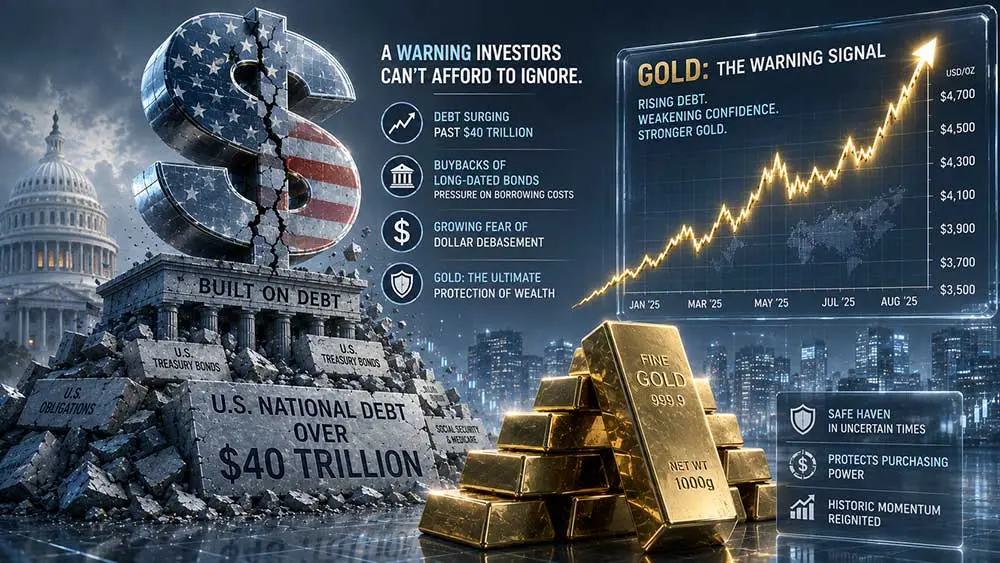
Gold’s momentum has been reignited by growing concerns that government debt is spiraling out of control. U.S. government debt has now surpassed $40 trillion, and investors are increasingly questioning how the world’s largest economy can manage that burden without eventually sacrificing the purchasing power of its currency.
That concern has breathed new life into the dollar debasement trade.
The catalyst was the U.S. Treasury Department’s decision to expand its purchases of long-dated government bonds as policymakers attempt to ease pressure on borrowing costs. Although these buybacks are a long way from quantitative easing or formal yield-curve control, markets understand the direction of travel.
The government has three broad choices when confronting an increasingly expensive debt burden: reduce spending and deficits, tolerate significantly higher borrowing costs, or find ways to suppress those costs while allowing inflation and currency depreciation to gradually erode the real value of the debt.
Right now, investors appear increasingly skeptical that Washington will choose the first option.
This is why gold’s relationship with bond yields is becoming more complicated. Traditionally, rising real yields have been negative for gold because they increase the opportunity cost of holding a non-yielding asset. But that relationship becomes less reliable when yields are rising because investors are questioning fiscal sustainability.
Aakash Doshi, Head of Gold Strategy at State Street Investment Management, recently explained that investors must increasingly consider the question of why yields are rising. When higher yields reflect growing term premiums, excessive government borrowing and concerns about fiscal credibility, gold becomes less of an interest-rate trade and more of a hedge against purchasing-power risk.
That distinction could become increasingly important.
Federal Reserve Chair Kevin Warsh can maintain a hawkish commitment to controlling inflation, but dramatically higher interest rates would also increase government debt-servicing costs, widen deficits and require even greater Treasury issuance. Eventually, monetary policy runs headfirst into fiscal reality.
This doesn’t mean gold will move higher in a straight line. After August’s powerful rally, volatility and profit-taking should be expected.
But investors shouldn’t lose sight of the bigger picture.
Natixis, State Street and UBS now see $5,000 gold as a realistic target in the coming months, while Doshi argues that $10,000 is ultimately a question of “when, not if.” Those forecasts may sound aggressive, but they are increasingly based on something much larger than bullish sentiment.
Gold is responding to a fundamental question about the sustainability of the global monetary system.
As long as governments continue accumulating debt faster than their economies can realistically absorb it, the debasement trade will remain alive.
And the uncomfortable reality is that the math continues to favor gold.
Have a great weekend.
See live precious metals prices for gold, silver, platinum and palladium — in USD, CAD and 12 more currencies.
