
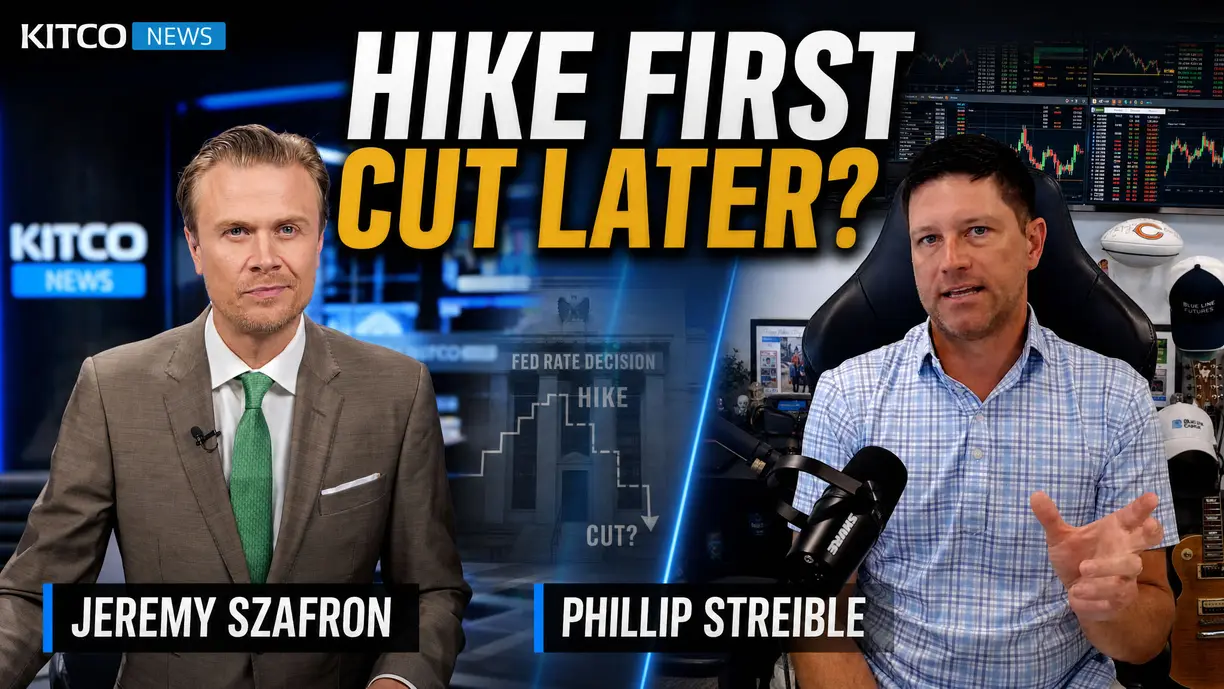
(Kitco News) - Blue Line Futures' Phil Streible told Kitco News on Monday that a close below 4,350 would change his mind on gold. It touched 4,325 on Tuesday morning
Gold fell to $4,325.50 an ounce Tuesday morning, going straight through two key levels a veteran futures strategist had marked out on this site less than 24 hours earlier.
Phil Streible, chief market strategist at Blue Line Futures, told Kitco News on Monday that a close under $4,350 was where he would change his mind.
"What would change my mind? Maybe a close below $4,350," Streible said. "That's where you gave back everything in August on that breakout."
He gave a second number as well, and tied it to the day Treasury Secretary Scott Bessent surprised the bond market by expanding the government's buyback program.
"It's that August 18th low, where Secretary Bessent had come in and talked about those purchases of longer dated Treasuries. That's got to be your line in the sand, so call it $4,378 or so," he said. "Any kind of break below there and the bears would come out beating on their chests saying we're going back to $4,000."
Spot gold was bid at $4,364.50 at 10:39 a.m. Eastern, down $82.30 or 1.85%, roughly $137 off its overnight high. That puts it above the number that would change his mind and below the one he called the line in the sand.
He was careful about which one counts. It's the close he watches, not the intraday print, so Tuesday's intraday low doesn't break the call on its own.
A correction inside a much bigger one
Streible went into Tuesday arguing the worst of the selling was behind us.
"I think that gold has already seen much of the sell-off that we're going to have," he said. "We've fallen $150 down in one day; we've got a little bit of an extension lower here today, but we've had a $600 run, so $150 is just a correction."
Three sessions don't make that case. The year does.
Gold set a record above $5,500 an ounce in late January, a month before the war with Iran began. By late June it was under $4,000. It rose about 10% in August, its best month since January, and it's still down roughly 7% on the year.
The mining shares have swung harder in both directions. The NYSE Arca Gold Miners Index rose 33% in August, its best August in more than three decades and more than triple the move in bullion, after falling 39% from its March high.
What's pushing it down
None of this is about gold. It's about bonds and oil.
The 30-year Treasury yield sat near 5.28% on Tuesday and has now closed above 5% on 55 days this year, the most since 2006. The 10-year topped 4.75% on Monday for the first time since January 2025. Long-dated yields in Germany, Britain and Australia hit multi-year or record highs the same morning, so this is not just a US story.
Brent crude went above $92 a barrel after crude carriers in the Strait of Hormuz were hit by projectiles, extending a run that started when US forces struck Iranian rocket launchers on Larak Island over the weekend.
Expensive energy makes traders nervous about inflation, and nervous traders price rate hikes. The odds of a quarter-point increase at the Federal Reserve's Sept. 15-16 meeting are now near 70%, up from roughly one in three before Chairman Kevin Warsh spoke at Jackson Hole on Friday. Fed Governor Michael Barr said Tuesday the central bank should be ready to raise rates if inflation doesn't come down.
Bessent, speaking at a gathering of global finance chiefs, brushed the Hormuz disruption aside altogether, saying pipelines will soon bypass the waterway.

Why Streible thinks it's the wrong tool
Streible isn't arguing inflation is fine. He's arguing about where it's coming from.
"The inflation that we're seeing isn't demand driven. 50% tariffs on Canadian goods, you've got crude oil up on Iranian strikes, you got wheat at three-year highs on an attack on a Black Sea Russian port," Streible said. "These are supply shocks here that are taxes for the consumer."
All three are happening right now. A 50% tariff on more than 550 Canadian products took effect Aug. 22 under a section of the 1930 Tariff Act that had never been used before, covering roughly $20 billion of goods, and Canada starts matching it dollar-for-dollar on Sept. 8. Wheat hit a three-year high last week after Ukrainian drones struck Russian grain terminals at Novorossiysk, with Russia's August exports running at about two thirds of their five-year average.
"Rate hikes, they're designed to cripple the demand, but they don't manufacture more oil or wheat or a tariff infrastructure," he said. "So you'll get more economic damage if you start to try and raise rates here to fix some of these smaller issues that'll ultimately end up resolving themselves."
Which brings him to the meeting on the 16th.
"We do believe that the Federal Reserve, if they do raise rates, that it will be a policy mistake here, and ultimately it will need to be undone in the near future," Streible said.
His evidence is the shape of the yield curve. The gap between the 2-year and the 10-year has flattened to about 39 basis points, or 39 hundredths of a percentage point, after steepening all summer.
"Every time the Fed has hiked into a flattening curve, the curve has been right and the Fed has been too early on raising rates," he said. "So ultimately what would end up happening in that situation is the Fed will ultimately have to cut rates."
That's the moment he thinks the metal turns. Gold does well in stagflation, he said, meaning rising prices and slowing growth at the same time, and badly only in outright deflation.
Silver near its own line
Silver fell 2.46% to $64.78 an ounce Tuesday, with a session low of $64.15. Streible's floor sits just underneath.
"You don't want to see it take out $60, the psychological level," he said, pointing to $62 as the 50-day moving average and $63.25 as the level tied to the Treasury's buyback announcement. On the way up he named $73.65, the 200-day average, as his next target.
The supply story, he says, doesn't care what the tape does. Roughly 70% of silver comes out of the ground as a byproduct of copper, lead and zinc mining, which means a higher price doesn't quickly produce more of it.
Platinum was $1,768 an ounce and palladium $1,304, down 2.83%, both adding to Monday's losses.
What decides it
Job openings edged up to 7.27 million in July from a downwardly revised 7.18 million in June, the Bureau of Labor Statistics said Tuesday, with layoffs at their lowest since January. The Institute for Supply Management's factory gauge slipped to 54.6 in August, an eighth straight month of growth.
The August employment report lands Friday at 8:30 a.m. Eastern. Economists are looking for around 55,000 jobs after employers shed 23,000 in July. Consumer prices follow on Sept. 11.
Then the Fed meets Sept. 15 and 16, with fresh economic projections attached.
Watch the full Kitco News interview with Phil Streible above.
See live precious metals prices for gold, silver, platinum and palladium — in USD, CAD and 12 more currencies.