
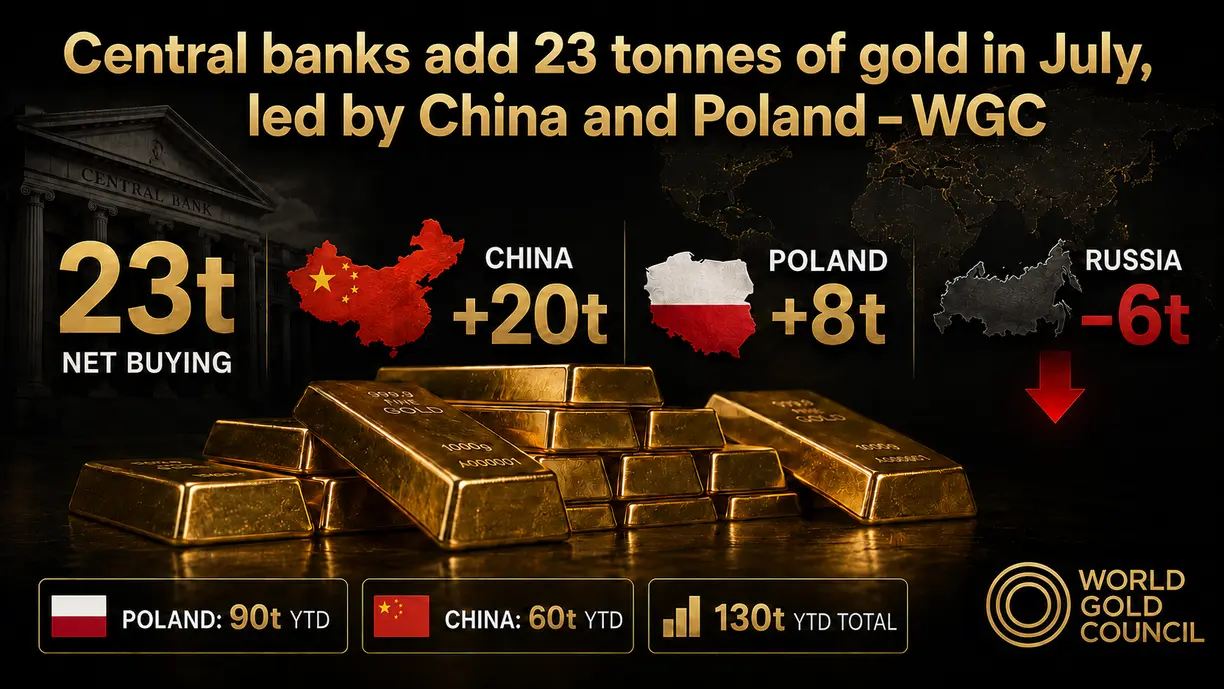
(Kitco News) – Central banks increased allocations to their gold reserves in July, with the Chinese and Polish central banks once again leading all sovereign buyers, according to Marissa Salim, Senior Research Lead, APAC at the World Gold Council (WGC).
“Central banks continued their gold accumulation in July with net buying reported at 23t,” Salim wrote in the WGC’s latest update. “Emerging markets have also continued to accumulate gold this month with China (20t) and Poland (8t) taking the lead.”
Other significant buyers in July included the Czech National Bank, which purchased two tonnes of gold for its 41st consecutive month of net buying, while the National Bank of Kazakhstan (NBK), Bank Negara Malaysia (BNM) and the Central Bank of Bolivia (CBB) each bought one tonne. “Kazakhstan’s gold holdings stand at 75% of its total reserves,” she noted.
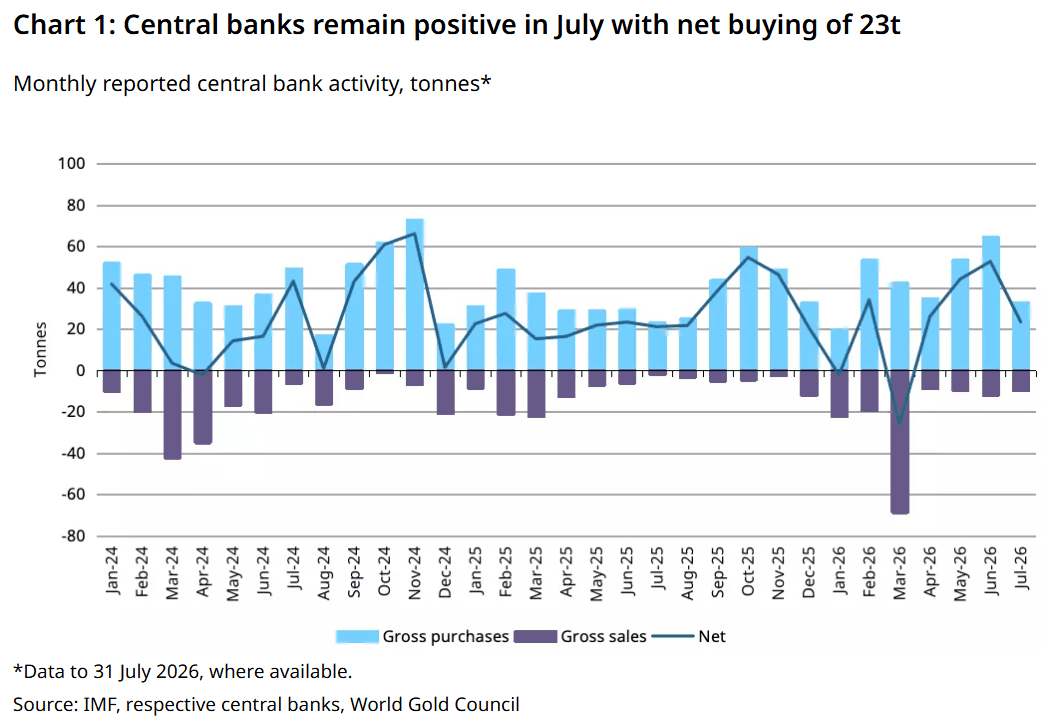
Russia was the top net seller in July, posting sales of 6 tonnes, followed by Turkey, Jordan and Uzbekistan with 1 tonne of sales each.
Year-to-date, Poland once again tops the scoreboard for gold purchases, buying 90 tonnes so far this year. “The country has accumulated 640t of gold – against its target of 700t – or approximately 28% of its total reserves,” Salim noted.
Meanwhile, China has added 60t to its gold reserves in 2026, second only to Poland, and July represented the 21st consecutive month of buying by the PBoC. “China’s official gold reserves now stand at 8% of total reserves, or around 2,366t, and is the sixth largest reported gold holder globally,” Salim said. “Notably, activity from the People’s Bank of China (PBoC) has picked up pace in recent months, with double-digit monthly purchases of gold since May 2026.”
The Central Bank of Uzbekistan’s year-to-date gold purchases now stand at 40t. “The central bank hit the news recently as Governor Timur Ishmetov looked to engage with American money managers,” she noted. “Ishmetov said that while ‘gold has turned out to be the best investment so far’, the central bank is looking at potential sales of gold at ‘favourable prices’ as part of its overall reserve management plan. Uzbekistan’s gold now stands at 87% of total reserves, or about 431t.”
The National Bank of Kazakhstan has accumulated 29 tonnes of gold year-to-date, and the NBK is one of the top five gold accumulators. “Both the [Bank Negara Malaysia and the Central Bank of Bolivia] are relatively new entrants to the gold market, with y-t-d gold holdings at 6t and 2t respectively,” Salim said. “The Czech National Bank has bought 12t y-t-d, bringing its gold holdings to 6% of its total reserves, or 84t.”
“On a y-t-d basis, central banks’ reported purchases have totalled around 130t of gold,” she wrote. “This compares to a reported ~160t which was purchased over the same period last year.”
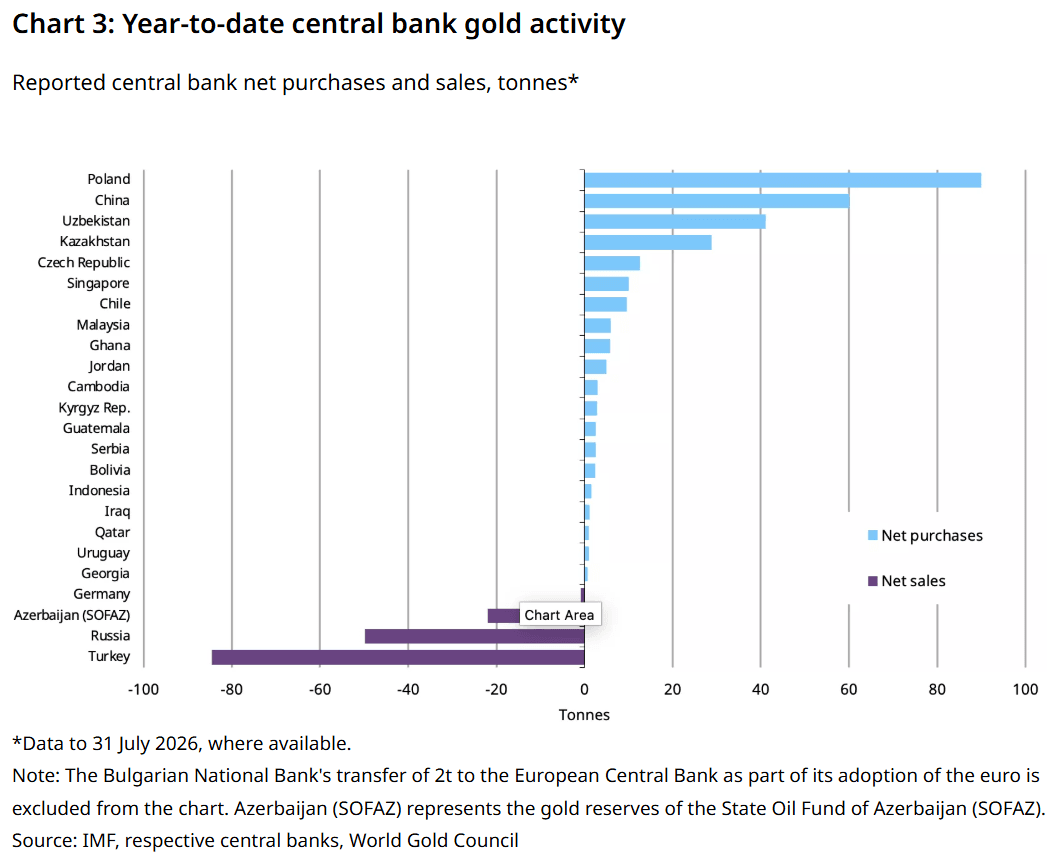
On the selling side, Russia’s 2026 sales now total 50 tonnes of gold in 2026, lowering its total gold holdings to 2,277 tonnes, while Turkey’s total sales so far this year now stand at 85 tonnes.
Salim noted that the Bulgarian National Bank's transfer of 2 tonnes to the European Central Bank as part of its adoption of the euro is excluded from the chart, while Azerbaijan’s number represents the gold reserves of the State Oil Fund of Azerbaijan (SOFAZ).
Central banks also continued to make gold-related announcements.
“The Bank of Korea (BOK) added to central bank headlines by announcing an official gold allocation after 13 years,” The allocation, made via gold-backed ETFs, is estimated at US$250mn or approximately 2t,” she said. “The BOK also announced plans to purchase domestically refined gold in order to diversify its reserves and hedge against risks related to inflation and geopolitics.”
The Venezuelan government also requested the repatriation of around $4 billion of its gold reserves from the Bank of England. “The move comes about as Venezuela looks to rebuild infrastructure post the 2026 earthquake,” Salim wrote. “Since 2018, Venezuela has been blocked from accessing its gold reserves as the UK government declined to recognise the country’s socialist government.”
And the Bank of Namibia is ramping up its plans for gold accumulation, announcing the intention to increase gold reserves from 1% to 3% by the end of March 2027. “The bank signed a gold purchase agreement in March this year with QKR Namibia Navachab, a local mining company, to help build up its gold reserves,” she said.
See live precious metals prices for gold, silver, platinum and palladium — in USD, CAD and 12 more currencies.
