
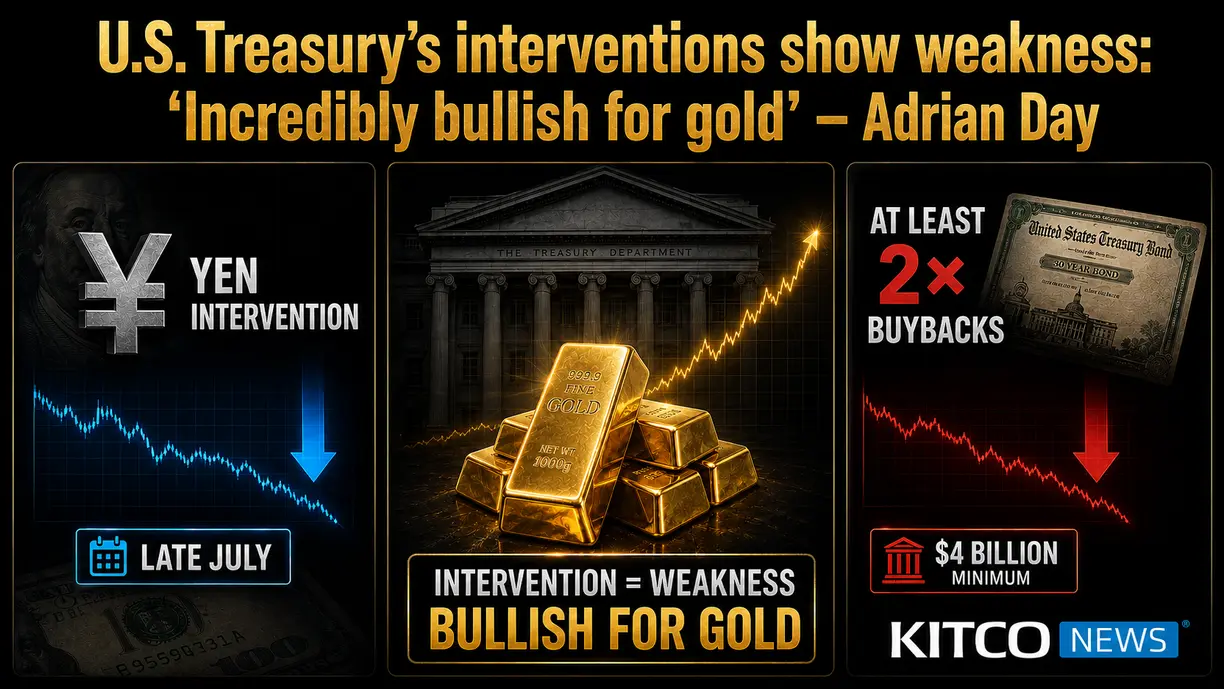
(Kitco News) – While the U.S. Treasury Department has made massive waves with their two recent interventions – one targeting the yen, and the other long-term yields – these did next to nothing to solve the real problems plaguing the dollar and the debt, and gold will be the inevitable beneficiary, according to Adrian Day, president of Adrian Day Asset Management.
Day said that while Bessent’s announcement made headlines around the world, it had surprisingly little lasting impact in the one area it was supposed to.
“It didn't really do much for Treasuries at all, did it?” he said. “Just like the yen intervention at the end of July that didn't really do much to the yen [beyond] a couple of days. And it's interesting that August was bookended by those two interventions.”
Day said the recent announcement was a little bit puzzling, because there was already an existing program from the Yellen years to buy back long bonds, and Bessent announced that they were going to at least double it.
“If you look at the number, $4 billion that's really not an enormous amount of buybacks in the context of the Treasury market,” Day said. “To me, and to the market, what's more important is the direction of travel. And I think the fact that Bessent actually announced it is a little bit odd, because if it's nothing more than a continuation of the existing program meant to help manage the liquidity on the long end, why make a big deal out of it?”
“But the fact is that Bessent made a big deal out of it, and so I think the market is right to make a big deal out of it.”
Day said the reasoning behind the ramped-up buybacks also didn’t make sense. “Was the Treasury thinking that in announcing that they were going to double the program, that they would somehow get more participants active in the long end? It's really peculiar,” he said. “Bessent said that the idea of the program was to add liquidity to the long end. That's really puzzling, because if the treasury is buying back and canceling, you're actually reducing the liquidity, and in the short term, in the immediate term, you're helping holders who want to sell.”
Day said these buybacks also won’t reduce the overall supply of treasuries, because Treasury is issuing against them.
“As everybody knows, the buybacks that the Treasury did at the long end were offset by increased issuance at the short end,” he said. “So you're not reducing the market supply, which would help on the demand side. The problem with the Treasury market – and I'm talking about the Treasuries from [10-year] to 30-year – we have far too much supply and an increasing supply, and we don't have enough willing buyers. And we have, it would appear, a declining number of the traditional buyers.”
Day said this is the fundamental problem that drove the yen intervention as well. “If the yen moves up, then that encourages domestic holders not to sell their treasuries; that was the purpose of the yen intervention,” he said. “But that is the fundamental problem that the Treasury is facing – and it's facing it not only under Trump, but it's an increasing problem that's been going on for years and years now.”
He pointed to Russia no longer buying treasuries after they were locked out of the dollar system since the Ukraine war. “China is obviously reducing their holdings of treasuries,” he noted. “And the Japanese government was selling their treasuries in May and June, before this intervention.”
Day said the important thing in Bessent’s announcement was not the $4 billion minimum, but the absence of a maximum.
“It's at least double,” he said. “So the sky's the limit. I think the idea, in both instances, was to get the thing kickstarted and to send a message. But as with most interventions, surely we found over fifty years that currency interventions rarely work for more than a very short period of time, unless you are willing to continue to put increasing amounts of money behind it.”
Turning to gold, Day said gold’s reaction to the U.S. government’s interventions was predictable, but like the impact on the currency markets, it was relatively short-lived.
“With gold, we saw a rally – again, bookended by these two interventions,” he said. “But it shouldn't surprise us that we've had a pullback after that.”
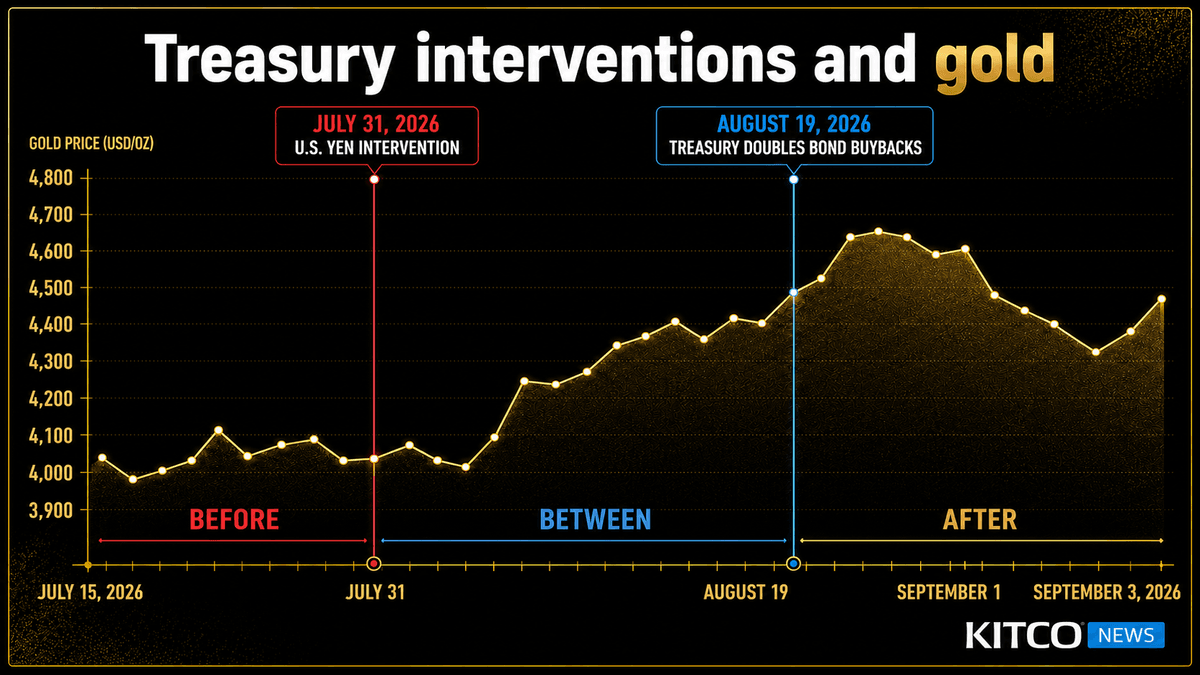
Firstly, Day pointed out that any time you have a market go up 14% or 15% percent in a month, you should expect some kind of pullback. “Secondly, Warsh's speech at Jackson Hole,” he said. “Anytime you have a big market run-up, then people are looking for reasons, triggers to take profits. And I think, frankly, whatever Warsh had said, that was going to be a reason to take some profits, unless he had come out and said, ‘Ah, forget about it. Inflation doesn't matter. We're going to ease rates.’”
Then oil and the dollar both rallied on the latest round of conflict between the U.S. and Iran. “All of that contrived to make gold look really quite weak,” Day said. “But the fundamental issue is, how do we service our debt, and how do we sell these bonds? That remains the issue.”
“And until that issue is resolved, gold has support.”
Looking ahead, Day said the war is critical in the short term, because the impacts on the global oil supply, prices and inflation are very real and concrete. But he also believes the U.S. government interventions are sending the exact opposite signal of the one intended, and gold will be the ultimate beneficiary.
“When you do an intervention, yields go up, the dollar goes up, negative for gold,” he said. “But wait a minute… the intervention is a reflection of weakness: Incredibly bullish for gold.”
“If the U.S. can't sell its bonds at a reasonable price, that is incredibly bullish for gold, because whatever we would like to happen, they're not going to cut spending sufficiently, they can't raise taxes sufficiently. What is going to happen is the Fed is going to continue to intervene and buy the bonds – it has to, because there is no other buyer – and the dollar is going to drop in reaction to that.”
See live precious metals prices for gold, silver, platinum and palladium — in USD, CAD and 12 more currencies.
