
(Kitco News) – Mounting fiscal concerns, elevated inflation and geopolitical uncertainty, and robust sovereign demand make a significant gold allocation a must-have in investor portfolios, according to commodity and currency analysts at UBS.
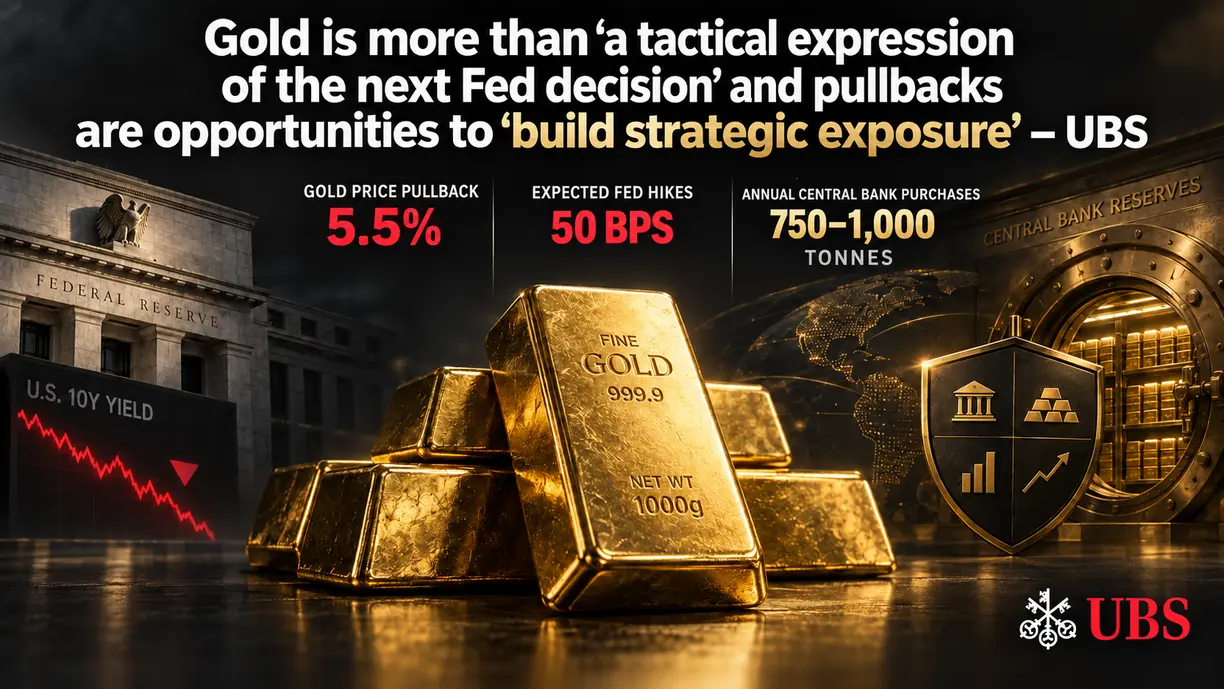
“Gold has come under renewed pressure over the past two weeks amid rising US Treasury yields, hawkish comments from Federal Reserve Chair Kevin Warsh, and stronger-than-expected US payroll data,” the Swiss banking giant’s Chief Investment Office wrote in a note on Tuesday. “Following a 15% gain in the first three weeks of August, gold prices have since fallen 5.5%.
“We now expect the Fed to raise policy rates by 50 basis points this year,” the analysts wrote. “The resulting pressure from higher real yields and a stronger US dollar is likely to remain a near-term headwind for gold. But just as we do not believe near-term Fed decisions undermine the medium-term outlook for global equities—which is supported by AI spending, resilient economic activity, and broad earnings growth—we do not think they diminish gold’s strategic role in a portfolio.”
UBS believes that gold remains a valuable portfolio diversifier, particularly for investors who favor real assets. The analysts highlight a number of key factors that are expected to support gold prices over the medium term.
The first of these is strong central bank demand for bullion. “The People’s Bank of China purchased 650,000 ounces of gold (around 20 metric tons) in August, up from 640,000 ounces in July and its largest monthly addition since October 2023,” they noted. “The purchase extended Beijing’s buying streak to 22 consecutive months, but China is not alone in seeking to increase its gold reserves. According to a recent World Gold Council survey, nearly 90% of surveyed central banks expected global official gold reserves to increase over the next 12 months, with 45% expecting their own holdings to rise.”
“We continue to expect annual central bank purchases of between 750 and 1,000 metric tons, providing an important source of structural support for gold.”
Fiscal concerns are also expected to reinforce the long-term trend of diversification away from the U.S. dollar and into alternative assets. “Higher US rates and resilient growth make the near-term US dollar outlook stronger, but persistent concerns about fiscal sustainability could constrain its appreciation over a longer horizon,” the analysts wrote. “Elevated government debt should also reinforce the gradual shift away from concentrated US dollar exposure. This should benefit gold, which is widely viewed as a reliable store of value and an alternative to traditional reserve currencies.”
“Over the medium to long term, a weaker US dollar would also boost demand for the precious metal and support its price,” they added.
Finally, UBS analysts said that gold helps insulate investors’ portfolios against the effects of inflation and geopolitical uncertainty.
“Persistent inflation and geopolitical uncertainty reinforce gold’s role as a portfolio hedge and diversifier,” they said. “Institutional investors often cite gold’s performance during crises, its potential to hedge geopolitical risks, and its diversification benefits as reasons to maintain or increase their holdings. Gold has also historically offered protection against inflation over long periods. According to the Global Investment Returns Yearbook, real returns of gold and commodities since 1900 have been positively correlated with inflation.”
For these reasons, UBS sees the long-term investment case for gold as constructive. “We view gold primarily as a portfolio hedge and diversifier, rather than as a tactical expression of the next Fed decision,” the analysts said. “Underallocated investors could use periods of weakness to build strategic exposure within a well-diversified portfolio.”
In mid-August, UBS strategists said that falling real rates will drive investors back into gold, with a weaker dollar and strong central bank demand helping to propel prices back toward $5,000 per ounce in the first half of 2027.
The Swiss banking giant pointed out that prices have successfully broken out of their recent $100 trading channel to rise above the $4,250 resistance area for the first time in two months. “Reported Chinese institutional buying and inflows into exchange-traded funds (ETFs) have supported the latest price movement, while recent joint government efforts by the US and Japan to stabilize the yen may also have helped reduce the risk of a sell-off in US Treasuries,” they wrote.
“Near-term risks remain, especially if US data stay firm, oil prices keep inflation concerns alive, or markets continue to price in a more hawkish Federal Reserve rate path,” the strategists warned. “But while the immediate backdrop may remain volatile, the medium- to long-term case for gold still looks supported by several durable drivers. We expect gold prices to rise toward USD 5,000/oz in the first half of 2027.”
UBS expects lower real interest rates will help to reignite investment demand for the yellow metal. “[W]e expect inflation to gradually moderate, allowing the Fed to hold interest rates steady this year before resuming easing in 2027,” they said. “This should create a more favorable backdrop for gold, as a shift toward lower policy-rate expectations would likely reduce real yields, weigh on the US dollar, and help boost investment demand for gold.”
A softening U.S. dollar and ongoing diversification flows are also powerful medium-term tailwinds for the gold price. “The US dollar may stay resilient in the near term, but structural challenges including large US fiscal and external deficits and already elevated investor allocations to US dollar assets mean there is scope for renewed weakness,” the strategists wrote. “A weaker dollar has historically been a powerful tailwind for gold, while a renewed focus on diversification away from the US dollar should benefit the precious metal.”
Meanwhile, sovereign gold purchases continue to provide a firm price floor beneath the market. “Central bank demand has remained an important pillar of support, even when private investment demand has been lackluster,” they said. “We expect annual central bank purchases to remain elevated, supported by a long-term desire to reduce exposure to USD assets.”
UBS noted that central banks bought 289 tonnes of gold in Q2, and their in-house estimates project full-year purchases to total between 750-1,000 tonnes in 2026. “While these flows may not be enough to drive prices sharply higher on their own, they can help stabilize the market and offset weaker areas such as jewelry demand.”
The Swiss bank advised investors to separate gold’s near-term trading risk from its longer-term investment case.
“[P]eriods of weakness toward USD 4,000/oz or below may ultimately prove to be opportunities to build strategic exposure,” they said. “For investors with an affinity for real assets, we continue to view a mid-single-digit gold allocation as appropriate within a well-diversified portfolio.”
See live precious metals prices for gold, silver, platinum and palladium — in USD, CAD and 12 more currencies.
