
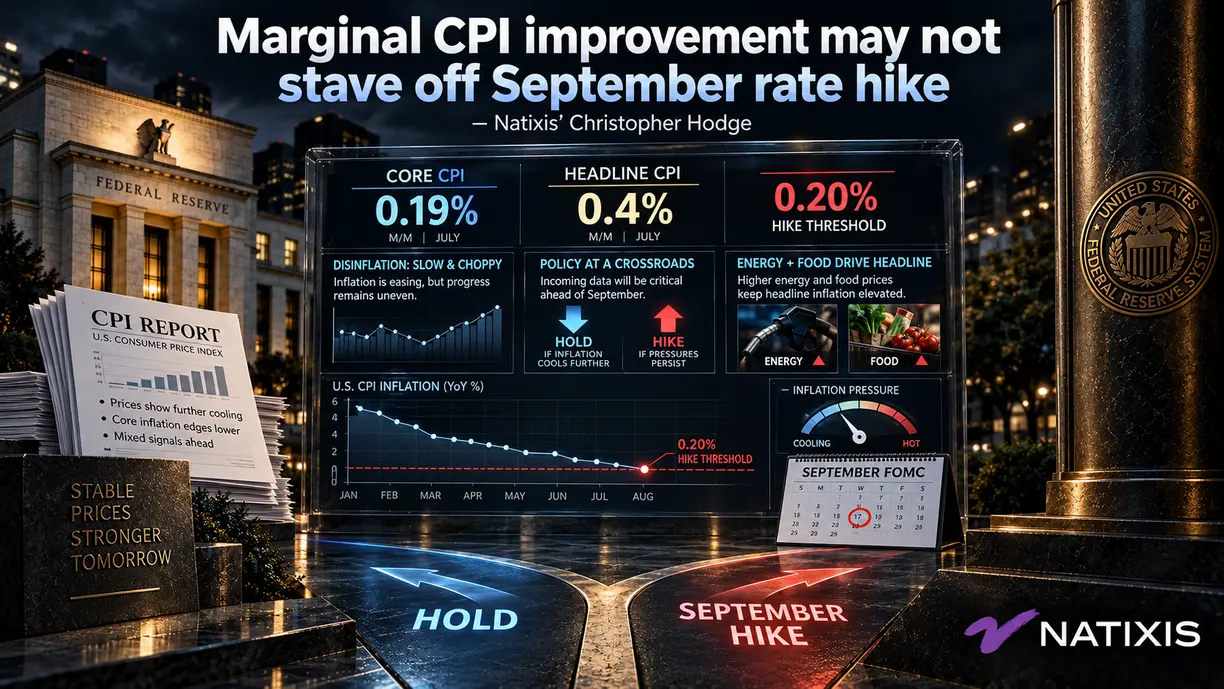
(Kitco News) – Friday’s CPI report will likely show that underlying inflation continues to move in the right direction – but even if it does, if the Fed is disappointed with the speed of progress, the committee could still hike rates at the September meeting, according to Christopher Hodge, Head Economist for the U.S. at Natixis.
“We expect the August CPI report to show a 0.2% increase in the core component and 0.4% for the headline,” Hodge wrote in Natixis’ August CPI Preview. “More precisely, we see core CPI rising 0.19% and rounding to the second decimal point has rarely been more important. With Fed policymakers genuinely divided on the proper course of action, we think that something below 0.20% is likely needed to avoid a hike in the September meeting.”
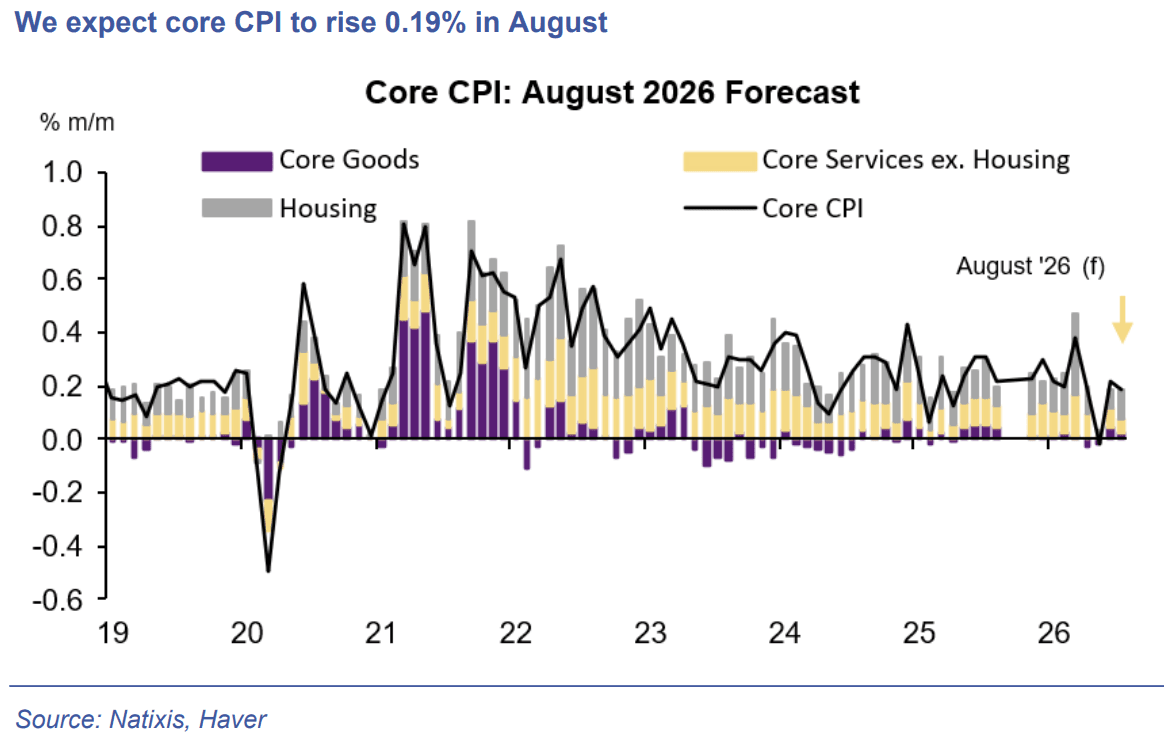
Hodge said the acceleration in headline inflation has been largely driven by energy and food prices rather than a broadening of underlying inflation. “Gasoline prices, which subtracted nearly 12 basis points from headline CPI in July, are expected to add roughly 2.5 basis points in August,” he said. “Food at home should also reverse its July decline, while food away from home remains firm. Taken together, food and energy account for much of the difference between July’s unusually soft headline reading and our August forecast.”
Hodge pointed out that the major development since the July CPI report was Fed Chair Kevin Warsh’s declaration that despite the better-than-expected inflation readings over the summer, “underlying trends have [not] meaningfully improved.”
“We can quibble about the definition of ‘meaningful,’ but the pace of inflation appears to have slowed, albeit choppily, in the past few years,” he said. “The question for policymakers is whether or not that progress has been sufficient enough at the current policy rate.”
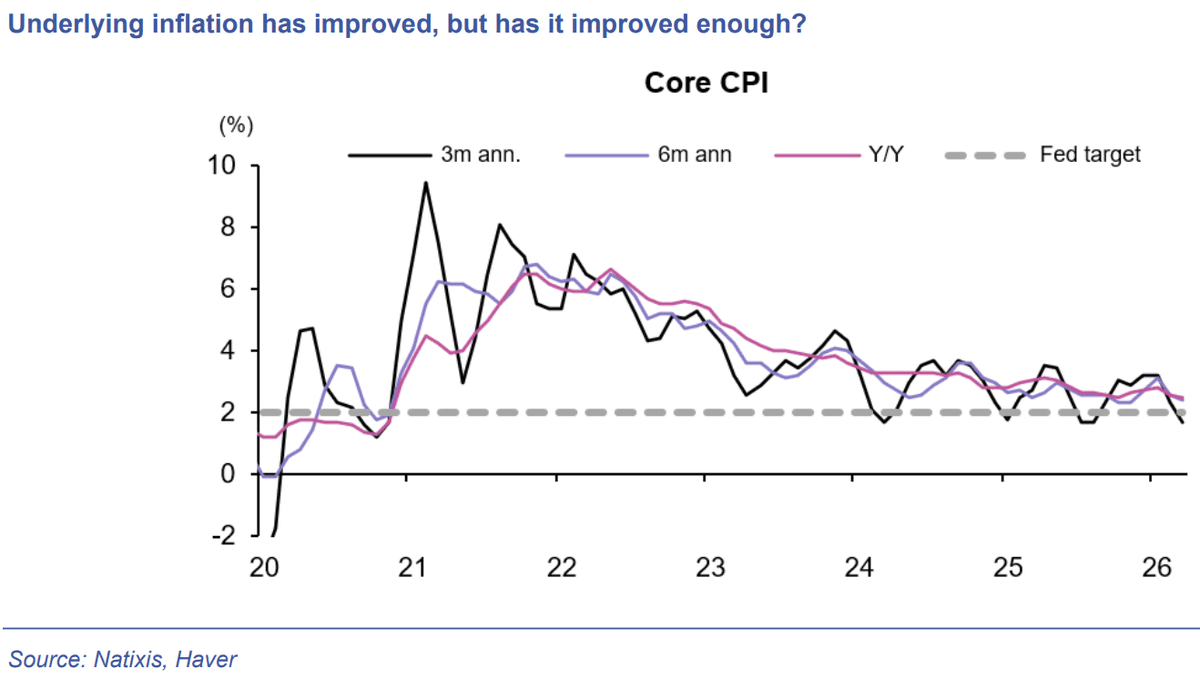
“Analysis from the San Francisco Federal Reserve suggests that current inflation is being driven by acyclical factors - residual impacts from tariffs previously and more recently higher energy prices,” he noted. “Warsh has also mentioned other metrics, such as the median and trimmed mean measures of inflation. Those metrics too have shown a downward trend.”
As for the implications of August’s CPI on the Fed’s next rate decision, Natixis does not see a reacceleration in inflation, and they expect price growth to slow over the coming quarters.
“Our assessment of the inflation path has not changed, but our assessment of the reaction function of the Fed has,” he said. “Policymakers increasing look skeptical that the trajectory of inflation is declining at a rapid enough pace to keep rates on hold. We think Governor Waller is a bellwether of the Committee, and he has been clear about his stance. He has said he wants to “give disinflation a chance,” and if incoming data proves to be encouraging, we think he would be inclined to keep rates on hold. We also don’t think Waller would be hesitant to hike if that is not the case.”
“We think that policymakers feel that monetary policy is at a crossroads and that the time for attributing excess inflation to exogenous factors (i.e. tariffs or higher energy prices) is over,” Hodge concluded. “Therefore, a print on core CPI at our forecast of 19bps or below would likely tip Waller, and in our view the entire FOMC, towards a hold stance. Admittedly, this presents a narrow path. Should Friday’s core CPI exceed that, we think the Fed will likely lift its policy rate next week.”
“If policymakers are not satisfied with the speed of disinflation, a nudge (one or two hikes) could be all that is needed to push inflation lower.”
