
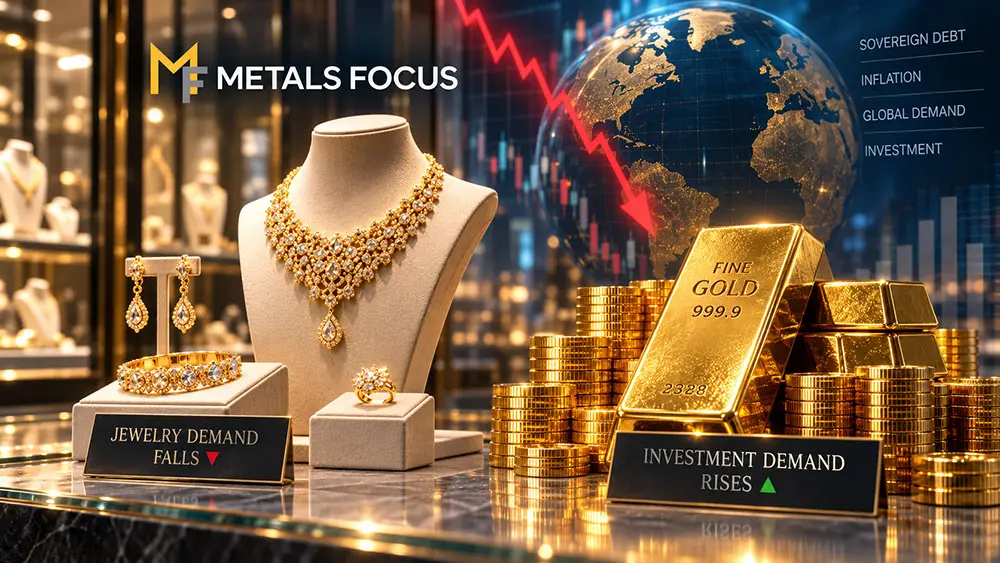
(Kitco News) - Investment demand has been a critical pillar of support for gold in recent years and, while the unsustainable rise in global sovereign debt remains a key driver in the precious metal’s long-term uptrend, one research firm is warning investors to keep an eye on another pillar that has weakened.
In a recent report, analysts at Metals Focus warned investors that record-high gold prices are taking a significant toll on global jewelry demand, with consumption expected to fall to its lowest level since the pandemic.
The U.K.-based research firm forecasts that global gold jewelry consumption in 2026 will be more than one-third lower than in 2023. The decline is significant enough that jewelry is expected to lose its position as gold’s largest demand component, overtaken by bar and coin investment.
“While high prices undoubtedly support the value proposition of precious metal jewellery, and benefit sales revenue, that same price strength is eroding jewellery demand measured in fine weight terms,” the analysts said.
Although aggregate demand is expected to decline, the analysts pointed out that a divergence between the value and volume of jewelry demand is becoming increasingly important. Consumers continue to spend heavily on gold jewelry, but elevated prices mean those purchases contain fewer grams of the precious metal.
As a result, strong retail revenues can mask deteriorating physical demand further up the supply chain, including weaker fabrication activity and refining throughput.
The weakness has been particularly pronounced in gold’s two largest jewelry markets.
According to Metals Focus, gold jewelry consumption in India fell 17% year-over-year during the first six months of 2026, while Chinese demand plunged 30%. Consumption throughout the rest of the world declined 18% compared with the first half of 2025.
At the same time, the analysts noted that high gold prices are changing consumer behavior, particularly across South and East Asia and the Middle East, where high-carat jewelry has historically served both decorative and investment purposes.
Metals Focus said some consumers are increasingly shifting toward bars and coins, which provide more direct exposure to gold with lower markups.
The report also noted that gold-filled and plated products are also gaining traction, while manufacturers are increasingly using gemstones, diamonds and alternative materials to reduce the amount of precious metal required in each piece.
Consumers, meanwhile, are buying less frequently, delaying purchases or opting for smaller products even when their overall spending remains relatively unchanged.
Despite the growing weakness in the jewelry market, Metals Focus does not expect this trend to derail gold’s broader bull market through the second half of the year.
The research firm said the fundamental factors supporting gold over the next six months remain firmly in place, including central bank purchases, concerns surrounding currency debasement and sovereign debt sustainability, U.S. policy uncertainty and increased portfolio diversification.
Against that backdrop, Metals Focus said another rally in gold prices appears likely. But higher prices would also create a feedback loop, putting even greater pressure on jewelry demand measured by weight.
That suggests jewelry could become a progressively weaker source of physical support as prices rise, leaving investment and central bank demand increasingly responsible for absorbing available supply.
The structural shift is notable because of the sheer size of the jewelry market. Metals Focus estimated that global gold jewelry fabrication represented roughly $182 billion in raw metal value in 2025, compared with $8 billion for silver jewelry and $3 billion for platinum. Gold jewelry demand totaled 53 million ounces by weight.
Metals Focus emphasized that the decline in volumes does not mean consumers have lost interest in gold.
“Precious metal jewellery retains cultural, bridal, gifting and investment appeal,” the analysts said, adding that spending on precious-metal content remains robust even as volumes decline. Instead, high prices are reshaping the market and forcing both consumers and manufacturers to adapt.
See live precious metals prices for gold, silver, platinum and palladium — in USD, CAD and 12 more currencies.
