
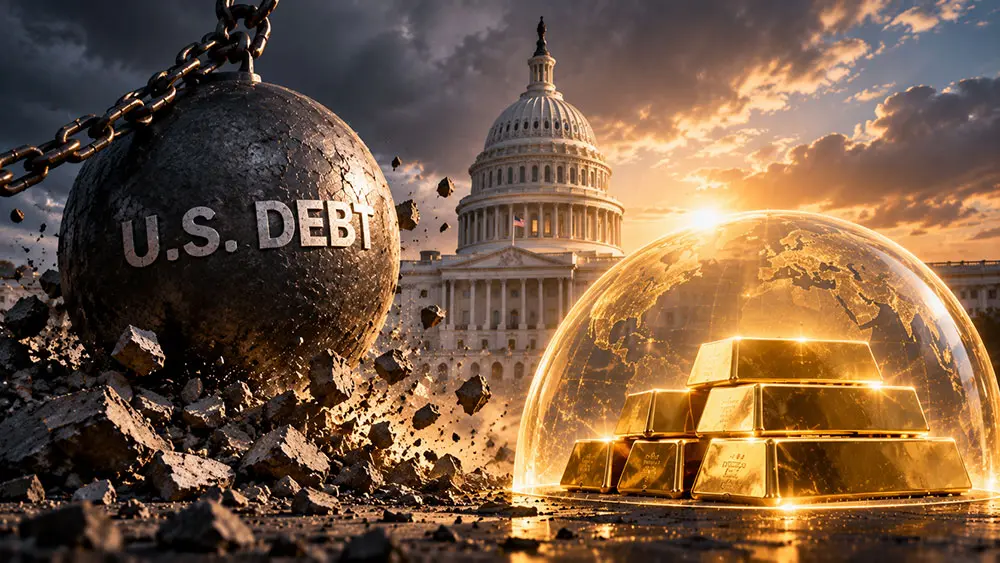
(Kitco News) - The Federal Reserve’s commitment to bring inflation down to its 2% target is creating some much-needed confidence in the long end of the yield curve as 10-year bond yields fall back below 5.00%; however, according to one fund manager, gold remains the ultimate safe-haven insurance play.
In an interview with Kitco News, Jeff Sarti, CEO of Morton Wealth, said that if he had a choice between buying gold and investing in 10-year bonds, “I would pick gold all day long.” He explained that in an environment of persistent inflation and rising economic uncertainty, a return of 5% over the next 10 years is not attractive.
Sarti said investors make a mistake when they simply compare gold, a non-yielding asset, with the return offered by U.S. government debt. While Treasury bonds are designed to generate income, he said gold serves a fundamentally different role in a portfolio.
“Gold is an insurance policy,” he said. “A 10-year Treasury is not an insurance policy. It’s a yield-producing instrument.”
Sarti added that locking in a 5% yield for 10 years provides little protection if inflation remains persistently elevated, currency volatility increases or confidence in U.S. fiscal policy deteriorates.
“An insurance policy should pay you an outsized return when things go bad,” he said.
His comments come one day after the Federal Reserve raised interest rates by 25 basis points, pushing the federal funds rate to a range between 3.75% and 4.00%.
The hawkish move came as inflation remains stubbornly above the central bank’s target. The Consumer Price Index rose 0.4% in August and 3.4% over the last 12 months, while core inflation increased 2.4% year over year.
Although Sarti said the Federal Reserve is moving in the right direction by tightening monetary policy, he questioned whether another 25-basis-point increase — or even several modest hikes — would be enough to materially change the inflation outlook.
“I think any minor 25 basis points here or there are noise,” he said. “I think the bigger signaling points are fiscal.”
Sarti said the central bank faces a difficult task because the U.S. economy and financial system are carrying significantly more debt than during previous inflationary cycles. He argued that a Federal Reserve chair today would have far less room than former Fed Chair Paul Volcker had in the early 1980s to aggressively raise interest rates.
“Someone like Paul Volcker cannot do what he did then. He would not be able to do the same thing today, mainly just because of our debt-to-GDP ratio,” Sarti said.
At the same time, Sarti said the Fed cannot simply ignore inflation. In his view, policymakers still need to lean toward tighter monetary policy, even if higher rates increase financing costs for the economy and the federal government.
However, that tension, he added, is becoming increasingly visible in the bond market.
Sarti said rising borrowing costs become particularly problematic as large amounts of federal debt have to be refinanced. Higher rates ultimately translate into higher government interest expenses, further complicating the fiscal outlook.
However, he cautioned against interpreting the recent rise in long-term yields as evidence that the Treasury market has already become unanchored. Some of the move, he said, reflects normalization after the deeply inverted yield curve seen between 2022 and 2024.
Nevertheless, Sarti said the long end of the Treasury market remains one of the most important indicators investors should be watching.
“Is there enough demand for the tremendous supply that’s coming to the market?” he said.
According to Sarti, that question ultimately matters more for gold than whether the Fed raises rates another 25 basis points before the end of the year.
“This is fiscal now. This is a fiscal landscape we’re in,” he said.
Sarti argued that years of extraordinarily low interest rates helped create an environment in which governments could dramatically increase spending without immediately feeling the consequences of higher borrowing costs. Reversing those imbalances, he said, will require something increasingly absent from Washington: spending restraint.
“The only real disciplined way and thoughtful way to fix this … is we have to slow our spending,” he said. “It ain’t happening.”
Sarti said the U.S. appears to be facing persistent trillion-dollar deficits for the foreseeable future, leaving the Federal Reserve with increasingly difficult policy choices.
In this environment, he said the bond market could ultimately impose the fiscal discipline that policymakers have been unwilling to deliver themselves.
“Fiscal policy is kind of set in stone. Monetary policy is backed into a corner,” he said. “They have bad choices. The bond market ultimately is going to be the one that makes a decision.”
For gold investors, Sarti said that changing dynamic is significant because the metal is increasingly reacting not just to Federal Reserve monetary policy, but to broader questions surrounding the sustainability of U.S. fiscal policy and confidence in the dollar. (Kitco Global Index shows how much of today's gold move is the dollar versus the gold market itself.)
“If the bond market becomes untethered … that is when you own gold,” he said.
Sarti said gold effectively acts as a “truth teller,” cutting through short-term market noise and reflecting whether investors continue to view the U.S. dollar and government debt as reliable safe-haven assets.
“I think what gold is telling you is there’s a lot of cooks in this kitchen, and the biggest one is fiscal,” he said.
For that reason, Sarti said another rate hike later this year might provide some reassurance that the Federal Reserve remains committed to controlling inflation, but it would do little to resolve the deeper structural problem.
Ultimately, he said gold’s long-term investment case rests less on whether the Fed raises rates by another quarter point and more on whether Washington can restore credibility to the nation’s fiscal trajectory.
With U.S. sovereign debt rising out of control, Sarti had one last piece of advice. He said that if American voters do get a $5,000 check from the Trump administration after the midterms, they should immediately buy gold.
“Immediately. Convert it,” he said.
See live precious metals prices for gold, silver, platinum and palladium — in USD, CAD and 12 more currencies.
