

(Kitco News) – Better-than-expected inflation and growth data are helping to drive renewed interest in gold on Wednesday morning.
The U.S. Bureau of Economic Analysis (BEA) announced on Wednesday that the final reading of second-quarter Gross Domestic Product (GDP) showed that the economy expanded by 2.2%, up from the preliminary reading of 1.5% and also above the first-quarter growth of 2.1%.
The data was better than expected, as economists' consensus forecast was for a reading of 1.5%.
The report also noted that inflation cooled in the second quarter. The final GDP Price Index rose 6.1% in Q2, down from the preliminary reading. Economists were expecting a reading of 6.4%.
The BEA also released Personal Consumption Expenditures (PCE) data for August, including the core PCE index, which excludes volatile food and energy prices and is the Federal Reserve’s preferred inflation gauge.
The report said that core PCE increased 0.2% in August, up from July’s downwardly revised increase of 0.1%. The increase was cooler than the consensus estimate for a 0.3% increase.
Annual core PCE rose 3.0% in August against expectations for a 3.3% increase.
Headline inflation was also relatively muted, even as energy prices remained elevated. Headline inflation rose 0.3% in August, against expectations for a 0.4% increase. In the last 12 months to August, headline inflation rose 3.4%. According to consensus forecasts, economists were expecting a 3.7% increase.
The report showed that consumers remain relatively healthy, which would help them weather rising prices.
The report said that personal income jumped 0.2% last month, down compared to July’s revised increase of 0.3%. Economists were forecasting a 0.4% increase.
At the same time, personal spending increased 0.9%, up sharply compared to June’s revised increase of 0.1% and above economists’ expectations for a 0.8% increase in spending.
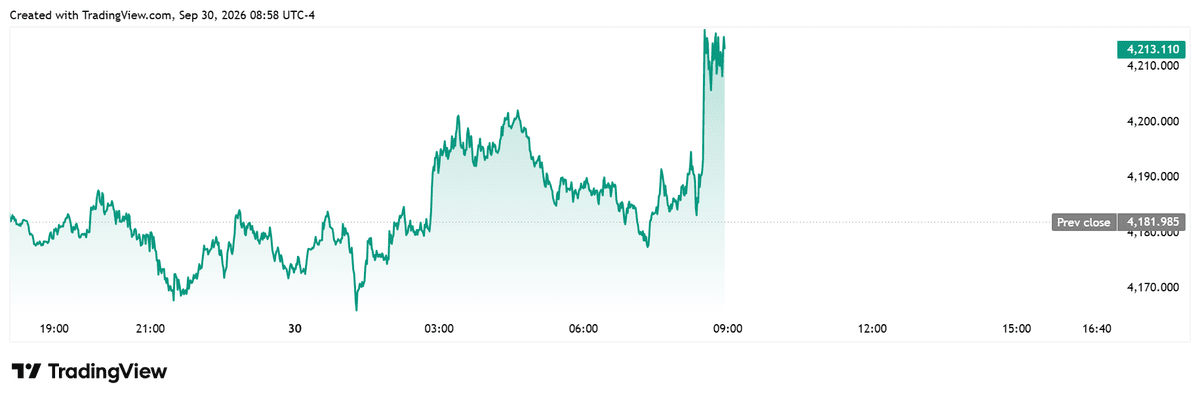
Gold prices shot to session highs following the better-than-expected GDP and PCE data, with spot gold last trading at $4,213.11 per ounce for a gain of 0.74% on the daily chart.
Chris Zaccarelli, Chief Investment Officer at Northlight Asset Management, said the GDP and PCE release contained mixed messages for investors.
"The economy is still expanding at a good pace (e.g. >2%), but inflation is running too hot (e.g. > 3%)," he said. "The monthly numbers are too high and rising (0.3% vs 0.2% prior), but the year-over-year numbers are improving (3.4% vs 3.7%)."
"Given the mixed nature of the data, it shows that the Fed was probably correct in raising rates this month, but if the inflation data improves they might be able to skip a meeting or at least raise rates less than the 3 times in a row that many were worried about," Zaccarelli said. "The stock market seems to be waiting for a new catalyst – neither selling off dramatically or rallying convincingly to new highs – and we believe a strong earnings season and getting past the midterm elections are what will break the market out of its trading range and see new highs by yearend."
Bill Adams, Chief U.S. Economist at Fifth Third Commercial Bank, said the August PCE inflation report was mixed.
"Inflation was stable on the month, but the trend was revised lower," he noted. "Inflation is a little closer to target than in the prior release, but that is because of how inflation is measured, not how it’s trending. You don’t need your glasses on to tell the difference between 3% core PCE inflation and a 2% target."
Adams pointed out that the revisions to personal incomes and outlays raised the saving rate, but it remains at its lowest level since late 2022. "Consumers are under financial stress as prices rise faster than incomes," he said. "The PCE report doesn’t capture the boost to spending power from capital gains, which are a big help to affluent Americans but irrelevant for those living paycheck to paycheck. Little wonder that consumer confidence fell to a 12-year low in September."
"For the Fed, the August PCE report is a glass half empty," Adams said. "Inflation’s trend is lower but still not close to their target and not improving, either. The reports leave the Fed’s October decision still in play, with its outcome likely dependent on the September CPI and PPI reports as well as prices at the pump and geopolitical developments in coming weeks."
"Other data out this morning point to an economy adding jobs at a decent pace and registering decent growth, keeping the Fed squarely focused on controlling inflation."
