
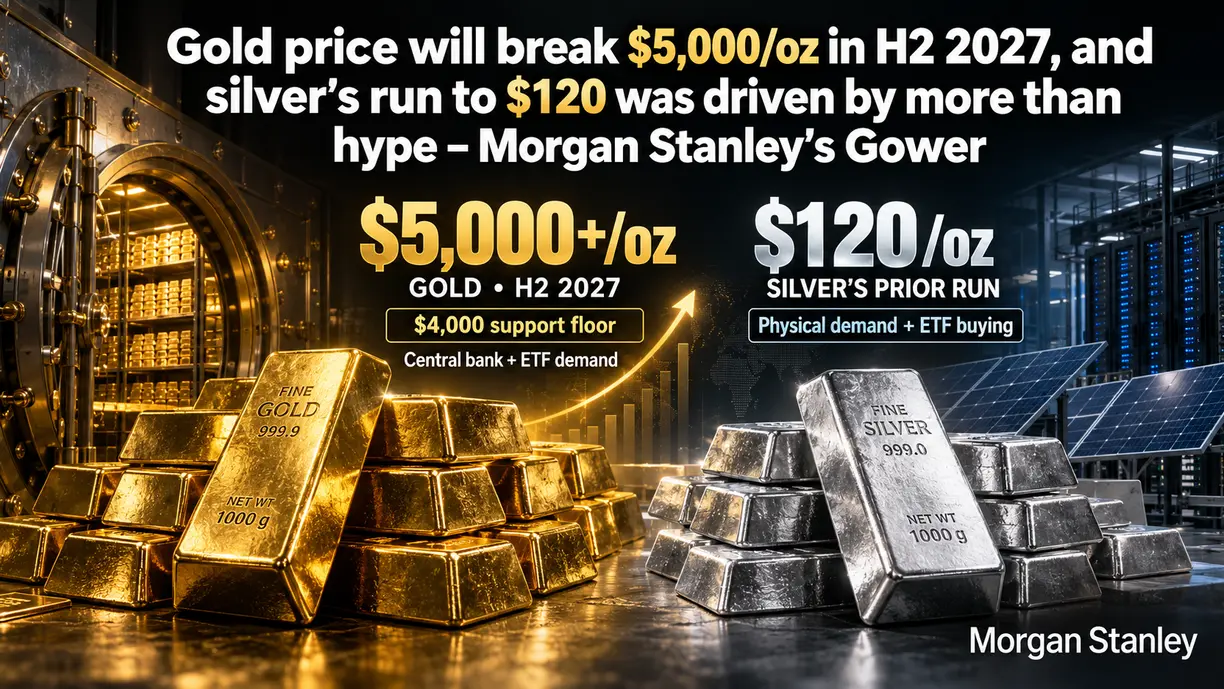
(Kitco News) – Gold prices may be under pressure at the moment, but ETF and central bank demand has stayed strong, and the yellow metal will be trading back above $5000 per ounce within a year, according to Amy Gower, head of metals and mining strategy at Morgan Stanley.
In a recent interview with CNBC, Gower acknowledged that the current environment was a challenging one for gold.
“We've got these long-dated bond yields hitting 20-year highs,” she said. “We've got a bit of dollar strength coming through. We've obviously got oil price strength as well.”
Gower pointed out that the market also saw a big run-up in gold positioning, with many investors adding to their gold positions in August. “A lot of those positions will have been added at quite close to current levels,” she said, so when the market experiences a big downward move like it did on Monday, they quickly get washed out.
“That said, though, gold does seem to be finding a bit of support above this $4,000 level,” she added. “I think we have to ask ourselves why is that? What else is going on here? And I think we can point to a few things.”
First, Gower said that physical demand remains very strong from central banks such as China and Poland. “But even if we just look at China's broad gold imports, they're on track for at least the highest since 2017, we think probably longer than that,” she noted. “China seems to have this very, very strong appetite for gold. We should remind ourselves they're going off for Golden Week on Thursday, so they might be a little quiet, but maybe when they're back, we'd see that re-engagement.”
Gower also pointed to persistent concerns around long-term government debt and fiscal sustainability. “What if we get more intervention in that long-dated bond market, and then you get yields coming back down?” she asked. “What happens if oil comes lower?”
“I think there's still lots of reasons to have gold, and I think we should see $4,000 as quite a strong floor.”
Asked where the recent selling may be coming from given that sovereign and other long-term buying has remained resilient, Gower said Morgan Stanley sees a fair amount of activity from the algorithmic trading funds. “We know that they were sellers through the second quarter and into July,” she said. “We know they flipped their positions into August. And probably those have flipped again. If we look at a lot of the technical signals, some of those also came under pressure [on Monday], so I think a lot of that is algorithmic.”
“In fact, exchange traded funds have been adding to gold, which is unusual in a market which is first anticipating and then delivering Fed rate hikes,” she added. “They've actually been more robust. Then you wonder if some of the central banks have maybe slowed their purchases with the rally, but I wonder if they'll come back in with this pullback.”
Amy, just sitting here doing my amateur charting, it looks to me as though the correlations are more significant between the gold and the dollar versus the gold and bond markets. In fact, you've seen a bigger breakout in the 10 year Treasury yield than what you've had on that gold and dollar trade.
So is this just a traditional role too, the correlation we see between the gold price and the strong dollar? That one moves in one direction and one moves in the other?
Gower agreed that the correlations appear to be shifting between gold and the dollar and between gold and the bond market of late.
“That does seem to be the case at the moment,” she said. “I think what you actually see, if you look at gold and the dollar over the long term, the correlation is close to zero. But you can get these periods where they're inversely correlated. A stronger dollar obviously makes gold more expensive for non-dollar holders. But equally, if they're both acting as safe havens, they can actually rally together.”
“I think at the moment, that seems to be the way it's trading, stronger dollar, weaker gold,” she said. “But I wouldn't be surprised if this changes as well.”
Gower was then asked about Morgan Stanley’s views on silver.
“Silver has been typically that high-beta play on gold, but also had that copper angle to it because it is used in electronics, data centers, solar panels, et cetera,” she said. “I think what we've seen over the last six months is it's been much more correlated to gold than it has to copper. And that's in contrast to last year, where the industrial demand was very strong. This year, that industrial demand is much weaker, and a lot relates to the very high prices, the volatility that we had last year, driving thrifting.”
Asked whether the extreme run-up in silver prices last year was all hype-driven, Gower disagreed.
“I think there was real physical demand,” she said. “We had a big push on solar last year, and we had a lot of ETF buying. But I think it did get a bit overstretched, and then when the price came down, it came down very fast.”
Gower said that while gold prices may face pressure in the near term, Morgan Stanley sees further gains in the months ahead.
“We do see upside to gold on a 12-month view,” she said. “We do see the price moving back above $5,000 an ounce by the second half of 2027, so we would say, on these pullbacks, we would be looking to add to gold positions.”
See live precious metals prices for gold, silver, platinum and palladium — in USD, CAD and 12 more currencies.
