
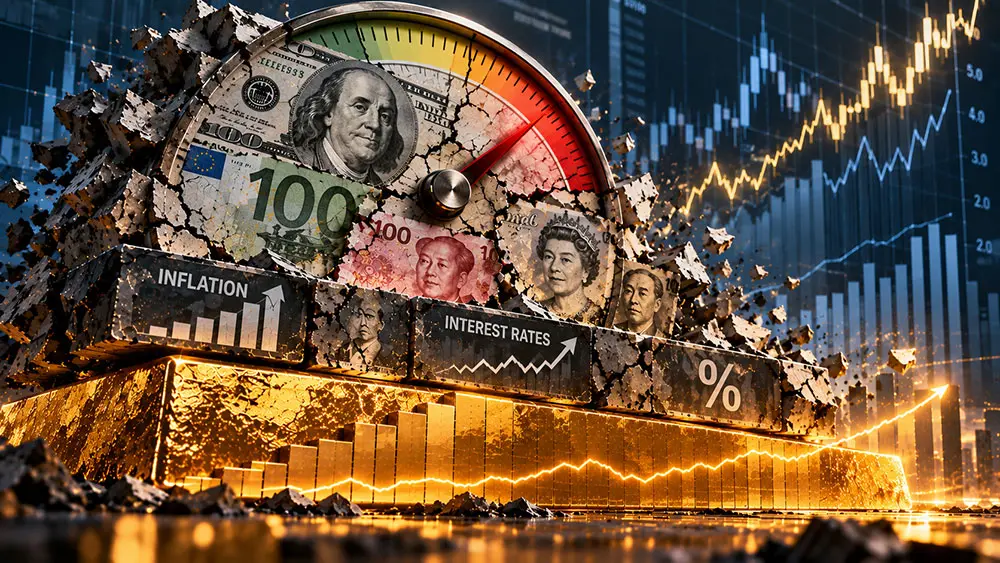
(Kitco News) - The gold market continues to struggle against rising bond yields and tighter global monetary policy, but one commodity strategist says investors may be focusing too much on the short-term headwinds and missing what could become one of the most important bullish environments for the precious metal in decades.
In an interview with Kitco News, Nitesh Shah, Head of Commodities and Macroeconomic Research at WisdomTree, said that although rising interest rates, elevated bond yields and a stronger U.S. dollar remain significant near-term obstacles, the forces driving yields higher could ultimately strengthen gold’s role as an alternative monetary asset.
“Gold seems to have defied the bond market for a number of years now,” he said. Shah noted that the traditional relationship can reassert itself over shorter periods but tends to break down when yields experience larger moves.
At the same time, Shah said persistent inflation continues to provide important underlying support for gold. Although market-based inflation expectations remain relatively well anchored, he said consumers have become accustomed to elevated prices and repeated inflation shocks.
“If you look at investors, their inflation expectations are fairly well anchored. If you look at breakeven rates, they look quite anchored. But you could talk to the average person on the street, they think inflation’s high and going to stay high forever… The average man, woman on the street doesn’t think that we’re going back to 2% anytime soon,” he said. “People have become accustomed to more frequent shocks that are driving prices higher. I think the gold market sits a little bit closer to the broader consumer market in terms of psychology than the investor market where inflation expectations are decently well-anchored.”
The problem for central banks, he added, is that higher interest rates cannot address many of the supply shocks currently driving inflation.
He explained that central banks can raise rates to suppress demand, but monetary policy cannot resolve geopolitical disruptions to global commodity markets. He said additional supply-side pressures, including potential weather-related disruptions, could also keep inflation elevated.
While persistent inflation pressures could force central banks to maintain tighter monetary policies in the near term, Shah said the bigger story for gold is unfolding in the bond market as the world deals with an unsustainable rise in sovereign debt.
U.S. government debt has been rising for years, and Shah said it is unreasonable to expect Treasury yields to remain exceptionally low indefinitely, particularly as the Federal Reserve unwinds the massive bond holdings accumulated following the Global Financial Crisis.
“We know debts are unsustainable, and that's the narrative we've been talking about for gold markets for the last five-plus years,” he said.
Shah said investors have been overly focused on the negative impact of higher short-term interest rates while paying less attention to the implications of fiscal dominance and deteriorating debt sustainability.
In the very short term, higher yields are negative for gold, he said. But over the medium term, those same pressures could represent “one of the most bullish stories for gold” of the decade, and potentially much longer.
“It is the contest of fiat currency versus […] the physical pseudo currency,” he said. “That is really going to be a very potent gold-positive story.”
For now, however, gold still has to navigate higher bond yields, elevated short-term rates and a stronger U.S. dollar, all of which Shah described as short-term headwinds.
Despite those pressures, Shah remains constructive on prices. He said that he expects gold prices to remain above $4,000 an ounce through the rest of the year. He added that because of ongoing economic uncertainty, he expects gold prices to be just below $5,000 an ounce within the next 12 months as slowing inflation pushes bond yields lower and weakens the U.S. dollar.(Kitco Global Index shows how much of today's gold move is the dollar versus the gold market itself.)
“It's still a positive story for gold for the coming year,” he said, but cautioned that if bond-market headwinds persist and consensus forecasts prove wrong, prices could instead trade relatively flat.
See live precious metals prices for gold, silver, platinum and palladium — in USD, CAD and 12 more currencies.