
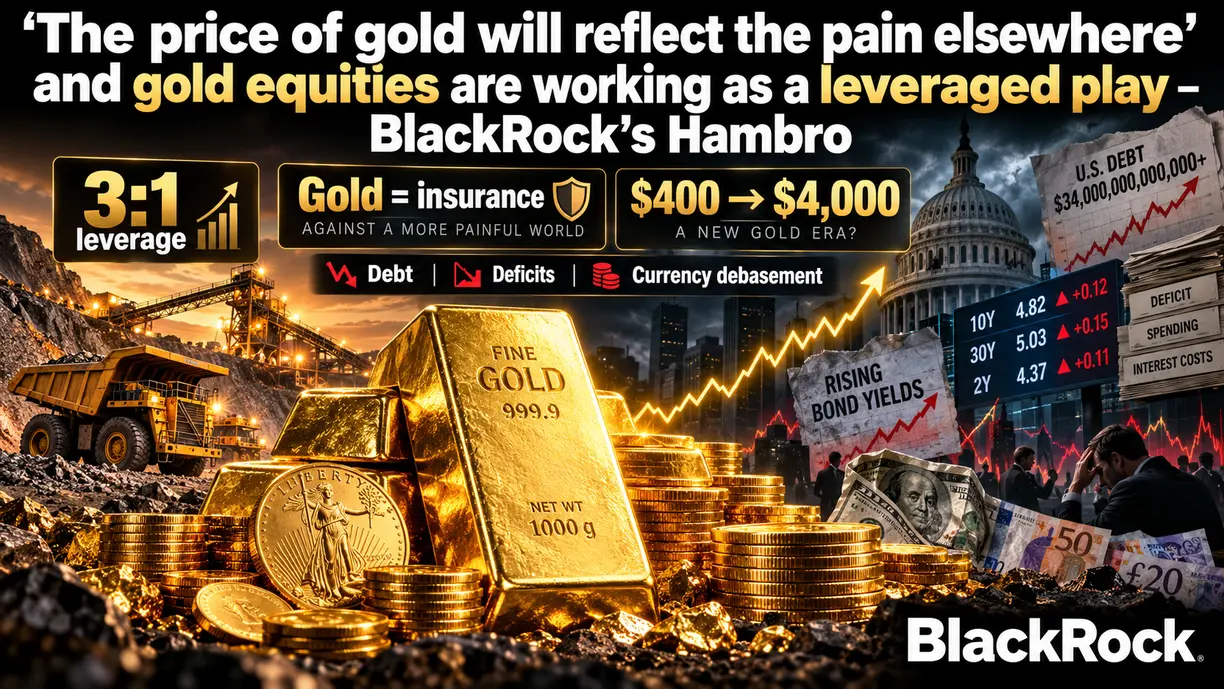
(Kitco News) – Gold will continue to appreciate as the systemic problems of ballooning debt, runaway deficits, and currency depreciation worsen, and the mining equities are once again providing multiples of leverage to the gold price, according to Evy Hambro, global head of thematic and sector investing at BlackRock.
Hambro was asked in a recent interview with MoneyWeek whether he expects the mild stagflation, weak dollar, and geopolitical turmoil that characterizes the current market environment to continue.
“I think so,” he said. “If we look out and try to see what's going on in the market, it's very, very clear to me, and I think to some people, that the bond markets, government bonds are talking. They're telling you things aren't healthy. The rates are going up, and the levels of debt are very, very large. The annual deficits that governments are having to fund are growing. and that's putting a lot of pressure on the financial system.”
“People are saying, ‘a pound or a dollar or a euro a decade ago or more bought me a lot more than it does today, and I don't want this risk.’ That's one element,” he said. “The second element is that some of the things that governments are spending the money on don't look that wise. There's a lot of waste in the system, so people are reluctant to keep lending to governments that are spending badly and don't have a pathway to dealing with the debt that they've taken on. It's a little bit like a business. Would you lend money to a company that loses money every year? You probably wouldn't want to do that. And if the company kept asking you for money, you might lend it to them, but at a much, much higher rate, to capture the risk that you might not get paid back.”
“These governments have got big deficits, they’ve got huge amounts of debt, and there isn't a plan to fix the situation, and the situation only looks like it's going to get worse,” he added. “If they want my money, they're going to have to pay me a lot more interest than they've been used to paying.”
Hambro said real assets are one way to protect against ongoing currency devaluation, debt, and deficits.
“Real assets can be infrastructure, it can be commodities, it can be gold,” he said. “Those are the kinds of things that through time have protected purchasing power. I started this job 30-odd years ago, and the price of copper was 60 cents a pound; it's six bucks. And gold was $400 an ounce, and it's $4,000 an ounce. The gold bugs love to joke that an ounce of gold has bought a men's suit for 2,000 years. So, it's very much a long-term store of value. There have been periods of time where it's outperformed and then underperformed, and it's bought you more than it should have done and bought you less than it should have done, but generally through time it's been that fantastic asset. I think that people are relearning that lesson.”
Hambro said that in the 1990s, wealth managers would have had an allocation to gold in clients’ accounts. “That disappeared in the early 2000s,” he said. “It's back, at a very, very small weighting, much smaller than people probably should have. They always say about 10% as gold, because it's insurance essentially. If you don't have insurance, then when something goes wrong it's very, very painful. And if you buy insurance every year and nothing goes wrong for a decade, you might think you've wasted the money. But the day when it does go wrong, you get it all back.”
“Having gold in your portfolio, there'll be periods of time where it underperforms,” he added. “If it underperforms, then you take a bit of profit out of the thing that's done really, really well – which is often nine or 10 times bigger than the amount you've got in gold – you take some of that profit and you put it back into gold, so you're always keeping that insurance level constant in your portfolio.”
Hambro said the bond market is telling investors to diversify. “Absolutely diversify,” he said. “Don't have all your eggs in one basket, because in the end, how does the debt go? The most painless way for it to go is to be inflated away. That does suggest that maybe governments and central banks won’t be quite as religious about reaching the inflation target, which they miss constantly anyway, as they should be.”
“To me it's very, very obvious,” he said. “I think the price of gold will reflect the pain elsewhere. If the situation gets worse, then gold will reflect that; if things get better, then gold will reflect that. And it's hard to see things getting better particularly quickly.”
Hambro was also asked about whether the miners still offer the same leveraged play on the gold price that they did in past cycles.
“Historically, commodity companies and gold in particular have had a relationship of about 3:1, so for 1% change in the price of the commodity you get a 3% change in in the value of the equity, and that was consistently the case for many, many years,” he said, “They acted like an option. The key with preserving that option value is to keep your costs flat. So when costs started to go up by more than the gold price, then you lost that upside participation in the equity value because you know your margin wasn't expanding. And in one of the years, the gold price was up and shares were down, so that that whole relationship went through a difficult period.”
“I'm really happy to say that over the last few years that relationship is completely intact,” Hambro said. “Not just this year, but for the last few years, we've had fantastic performance in the commodity, and we've had fantastic multiples of return in terms of the equities. And we've seen the same in copper and many of these other commodities as well. And that's because the rate of cost inflation from running these mines hasn't been going up as fast as the price has been going up, so we've been having this margin expansion.”
Hambro acknowledged that ETFs have also taken some market share away from the mining equities, but the miners offer a leveraged play that the metal itself does not.
“People always say, ‘How should I get my exposure?’ It depends what risk level you've got,” he said. “If you just want the gold price exposure, then you should have the gold ETF, a physically backed one. If you want a bit more excitement, then you have some gold equities. And if you want some turbochargers, you just have gold equities.”
“I've always been a fan of gold equities because gold bars don't pay a dividend,” he added. “They don't grow, M&A activity, you get all of that. And if you can manage that risk well through a diversified portfolio, then you should outperform the underlying commodity price.”
Speaking at the FT Mining Summit last week, Hambro said that the recently announced share buyback programmes from mining majors amount to “reckless capital allocation,” and that gold companies were approving these repurchases “without any real process.”
“One of the things we’ve been really dismayed about in the last 18 months or so has been the reckless capital allocation towards share buybacks in gold companies, where we’ve seen enormous amounts of money deployed on buybacks without any real process,” he said.
Hambro contrasted these buyback programmes with the real work of allocating capital to developing new mines to increase future supply. “If you look at what companies do when they’re making $1bn investment decisions on building new mines, they do far more work on that than they do on $1bn decisions to buy back their own shares,” he said.
Hambro was speaking as an industry and sector expert, but he’s also speaking on behalf of BlackRock as a major stakeholder. Four gold mining giants have announced share buyback programmes worth approximately $12 billion – Barrick Mining, Newmont, AngloGold Ashanti and Gold Fields. BlackRock owns 12% of Newmont, 10% of AngloGold Ashanti, and 6% of Gold Fields.
Hambro criticized the lack of transparency surrounding the programmes, which he said would be necessary to build investor trust.
“We’re very dismayed when companies announce big share buyback plans when share prices are at their peak, and then when the gold price falls back to $4,000 an ounce, they stop buying back shares – and the shares are 40% cheaper,” he said. “Where was the maths in making those decisions in the first place?”
Hambro said rather than locking themselves into expensive defined programmes, the companies should instead leave themselves the flexibility to take advantage of the opportunities in the market when they occur.
BlackRock remains bullish on the trajectory of gold prices, however, due the massive debts and deficits being carried by global governments.
“When you look around the world today, you see the incredible amount of debt governments are carrying and the large ongoing deficits many countries are running,” Hambro said. “You see no plan from governments to fix the problems, beyond doing more and more of the same. To me, that means you’re going to see an ongoing depreciation in the purchasing power of paper currencies.”
“The outcome is that real assets rise in price,” he said, “and gold is probably one of the biggest beneficiaries of that.”
Hambro said BlackRock sees the long-term trend for gold remaining higher, even as they expect further gold price volatility in the near term resulting from shifting monetary policy expectations and interest rates.
“That’s creating shorter-term volatility,” he said. “But the trend is very much your friend.”
See live precious metals prices for gold, silver, platinum and palladium — in USD, CAD and 12 more currencies.
