
(Kitco News) - Gold and silver are seeing a modest recovery after Friday’s market rout, which capped their worst October performance since 2008.
Some investors have grown frustrated with the precious metals as prices have struggled in recent weeks, facing rising opportunity costs as central banks around the world attempt to bring inflation under control. Most recently, gold and silver have also been caught in a broader liquidity squeeze as equity markets experienced a significant selloff last week.
However, one fund manager said that last week’s selloff, and any further correction, could represent the buying opportunity of a lifetime.
“Silver is about 60% below its $121.64 record, and gold hit a one-year low,” said Jen Bawden, founder of Bawden Capital, in her latest market commentary.
“Mainstream financial headlines are screaming about a precious metals wipeout, and retail traders who bought the highs are capitulating in sheer panic. To the untrained eye, it looks like a massacre.”
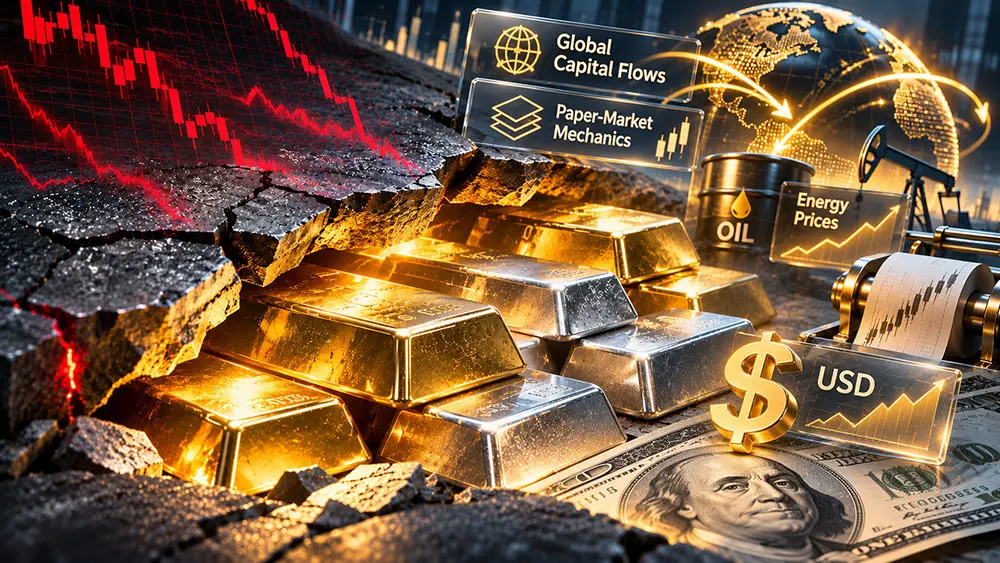
“To seasoned resource investors who understand global capital flows, paper-market mechanics, and cross-asset margin shocks, this is NOT a crisis; it is the exact liquidity air pocket we have been waiting for.”
Although the break below critical support levels last week was disappointing, Bawden said that the move was not surprising, given the headwinds facing both gold and silver.
She noted that although the Federal Reserve left interest rates unchanged last week, markets still expect rates to move higher in December. She pointed out that the threat of higher interest rates raises the opportunity cost of holding non-yielding assets like gold and silver.
Looking at the immediate price action and the technical damage inflicted Friday, Bawden noted that the threat of higher interest rates also appears to be taking its toll on equity markets. The S&P 500 lost 2% ahead of the weekend, its biggest drop since early June.
Bawden also noted that short-term volatility is being driven by broader geopolitical uncertainty and the global energy supply crisis stemming from the ongoing war in the Middle East.
“The biggest misconception circulating among retail commodity traders is: ‘If the Middle East is on fire and Brent crude is hovering above $113 a barrel, why are gold and silver falling?’” said Bawden.
She explained that disruptions to energy supplies are creating significant demand for U.S. dollars, adding another layer of pressure to precious metals.
“When conflict disrupts transit in the Strait of Hormuz and energy prices skyrocket, every major energy-importing nation, from Japan and South Korea to Germany and India, faces an immediate terms-of-trade crisis. Because crude is invoiced and settled globally in U.S. dollars, oil shooting up past $100 forces commercial importers to aggressively dump their domestic currencies on the open market to buy massive tranches of U.S. dollars just to keep their power grids running,” she said. Kitco Global Index shows how much of today's gold move is the dollar versus the gold market itself.)
Bawden added that the resulting demand for U.S. dollars is supporting the greenback, while higher energy prices are fueling persistent inflation pressures, raising the prospect of further monetary policy tightening and higher bond yields.
Bawden said that all this uncertainty is finally coming to a head as the threat of rising interest rates weighs on the broader economy and equity markets. She pointed out that higher bond yields are reducing the present value of future corporate earnings while also making much-needed capital more expensive to borrow.
“When a stretched tech and stock market cracks, it does not fall alone. It can trigger a sudden cash squeeze across many markets. In a sell-off, big funds do not sell what they want to sell. They sell whatever is liquid and easy to sell,” she said. “Gold and silver are very easy to sell.”
Although significant technical damage has been inflicted on gold and silver, Bawden said that the weakness is consistent with previous liquidity-driven selloffs.
“This is what happened in October 2008 and again in March 2020. Once the forced selling was over, gold and silver turned around and rallied hard,” she said.
“In both crises, gold and silver fell sharply along with stocks. After Lehman Brothers collapsed in the fall of 2008, gold fell about 29% and silver more than 50% from their March 2008 highs. In March 2020, gold fell roughly 10% and silver roughly 35% in a matter of days.”
Bawden noted that both precious metals subsequently experienced significant rallies after the initial liquidity shocks subsided.
“Once the forced selling ended, metals bounced back fast. After 2008, gold rose about 170% by August 2011, and silver climbed to nearly $50. After March 2020, gold gained about 39% to a new record high by August 2020, and silver jumped about 150%,” she said.
Although Bawden sees the current selloff as a potential long-term buying opportunity, she warned that prices could fall further before the precious metals market establishes a sustainable bottom. She noted that she has already placed limit orders to take advantage of further weakness, targeting discounts of between 20% and 30% in select mining equities.
At the same time, Bawden said that physical demand in Asia could provide some underlying support for silver. She pointed to the divergence between Shanghai and Western silver prices during Friday's selloff, although she acknowledged that China's tax on silver eliminates much of the apparent premium. She also expects Chinese demand for precious metals to remain an important factor supporting prices over the longer term.
Bawden explained that the near-term volatility has not changed her long-term outlook. She said that the next decade belongs to hard assets like gold and silver as investors are increasingly forced to protect their purchasing power in a world struggling with unsustainable sovereign debt.
“The sovereign debt mountain cannot survive high yields indefinitely without affecting the banking sector and the real economy,” she said.
“Governments, corporations and consumers around the world carry huge debts, and those debts get more expensive when interest rates stay high. If rates stay this high or go higher for too long, it will put real strain on banks and on the wider economy.”
Bawden expects mounting debt pressures will eventually force central banks to reverse course and ease monetary policy, creating a more favorable environment for precious metals.
“When the breaking point hits, central banks will be forced to ease, the dollar’s wartime strength will roll over, and global capital will flood into real, tangible assets,” she said.

