
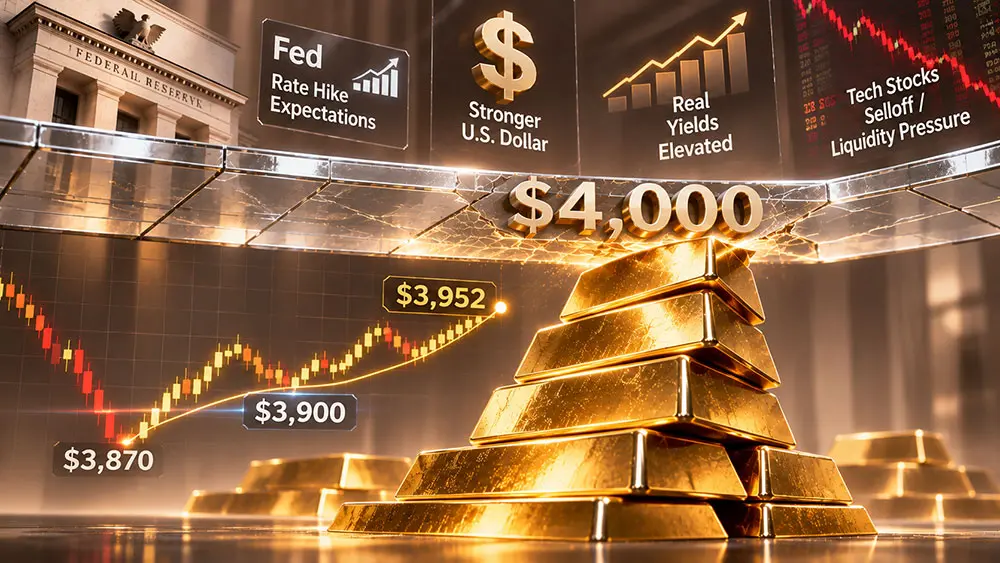
(Kitco News) - The gold market has managed to attract some important bargain hunting after falling to a one-year low last week below $3,900 an ounce. While the precious metal has managed to clear one near-term resistance level, according to one market strategist, it still faces an uphill battle ahead.
In her latest precious metals note, Dilin Wu, market strategist at Pepperstone, said that gold needs to break back above $4,000 an ounce to ease recent downside pressure and create room for a more sustained technical recovery.
Wu noted that gold's technical outlook deteriorated significantly last week as prices broke below critical support at $4,000 and $3,900 an ounce. The selling pressure pushed prices to a low of $3,870, their weakest level in more than a year. In some bargain hunting at the start of the week, spot gold last traded at $3,952.30 an ounce, up 2% on the day.
Despite early signs of a recovery, Wu said that gold still faces some downside risks. She added that interest rates remain a dominant market driver.
“For non-interest-bearing gold, a persistently strong US dollar and elevated real yields could keep the opportunity cost of holding the metal high, limiting its recovery potential,” she said.
She noted that although gold's 14-day Relative Strength Index is approaching oversold territory, prices still have room to move lower as the technical picture remains weak.
Wu added that stronger-than-expected economic data have reinforced expectations that the Federal Reserve's tightening cycle is not over. Although the central bank left interest rates unchanged last week, markets are still pricing in a rate hike in December.
However, while rising interest rates remain a significant risk, Wu pointed out that they are not the only headwind facing gold. The precious metal is also struggling as broader financial market volatility creates significant liquidity pressures.
She noted that last week's sharp selloff in technology stocks, including a nearly 29% decline in Intel shares on Friday, has raised concerns about excessive investment in artificial intelligence infrastructure and the potential returns on that spending.
As investors reduce their exposure to risk assets, Wu said that some market participants may be forced to liquidate gold holdings to meet margin calls or raise cash, adding to the precious metal's selling pressure.
In this environment, Wu noted that safe-haven flows in this environment have instead favored government bonds, leaving gold vulnerable to further liquidation.
She explained that falling bond yields alone may not be enough to support a sustained gold rally. The precious metal also needs to see expectations for further interest rate hikes ease and broader market liquidity conditions stabilize.
“Overall, gold continues to face the dual headwinds of rate hike expectations and market deleveraging,” she said.
Looking ahead, Wu said that investors will have several important economic and political events to navigate this week, including Tuesday's U.S. midterm elections, another round of technology earnings and Friday's October nonfarm payrolls report.
She noted that the election results could influence expectations for future fiscal spending, government deficits and Treasury issuance, potentially affecting bond yields and the U.S. dollar.
A shift in congressional control that reduces expectations for future fiscal deficits could help push longer-term bond yields lower, providing some support for gold. However, Wu cautioned that reduced political uncertainty could also strengthen the U.S. dollar and limit the precious metal's upside.
The most significant event for the precious metal could be Friday's employment report.
According to the report, economists expect the U.S. economy to create 65,000 jobs in October, up from September's increase of 29,000. The unemployment rate is expected to remain unchanged at 4.2%.
Wu said that stronger-than-expected employment growth, particularly if accompanied by resilient wage pressures, could reinforce expectations for a December rate hike, supporting the U.S. dollar and real bond yields. (Kitco Global Index shows how much of today's gold move is the dollar versus the gold market itself.)
Conversely, weaker employment data could provide gold with some relief by reducing expectations for further monetary tightening.
However, she cautioned that even disappointing economic data may not be enough to support a sustained recovery if broader financial markets remain under pressure.
If weakening employment conditions trigger another selloff in risk assets, gold could remain vulnerable as investors continue to raise cash and reduce leverage.
See live precious metals prices for gold, silver, platinum and palladium — in USD, CAD and 12 more currencies.

