
(Kitco News) - The gold market continues to struggle to attract consistent bullish momentum as persistent inflation pressures keep the Federal Reserve on a tightening path; however, one market strategist says investors should not overlook the precious metal's long-term value, even if prices remain volatile in the near term.
In an interview with Kitco News, Nitesh Shah, Head of Commodities and Macroeconomic Research at WisdomTree, said that although gold faces significant headwinds from elevated bond yields and a stronger U.S. dollar, the market is trading close to fair value, providing an attractive opportunity for long-term investors looking to protect their portfolios against growing economic and financial risks.
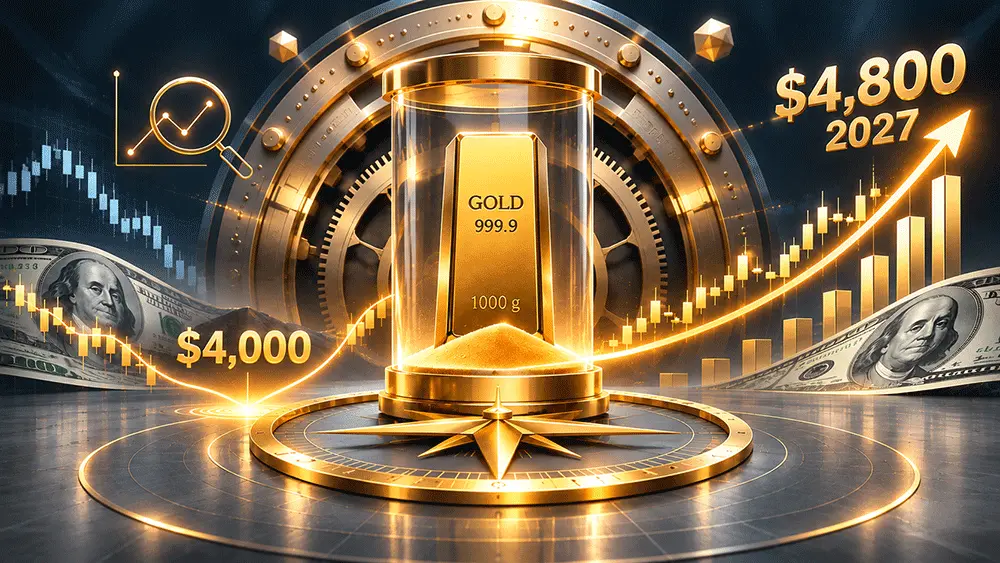
Even in the face of growing risks, Shah said that he remains optimistic that gold prices could rally back to $4,800 an ounce by the third quarter of 2027. While that forecast represents a significant gain from current levels around $4,000 an ounce, he added that investors should not expect the kind of explosive rallies that have defined the market in recent years.
"I don't think we're gonna get much, much deeper drawdowns than what we've already experienced," he said. "At the same time, gold prices don’t have to go up $1,000 to prove their value.”
Shah explained that gold has been fairly resilient despite the sharp rise in bond yields and the U.S. dollar in October. More recently, as yields have eased and the greenback has weakened, gold prices have moved closer to levels justified by his fundamental model.
He emphasized that this does not necessarily mean gold is undervalued. Instead, the market is finding a more sustainable foundation after its recent correction.
One of the biggest challenges facing gold remains the Federal Reserve's ongoing battle against inflation. Shah said the war in the Middle East has created a significant energy shock that is increasingly feeding into broader consumer prices, forcing central banks to maintain restrictive monetary policies.
Earlier in the week, the Consumer Price Index (CPI) rose by 0.4% last month, following September’s 0.6% increase, the U.S. Bureau of Labor Statistics announced. The inflation data was hotter than expected, as economists were looking for a 0.3% increase.
The report also showed core inflation, which strips out energy and food prices, rose more than expected. Core CPI increased 0.3% last month, matching September’s increase.
Despite the growing downside risks, Shah added that gold does not necessarily need interest rates to fall to regain its bullish momentum. A signal that central banks are finished tightening monetary policy could be enough to improve investor sentiment, particularly if inflation remains elevated.
"If the Fed and other central banks stop hiking or signal they're gonna stop hiking, even if inflation remains quite strong ... that's actually gold price positive," he said. "Strong inflation is actually good for gold. It's just the interest rate component that's limiting it at the moment."
Shah said a potential resolution to the conflict in the Middle East could ease some of the inflationary pressures weighing on gold. However, he cautioned that even if crude oil prices fall sharply, gasoline and diesel prices could remain elevated as global refining capacity and inventories take time to recover.
Beyond the near-term monetary policy outlook, Shah said the fundamental reasons for holding gold have not changed. In particular, he remains concerned about rising government debt and the growing burden of interest payments.
Although the Democratic sweep in the U.S. midterm elections could constrain additional government spending and tax cuts, Shah said the election results do little to address the nation's existing fiscal challenges.
He explained that elevated debt levels increase the risk of financial instability and could eventually force central banks to prioritize government financing needs over their traditional inflation mandates.
"It's that fiscal dominance aspect. The fiscal policy is driving the monetary policy. I don't think that changes," he said.
Against this backdrop, Shah sees gold maintaining its important role as a hedge against the long-term erosion of fiat currencies.
In his latest gold outlook report, Shah also highlighted the emergence of new institutional buyers, including Chinese insurance companies, Indian pension funds and stablecoin issuer Tether, as important sources of investment demand.
However, he cautioned that investors should not assume these institutions will continue buying gold at the same aggressive pace that helped drive prices to record highs. Initial allocations can have a significant impact on prices, but subsequent purchases may provide more modest support.
Shah said China's recent acceleration in gold purchases suggests that central banks remain comfortable adding to their reserves at lower prices. He also expects other central banks to remain active buyers, although limited transparency makes it difficult to determine the full extent of official-sector demand.
Despite his optimistic outlook, Shah acknowledged that gold faces a significant risk if investors begin questioning its traditional role as a safe-haven asset. He explained that some institutional investors are already questioning gold's inability to rally during periods of elevated inflation and geopolitical uncertainty.
However, Shah argued that gold's recent performance does not necessarily represent a fundamental change in its defensive characteristics. Instead, higher interest rates and a stronger U.S. dollar have offset the positive impact of inflation and geopolitical risks. (Kitco Global Index shows how much of today's gold move is the dollar versus the gold market itself.)
He also warned that a sharp equity market correction could initially drag gold prices lower as investors sell liquid assets to raise cash. Nevertheless, he expects gold to eventually benefit from a broader flight to safety.
Shah added that lower prices could also unleash pent-up physical demand from retail investors who have been priced out of the market.
Ultimately, Shah said investors need to look beyond short-term price movements and recognize gold's strategic role in a diversified portfolio.
"If you look at relative rankings of defensive assets, gold still holds a very strong position," he said.
See live precious metals prices for gold, silver, platinum and palladium — in USD, CAD and 12 more currencies.

