

(Kitco NewsWire) – Spot gold was lower and spot silver was higher in early U.S. trading Tuesday, as investors assessed slowing U.S. consumer spending and persistent expectations for additional Federal Reserve tightening. Gold remained near its lowest level in more than a year, while silver recovered from Monday's selloff. Gold was trading near $3,845.26 an ounce, down $0.29%, while silver was trading near $47.428 an ounce, up 1.00%.
The U.S. Commerce Department reported Tuesday that October retail and food services sales increased 0.2% to $748.2 billion, slowing from September's 0.8% increase and broadly matching economists' expectations. Sales were 6.8% higher than a year earlier, although the monthly increase was not statistically distinguishable from zero at the 90% confidence level. Sales excluding automobiles increased 0.6%, while sales excluding automobiles and gasoline advanced 0.5%. The figures indicate that consumer spending moderated following September's relatively strong performance, potentially easing some demand-driven inflation pressure. However, last week's stronger-than-expected consumer and producer inflation reports, together with October's 165,000 increase in nonfarm payrolls, continue to support expectations for restrictive Federal Reserve monetary policy.
Market positioning remains focused on the Fed's Dec. 8-9 meeting, with the latest published futures assessment indicating a 96.6% probability of a 25-basis-point increase and a 3.4% probability of a 50-basis-point move. The dollar eased modestly Tuesday after reaching its highest level since April 2025, while Treasury yields retreated from last week's elevated levels, providing limited support for gold. Investors will also assess October industrial production and capacity utilization, scheduled for 9:15 a.m. EST, followed by Wednesday's release of the minutes from the Fed's Oct. 27-28 meeting at 2 p.m. EST. The minutes could clarify policymakers' tolerance for persistent inflation and their assessment of labor-market risks. Softer economic activity or less hawkish commentary could reduce Treasury yields and support bullion, while continued inflation concerns would reinforce expectations for additional tightening.
The Strait of Hormuz and U.S.-Iran situation remains a significant source of uncertainty for energy markets, although recovering Middle Eastern petroleum exports have reduced immediate supply concerns. Commercial shipping continues to face attacks and elevated security risks, but regional exporters have increased shipments toward prewar levels despite the unresolved confrontation. The International Energy Agency expects the global petroleum market to return to surplus during the fourth quarter as recovering supply outpaces demand growth. The U.S. naval blockade of Iranian ports and disagreements over sanctions, nuclear activities and maritime security remain unresolved, leaving the possibility of renewed disruption. For gold, continuing geopolitical uncertainty supports underlying defensive demand, although the potential inflationary consequences of another sustained oil-price increase could reinforce Fed tightening expectations.
Crude oil prices were little changed Tuesday following Monday's decline of more than 3%, as expectations for a global supply surplus offset concerns about further attacks on tankers. Brent crude futures traded near $92.61 a barrel, up $0.17, or 0.18%, while Nymex WTI crude was near $85.73, up $0.01. Brent has declined approximately 22% so far in November, while WTI has fallen about 18%, reflecting the substantial reduction in the geopolitical risk premium as Middle Eastern exports recover. Lower energy prices could help moderate inflation expectations, although persistent underlying U.S. price pressure remains the more immediate consideration for Federal Reserve policy.
Global equity markets remained under pressure before the U.S. open as concerns about artificial intelligence-related investment, restrictive monetary policy and corporate valuations continued to weigh on risk sentiment. Monday's U.S. session saw the Dow Jones Industrial Average decline approximately 1.4%, the S&P 500 lose 1.9% and the Nasdaq Composite fall 2.5%, led by renewed weakness in semiconductor and technology shares. Asian equities were generally weaker Tuesday, while European markets faced similar pressure from technology-sector selling and uncertainty surrounding interest rates. Investors remain particularly sensitive to corporate earnings and whether elevated financing costs will constrain artificial intelligence infrastructure investment.
The key outside markets see Nymex WTI crude oil futures near $85.73 a barrel, while Brent crude was trading around $92.61. The U.S. dollar and Treasury yields were modestly lower after their recent advances, providing some relief for precious metals. However, expectations for another Federal Reserve rate increase in December continue to limit confidence in a sustained recovery. (Kitco Global Index shows how much of today's gold move is the dollar versus the gold market itself.)
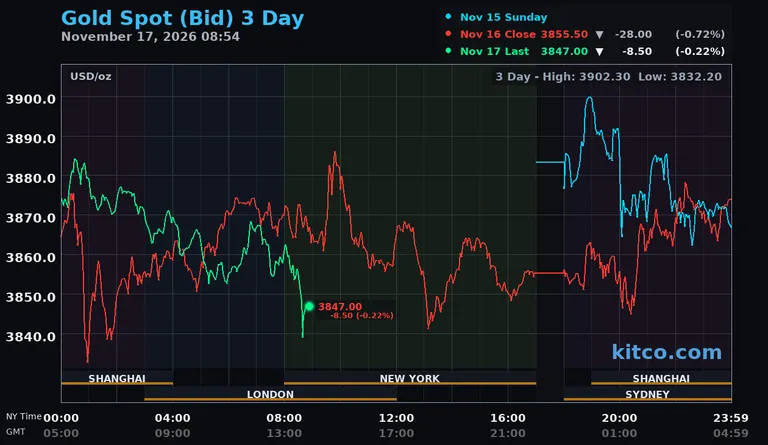
Technically, spot gold bulls' next upside price objective is to push prices back above the $3,888.00 to $3,922.00 resistance zone, with a sustained move through the upper boundary needed to improve the near-term bearish technical outlook. Bears' next near-term downside price objective is a break below $3,832.00, with a deeper downside target at $3,805.00. First resistance is seen at $3,888.00 and then at $3,922.00. First support is seen at $3,832.00 and then at $3,805.00.
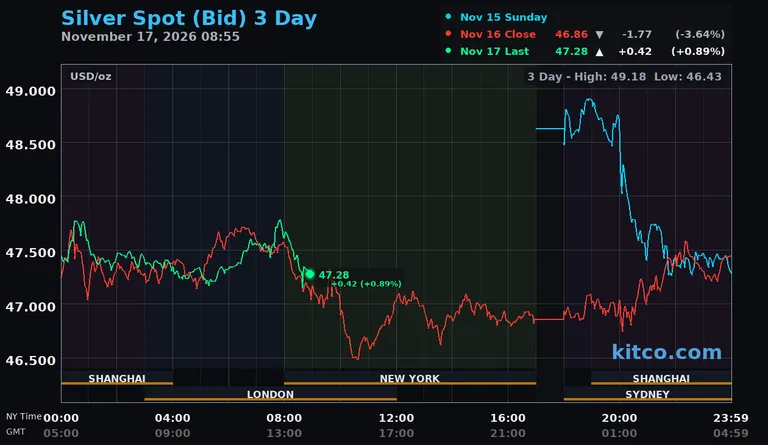
Spot silver bulls' next upside price objective is to drive prices back above the $48.540 to $49.840 resistance zone, with a sustained move through the upper boundary needed to strengthen the recovery. The next downside price objective for the bears is a break below $46.920, with a deeper downside target at $45.580. First resistance is seen at $48.540 and then at $49.840. Next support is seen at $46.920 and then at $45.580.
See live precious metals prices for gold, silver, platinum and palladium — in USD, CAD and 12 more currencies.

