
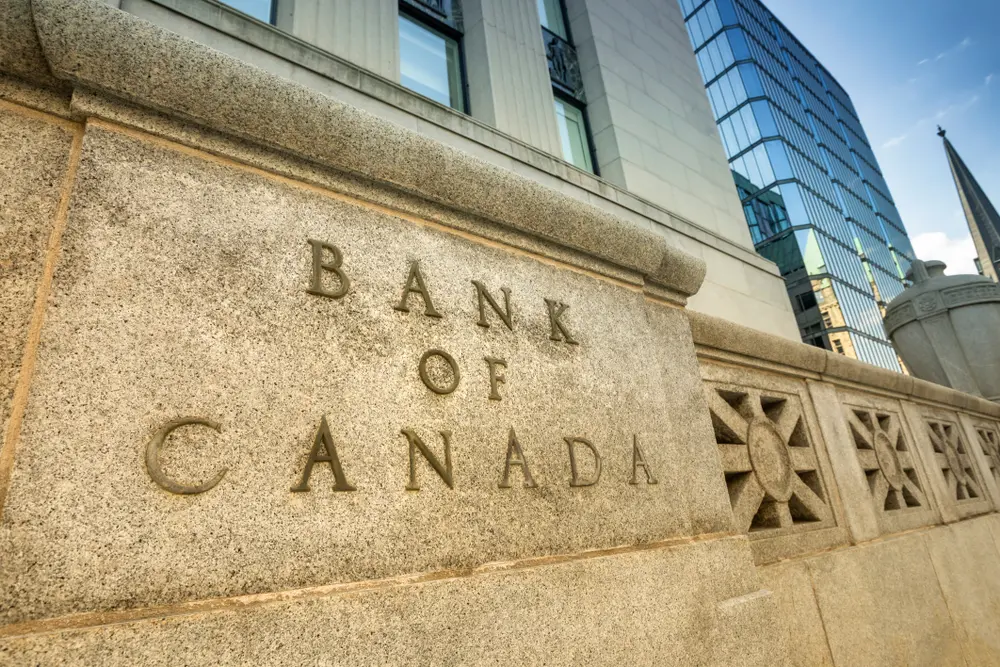
(Kitco News) - The gold market is not seeing much movement against the Canadian dollar after the Bank of Canada said it would continue to maintain its aggressive monetary policy and reduce its balance sheet.
In a much-anticipated move, Canada’s central bank left its overnight rate at 5.00%; at the same time, it left the Bank rate unchanged at 5.25%.
Although the central bank sees slower growth through the first quarter of 2024, it said that it remains concerned about stubbornly high consumer prices.
“In Canada, the economy has stalled since the middle of 2023 and growth will likely remain close to zero through the first quarter of 2024,” the BoC said in its monetary policy statement. “Consumers have pulled back their spending in response to higher prices and interest rates, and business investment has contracted. With weak growth, supply has caught up with demand and the economy now looks to be operating in modest excess supply. Labour market conditions have eased, with job vacancies returning to near pre-pandemic levels and new jobs being created at a slower rate than population growth. However, wages are still rising around 4% to 5%.”
“The Council is still concerned about risks to the outlook for inflation, particularly the persistence in underlying inflation. Governing Council wants to see further and sustained easing in core inflation and continues to focus on the balance between demand and supply in the economy, inflation expectations, wage growth, and corporate pricing behaviour. The Bank remains resolute in its commitment to restoring price stability for Canadians,” the central bank also said.
The BoC’s latest monetary policy decision is not having much of an impact on gold against the loonie as the precious metal sees some selling pressure. Spot gold last traded at $2,726.77 an ounce against the Canadian dollar. In comparison spot gold is trading at $2,021.84 against the U.S. dollar, down 0.35% on the day.
Although the BoC remains committed to fighting inflation, Stephen Brown, Deputy Chief North America Economist at Capital Economics, said that it has removed its overt tightening bias.
“The Bank’s decision to keep the policy rate at 5.0% was widely expected and the big change in the policy statement was that the Bank dropped its bias toward more tightening,” he said. “While that means we are one step closer to interest rate cuts, there was no sign that cuts are imminent. Given the shift in tone today, we are sticking to our view that the Bank will be prepared to make policy less restrictive by beginning to cut interest rates at the April policy meeting.”
