

Bitcoin (BTC) and the broader crypto market fell under pressure in early trading on Tuesday as investors continue to evaluate their next moves now that it seems certain that the Federal Reserve won’t be reducing interest rates anytime soon amid persistently high inflation and escalating global tensions.
Data provided by TradingView shows that Bitcoin bulls attempted to make a run at the $53,000 resistance level on Tuesday morning, but were rejected by bears, resulting in a return to support at $51,200.
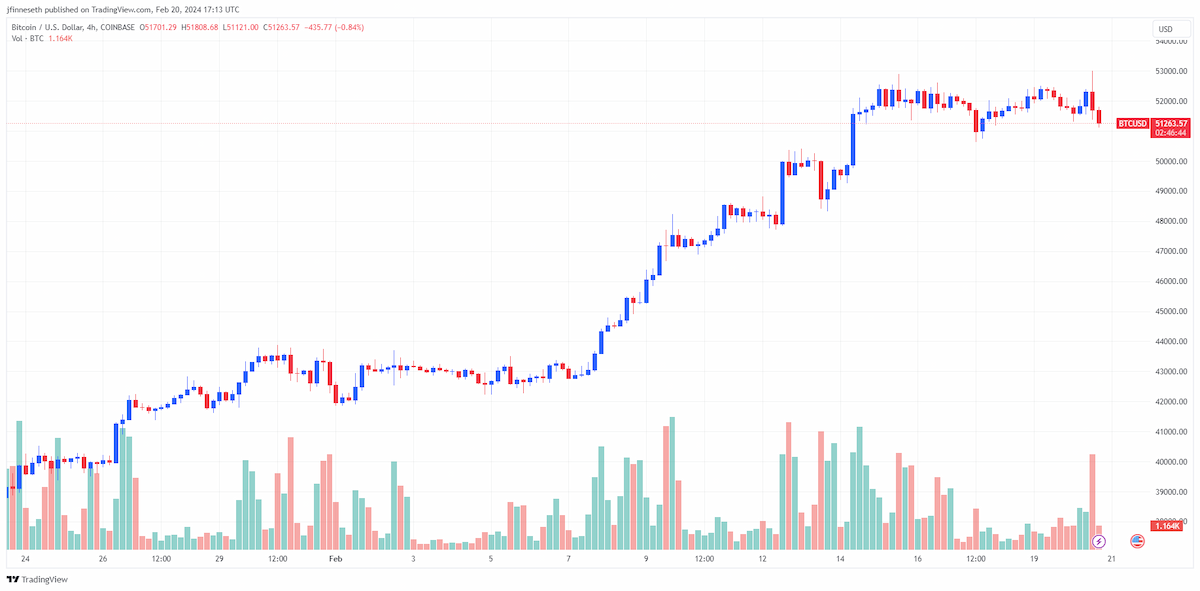
BTC/USD Chart by TradingView
While Bitcoin range trades in the wake of the launch of the first spot BTC exchange-traded funds (ETF) in the U.S., Ethereum (ETH) has come into focus for traders as there is a possibility that the first U.S.-listed spot Ether ETF could be approved in March.
Speculation about the approval of a spot ETH ETF has put a bid under the price of Ether similar to what was seen with Bitcoin in the lead-up to the launch of multiple spot BTC ETFs, briefly propelling ETH back above $3,000 for the first time since May 2022.

ETH/USD Chart by TradingView
The weakness seen in the broader crypto market is not unexpected, as prices have been running hot over the past couple of weeks.
Bitcoin closed at $52,150 on Friday, an increase of 7.9% from the previous week's closing value of around $48,300, said Matteo Greco, research analyst at Fineqia International, in a note shared with Kitco Crypto.
“Last week marked Bitcoin's return to trading above $50,000 for the first time in over two years, signaling strong momentum following the approval of BTC ETFs Spot,” he said. “The last time BTC traded above $50,000 was back in December 2021, immediately following its all-time high of $69,000 in November of the same year. This period was retrospectively recognized as the onset of a significant downtrend that persisted throughout 2022, leading to a price decline to approximately $16,000 by the end of that year.”
Greco said that a high level of demand for spot BTC ETFs is fueling the momentum in the market, as “the cumulative net inflow into BTC ETFs totaled about $2.3 billion [last week], nearly doubling the $1.2 billion recorded in the previous week, and accounting for almost half of the total net inflow since inception, which currently stands at roughly $5 billion.”
“Net inflows have remained consistently positive for 16 consecutive trading days since January 26th,” he added. “However, outflows from the Grayscale Bitcoin ETF (GBTC) saw a slight increase last week, reaching approximately $625 million, marking a 50% rise compared to the cumulative outflow of $415 million recorded in the preceding week. This suggests an uptick in profit-taking by investors following the recent surge in BTC price.”
He noted that the cumulative trading volume for the spot BTC ETFs reached around $9.6 billion last week, with an average daily trading volume of more than $1.9 billion.
“Since January 11th, the cumulative trading volume has totaled $45.3 billion, with an average daily volume of approximately $1.7 billion,” he said. “These figures indicate above-average trading volume for the week, underlining strong buy pressure and activity surrounding these ETFs.”
Greco said investors are now focused on macroeconomic concerns, with the next Federal Open Market Committee (FOMC) meeting less than 30 days away.
“Market expectations suggest a 90% probability of no change in rates, with the first 25bps cut still anticipated for some time between the end of Q2 and the beginning of Q3 this year,” he said. “This expectation fuels the anticipation for a less restrictive monetary policy from the FED, increasing risk exposure that market participants are willing to undertake. This contributes to the robust momentum of risk assets such as BTC, cryptocurrencies, and stocks, with the S&P 500 recently achieving a new all-time high.”
While macroeconomic factors are affecting financial markets globally, the upcoming Bitcoin halving is top of mind for crypto traders, who anticipate a major run-up in BTC price by the end of 2024 as a result of the quadrennial reduction in new Bitcoin supply.
“Bitcoin Price expectations related to the Bitcoin halving event this year shouldn’t be based solely on historical patterns of price surges pre- or post-halving, but also on the evolving landscape of cryptocurrency's integration into traditional finance,” said Mikkel Morch, founder of the digital asset investment fund ARK36.
“This year, the narrative is especially enriched by the significant interest from institutional investors, as evidenced by the robust inflows into Bitcoin ETFs, signaling a broader acceptance and understanding of Bitcoin as a legitimate investment vehicle,” Morch said.
“A key aspect to watch is, therefore, the market's significantly increased maturity compared to previous cycles,” he said. “With increased regulatory clarity and the adoption of cryptocurrencies by mainstream financial services, Bitcoin's response to the halving could provide new insights into its role in the global financial ecosystem, and we believe that the strong, bullish undertones are not unfounded also due to these reasons.”
Morch said the macroeconomic environment, which is characterized by expansive fiscal policies and a push towards digital currencies, “could amplify the halving's impact on Bitcoin's price. This backdrop offers a unique confluence of factors that could either propel Bitcoin to new heights or - who knows - test its volatility in unforeseen ways.”
“In summary, the upcoming halving is more than a historical repeat,” he said. “It's a moment of truth for Bitcoin's institutional adoption, market maturity, and resilience against a complex macroeconomic canvas. While optimism is palpable, the evolving dynamics still suggest a cautious approach, blending enthusiasm with a critical analysis of the new factors at play.”
