

Continued inflows into spot Bitcoin (BTC) exchange-traded funds while gold ETFs see outflows have prompted a deeper discussion around the role that Bitcoin will play as a store of wealth in the future as society advances deeper into the digital age.
Bitcoin ETF inflows keep accelerating with $50,000 taken out, coincidentally (or not!?) at the expense of Gold ETF outflows.
Total assets in all US Bitcoin ETFs = $38bn
Total assets in the GLD ETF = $54bn
Total assets in all global Gold ETFs = $166bn
So, physical buyers will… pic.twitter.com/baYzg4dF9F— Nicky Shiels (@nixsa84) February 14, 2024
While gold has historically served as a reliable store of value, many investors never took the step to include it as a mainstay in their portfolios for various reasons, despite the fact that governments and central banks around the world have always held it as a percentage of their reserves.
According to investor and mathematician Fred Krueger, “Gold really did not enter the 60/40 portfolio in any meaningful way,” but he thinks that Bitcoin will overcome the barrier to entry and find its way into a large number of portfolios in the future.
“And the reason is performance,” he said. “Even if all the Gold Bugs are right, Gold won't meaningfully outperform the SP500 as an inflation hedge. Bitcoin is different. It feels more like a growth component to a portfolio than a pure inflation hedge.”
Krueger noted that Bitcoin is “only 15 years old,” unlike gold, which has been used in financial matters for over 5,000 years. “It has an amazing 15-year track record, with just a few bad years (2018 and 2022), but overall stellar,” he said.
“The market loves growth stories. Especially ones that aren't correlated with the SP500,” Krueger declared.
After hypothetically asking, “How long will it take the average ‘model’ portfolio to go 2-5% Bitcoin?” Kruger answered his own question, saying, “It might be as short as 5 years.”
“If that happens, we absolutely get 1 Million/coin,” he said. “I don't see this kind of risk-return anywhere. Certainly not in altcoins.”
Bloomberg Intelligence senior ETF analyst Eric Balchunas backed up Kreuger’s thesis, tweeting, “This is right. Bitcoin ETFs are portfolios hot sauce, not an alternative IMO. But there’s a real market for hot sauce these days to complement the powerful but boring (bc you have to wait 30yrs for magic of compounding) 60/40 core.”
Technical analyst and quant trader Steve Bennett provided further support for Kreuger’s argument by posting the gold to monetary base (M2) chart, which shows that gold has been below the M2 for the majority of the past 40 years.
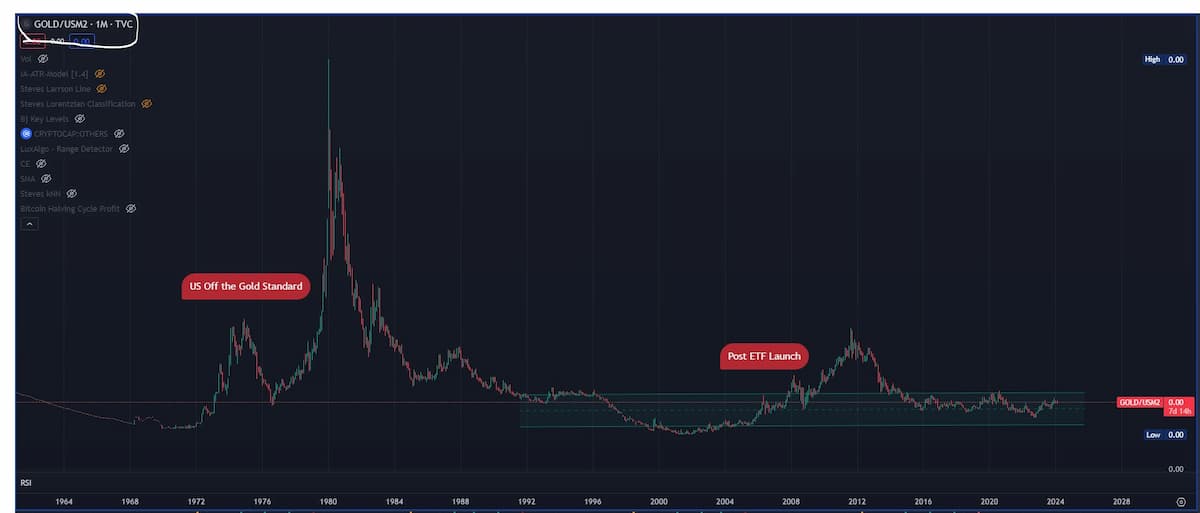
“Gold is frankly horrible,” Bennett said. “This is gold/m2, I plotted this the other day. Other than 71 and the ETF launch, [it] has not moved over M2 in 40 years. Yes, you ‘just’ retain your purchasing power but you shag all in returns.”
While the spot BTC ETF flows have been the focus of market commentators since their launch on Jan. 11, Bitwise Chief Investment Officer Matt Hougan provided some historical context into gold flows to help balance the conversation.
“Annual net flows into gold ETFs globally from launch through 2020,” Hougan tweeted, noting that there have been “10 straight years of inflows [and] 3 years of outflows (2013 - 2015),” while “Year 18 set a record for flows.”
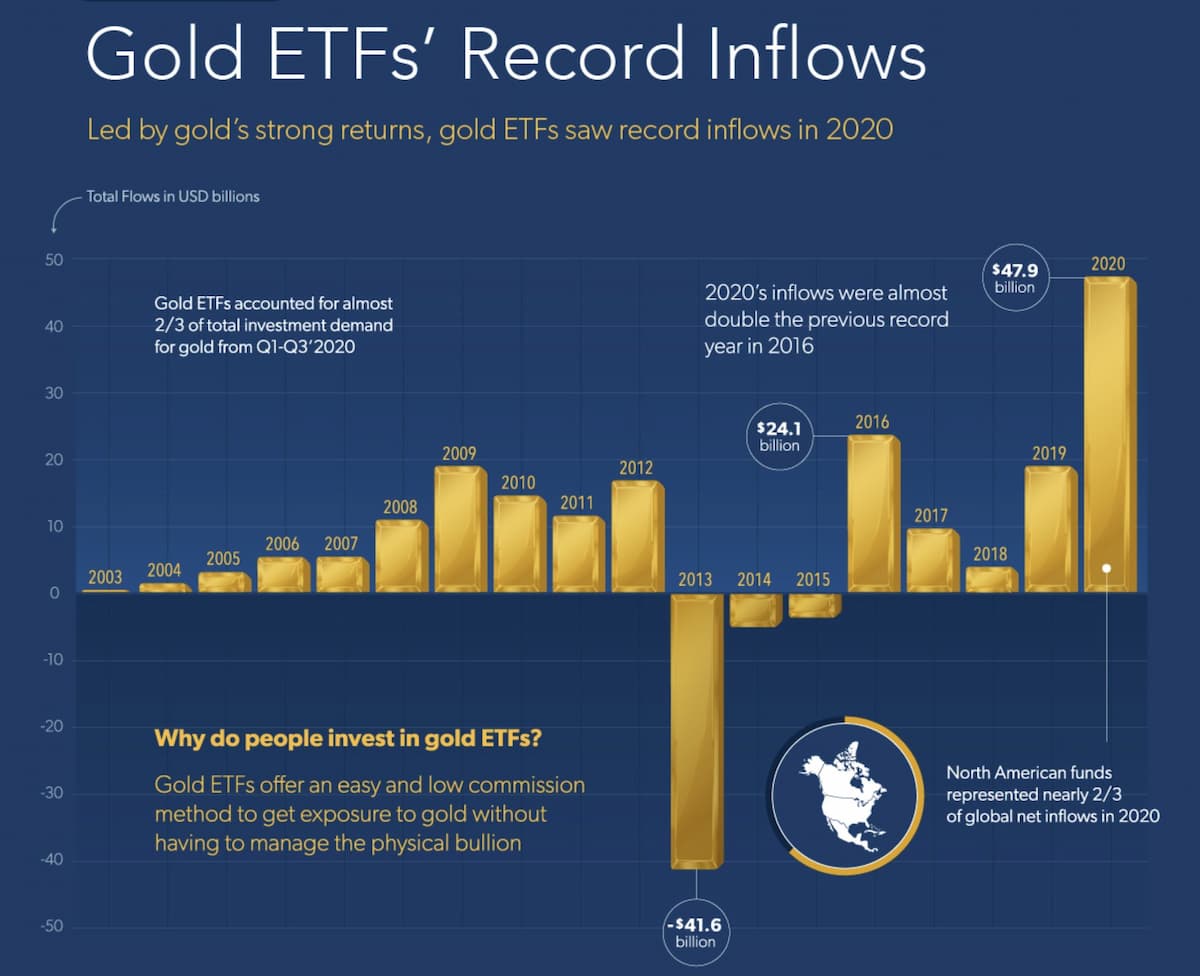
“Gold is much less interesting than Bitcoin, but the ETF example may be relevant because it was a single commodity ETF that made it easier for investors to access a unique market,” Hougan concluded.
Also coming to gold’s defense was Charlie Morris, Chief Investment Officer at ByteTree.
“Gold has reinvented itself many times. It’s the original monetary fintech,” Morris said. “The 5000-year thing has seen many different chapters, some with official recognition. Last one ended in 1971. Yet unofficially, the official sector [is] doubling down on gold.”
His mention of “the official sector” is likely referring to governments and central banks, which have been on a gold-buying spree over the past couple of years as countries moved to reduce their exposure to the U.S. dollar and shore up their reserves.
“The last bull market peaked in 2011 after a 7x surge into a bubble,” Morris noted. “These bubbles take years to recover like Nasdaq in 2000 etc. Yet gold [is] back at [its] all-time high quite soon and ready for the next chapter.”
Referring to the comment about not being included in portfolios, Morris said, “In 60/40, gold is in the 40 as it’s a risk-off asset. Bitcoin is in the 60 because it’s risk-on. Always structural demand for interesting hedges in the 40.”
“Gold and bitcoin are not [in] competition, or at least shouldn’t be,” he said. “Gold [is] embraced by the official sector. Bitcoin is not. 60/40 should own both. That’s why I created the BOLD index. It is designed to be the liquid alternative asset combo in a 60/40.”
Bloomberg Intelligence Senior Commodity Strategist Mike McGlone agreed with Morris that the best path forward for gold is to be paired with Bitcoin.
“If Not Paired With Some Bitcoin, Gold May Be Naked,” McGlone tweeted. “With the advent of US #Bitcoin #ETFs, competition for tangible #gold may be increasing from the intangible digital version, with implications for coupling.”
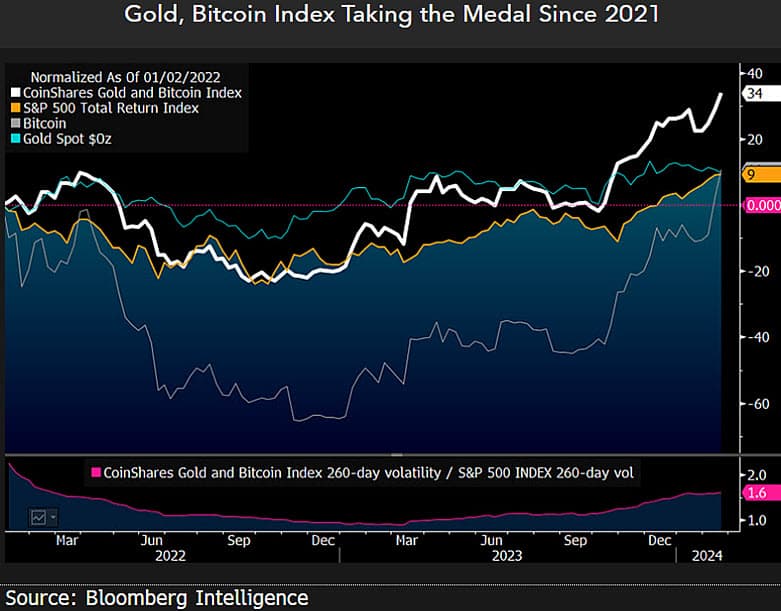
“Since the end of 2021, just before the onset of one of the most aggressive #Fed tightening periods in history, the CoinShares Gold and Bitcoin Index is up about 30% vs. around 10% for the S&P 500 Total Return Index,” he said. “Bitcoin AND gold.”
