

Bitcoin (BTC) bulls continued to graze in the pastures above $61,000 in early trading on Friday as the top crypto is in consolidation mode following its breakout to a 27-month high on Wednesday, a welcomed pause for those who know that rapid rises can often lead to gut-wrenching pullbacks.
After a brief dip below the $61,000 handle in the wee hours of the morning, BTC bulls attempted to reignite the rally but were stopped out below $63,000 as bears appear determined to halt any further advancement.
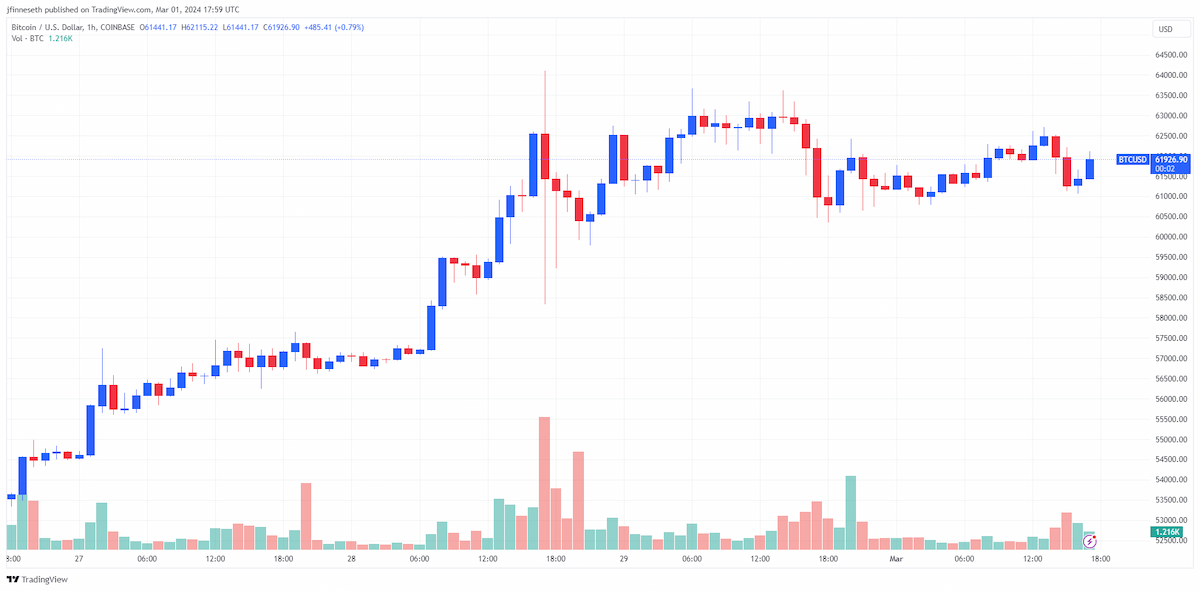
BTC/USD Chart by TradingView
The rejection at $62,730 led to a pullback to $61,055, and at the time of writing, BTC trades at $61,995, an increase of 1.6% on the 24-hour chart.
ETF flows remain top of mind for market observers and crypto investors alike as heavy inflows continue to impress, with BlackRock’s IBIT leading the way. As noted by Bloomberg Intelligence Senior ETF Analyst Eric Balchunas, IBIT is “the newest member of the $10 Billion Club,” and was the “fastest ever to get there.”
Balchunas added that there are only 152 ETFs with a valuation of over $10 billion, including GBTC, and he expects the next $10 billion to come “easier because market appreciation is a bigger variable.”
Cointucky Derby Update: Widely covered already but $IBIT single handedly offset a $600 million outflow from $GBTC. The group of #Bitcoin ETFs took in $92 million.
Importantly $IBIT already crossed $10 billion in assets. Doing this in just 7 weeks (to the day) is insane. pic.twitter.com/AYQKL4os0Y— James Seyffart (@JSeyff) March 1, 2024
“This week, we've observed another record-setting inflow into Bitcoin ETFs, with a net flow of $673 million on February 28th, surpassing the previous day-one record of $655 million,” Ryze Labs analysts told Kitco Crypto. “It's important to emphasize the remarkable pace at which funds are flowing into Bitcoin ETFs.”
“For perspective, Blackrock’s $IBIT is approaching $10 billion in assets under management (AUM) merely seven weeks post-launch,” they said. “To put this in context, it took State Street’s gold ETF, $GLD, two full years to reach a similar milestone. Moreover, while $IBIT represents just 0.2% of BlackRock’s total ETF AUM, it has accounted for 42% of this year's inflows.”
Ryze Labs previously predicted that “the wave of GBTC redemptions by earlier investors would gradually diminish,” and “anticipated that it would take a few weeks for the ETF asset managers' sales and marketing efforts to fully ramp up, as evidenced by Fidelity Canada's recent recommendation for a 1-3% allocation into BTC last week.”
“These developments have unfolded as expected, leading to a significant net demand for BTC,” they said. “This demand was reflected in this week’s bullish price movement, with BTC surpassing $64,000 on Wednesday.”
“This surge in interest triggered an unprecedented increase in activity on centralized exchanges, causing temporary outages on platforms like Coinbase due to activity spikes more than tenfold,” they noted. “With the November 2021 all-time high of $69,000 now within close reach, we anticipate that the heightened open interest and funding rates from bullish market participants will introduce more volatility into the market in the near future.”
Next major catalyst: Bitcoin halving
With the launch of spot BTC ETFs in the rearview mirror – while speculation about the potential approval of spot Ethereum (ETH) ETFs ramps up – the next catalyst for Bitcoin is the halving, which is predicted to occur sometime between April 19 and 21.
"The halving will lead to a supply shock, as the supply of BTC mined drops while the demand continues to grow (due to BTC ETFs, the demand for blockspace - due to Ordinals and other assets, and ‘Building on Bitcoin’ projects such as L2s),” Aki Balogh, Co-founder and CEO of DLC.Link, told Kitco Crypto. “This is expected to sharply increase the BTC price.”
“Also, Microstrategy has been cornering the market, further reducing the supply,” he added. “ETH and other tokens are highly correlated to BTC. A lot of hedge traders trade ETH and other tokens against BTC instead of USD, to minimize FX risk. So, if BTC goes up, it will have a secondary effect of increasing the values of ETH and other tokens.”
Balogh said that as halvings occur, “miners are compelled to seek alternative avenues for generating yield from their BTC assets.”
“Previously reliant on BTC price appreciation, many miners now find it unfeasible to remain profitable at current electricity rates, with profitability typically above 12 cents per kWh but now dropping to above 6-8 cents per kWh,” he said. “Essentially, it takes double the amount of electricity to make the same amount of BTC. The rate stays the same, but miner profitability is halved. The halving tends to drive a supply shock, resulting in an increase in BTC price, but that's not guaranteed.”
Some of the additional yield sources that miners are known to explore include “CeFi and DeFi options,” Balogh said. “DeFi, in particular, stands out for its transparency and independence from intermediaries, reducing counterparty risks. Miners, wary of potential token devaluation, hesitate to exchange their BTC holdings.”
While miners always experience a shake-up in their business plans as halvings transpire, Crypto Feras highlighted the real impact the quadrennial reduction in new Bitcoin emissions will have amid soaring ETF demand.
#Bitcoin spot ETFs recorded 2,090,000,000$ net inflow this week
average of ~7400 #Bitcoin daily net buy
knowing that the daily Supply of #BTC is currently @ 900 $BTC/Day
Current Supply is never enough, covering 12% of spot #ETFs demand, next month it will be 50% less (halving) pic.twitter.com/bUnJCzHaIW— Crypto Feras (@CryptoFeras) March 1, 2024
