
(Kitco News) – The factors that supported central banks’ near-record gold purchases in 2023 continued into the new year, and if January is any indication, 2024 will be another blowout year for the yellow metal, according to Krishan Gopaul, Senior Analyst, EMEA at the World Gold Council.
Gopaul noted that after the record-setting 2022 and the strong follow-up last year, “central bank gold demand has become a key support for gold.”
“Naturally, the focus has been not only on what has happened but also on what is to come,” he said. “Will central banks continue to buy gold, and if so why and how much?”
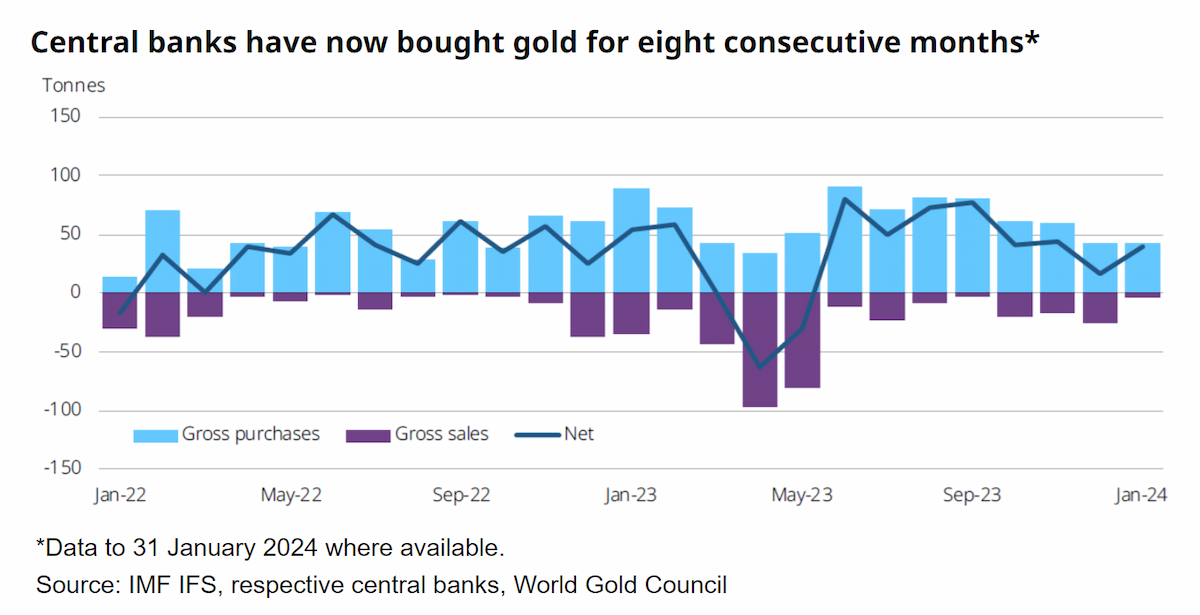
Gopaul said the answers to these questions are beginning to emerge with the latest central bank purchase data, and they bode well for gold bugs. “In January, central banks reported that they increased global official gold reserves by 39t.” he wrote. “This was more than double the (revised) December net purchases of 17t, and the eighth consecutive month of net purchases.”
Gopaul noted that all six of the central banks which increased their gold reserves by one tonne or more in January have been regular buyers.
“The Central Bank of Turkey was the largest buyer, increasing official gold holdings by 12t,” he said. “This helped lift total gold holdings to 552 tonnes, just 6% off the all-time high of 587 tonnes back in February 2023.”
The People’s Bank of China increased their holdings by 10 tonnes in January, marking their 15th consecutive month of additions. “Total gold holdings now stand at 2,245t, nearly 300t higher than at the end of October 2022 when the bank resumed reporting gold purchases,” he said.
The Reserve Bank of India added nearly nine tonnes of the precious metal. “This is the first monthly increase in its gold reserves since October 2023 and the largest since July 2022; its gold holdings now total 812t,” Gopaul noted.
The National Bank of Kazakhstan bought six tonnes, their first monthly addition since January 2023, while the Central Bank of Jordan bought three, lifting their total gold holdings to 75 tonnes.
“The Czech National Bank added nearly 2t – the eleventh consecutive month of buying,” he said. “Over that period gold reserves have surged from 12t to more than 32t (+170%).”
Gopaul said that significant sales of the precious metal were virtually non-existent in January, with the Central Bank of Russia (CBR) being the lone exception. “Gold reserves at the CBR declined by 3t in a continuation of a pattern that has been in place since 2021: frequent 3t declines that are subsequently replenished,” he said. “We believe this activity is related to the country’s coin minting programme.”
Gopaul said the January numbers support his expectation that 2024 will be another strong year for central bank gold demand. “Central banks, particularly those in emerging markets, have shown since 2010 that they have a long-term strategy towards gold accumulation,” he said.
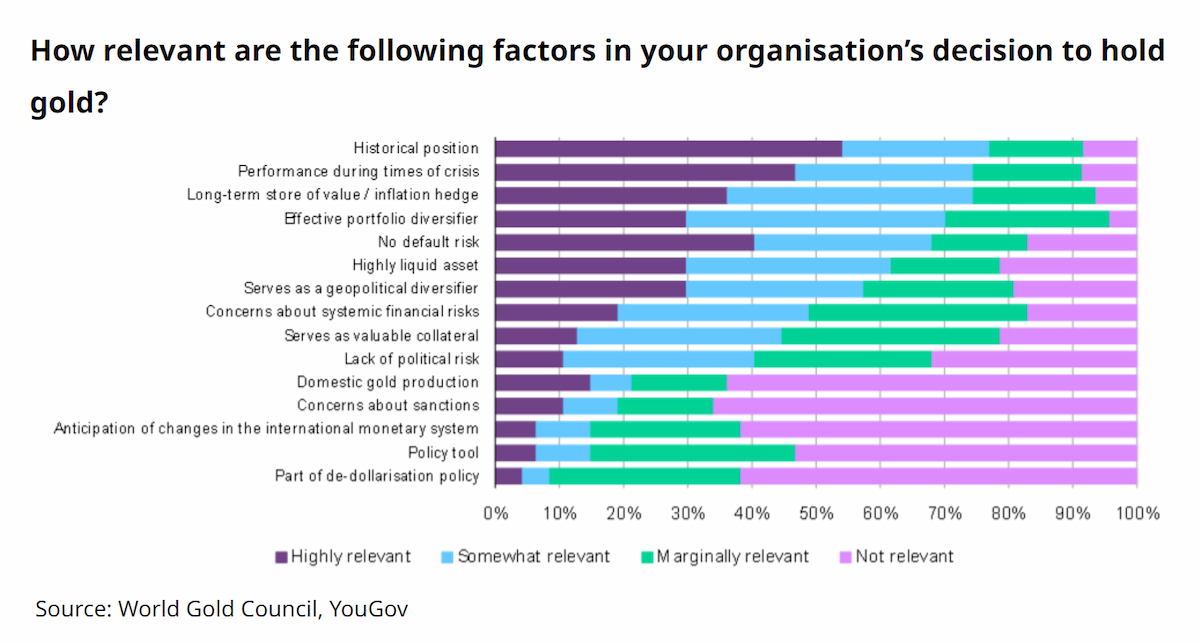
Turning to the question of why central banks continue to increase their gold reserves, Gopaul said the key drivers from the last two years remain in place. “Last year central banks placed great emphasis on gold’s value in crisis response, diversification attributes and store-of-value credentials,” he said. “A few months into 2024 the world seems no less uncertain meaning those reasons for owning gold are as relevant as ever.”