

Digital asset investment products continue to see record inflows thanks to the spot Bitcoin (BTC) exchange-traded funds (ETFs) launched on the U.S. market as last week saw a total of $2.7 billion flow into globally listed funds, bringing the total inflow year-to-date to $10.3 billion.
The significance of the inflows is obvious when compared to the record inflows of 2021, which totaled $10.6 billion for the entire year, whereas the $10.3 billion mark reached last week was achieved in just the first ten weeks of 2024.
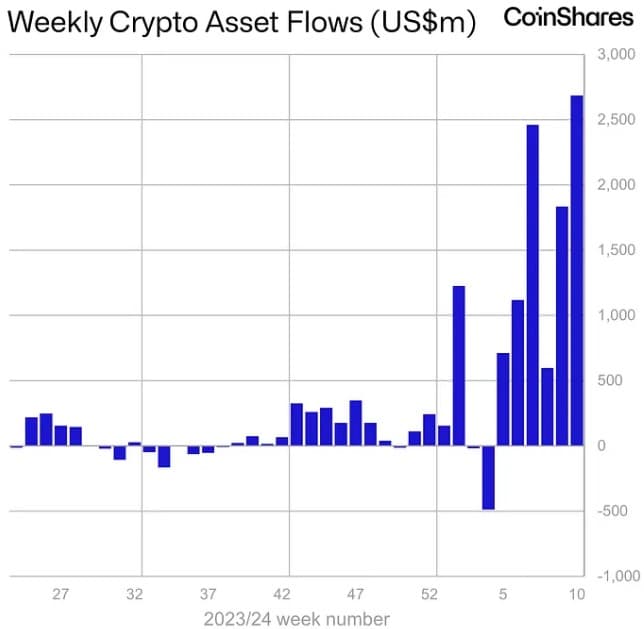
“Weekly trading turnover reached US$43bn for the week, smashing last week’s record US$30bn,” said James Butterfill, Head of Research at CoinShares. “Recent price gains have pushed total assets under management (AuM) to a record high of US$94.4bn, having leapt 14% over the last week and rising 88% so far this year.”
The U.S.-listed ETFs accounted for the bulk of the flows, with $2.8 billion invested into these products, while Switzerland and Brazil recorded inflows of $21 million and $18 million, respectively.
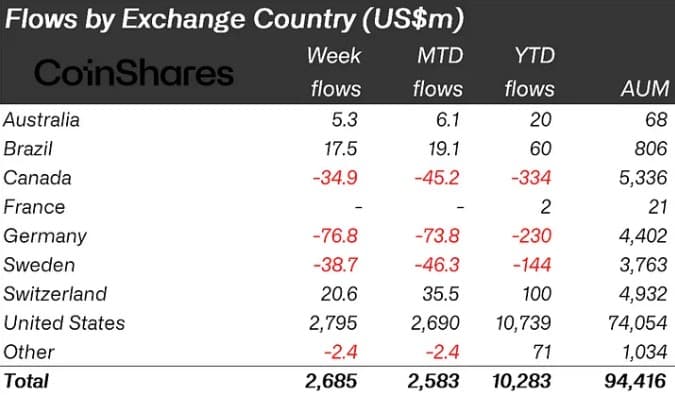
Those flows were slightly offset by outflows in Germany, Sweden and Canada, which saw profit-taking lead to declines of $76.8 million, $38.7 million, and $34.9 million, respectively.
“Bitcoin remained the focus of investors, seeing US$2.6bn inflows with year-to-date inflows now representing 14% of total AuM,” said Butterfill. “Despite recent price rises, the inflows into short Bitcoin continue, seeing a further US$11m last week.”
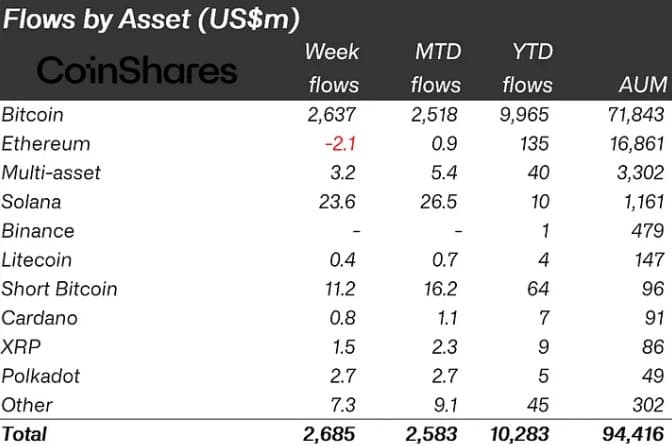
Solana finally recovered from the negative sentiment brought about by its five-hour network outage in February and recorded $24 million in inflows last week, while Ethereum (ETH) saw minor outflows of $2.1 million.
“Other notable inflows were Polkadot, Fantom, Chainlink and Uniswap, seeing US$2.7m, US$2m, US$2m, and US$1.6m, respectively,” Butterfill said. “Blockchain equities saw minor outflows totaling US$2.5m.”
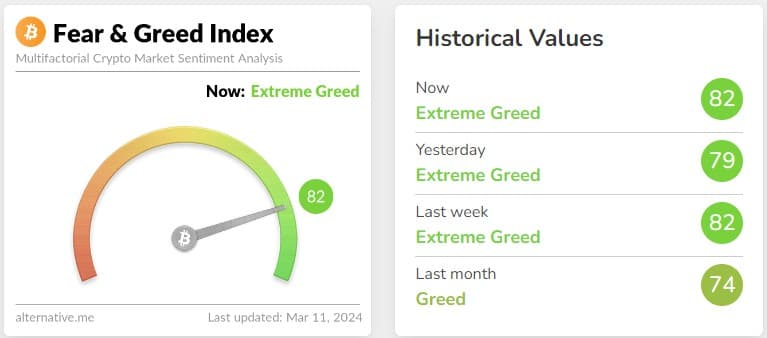
Data provided by Alternative shows that sentiment in the crypto market remains in ‘Extreme Greed’ territory, the level it has been at since Bitcoin hit a new all-time high last Tuesday.
The flows into Bitcoin helped lift its price to a weekly close “at approximately $69,000, marking a notable 9.3% surge from the previous week's closing price of around $61,100,” said Matteo Greco, Research Analyst at Fineqia International
“Throughout the week, BTC demonstrated strong momentum, achieving its all-time high (at the time) of about $70,000. However, overnight, the price of BTC soared, surpassing $71,000 and reaching a new all-time high” on Monday, he said. At the time of writing, BTC is trading at around $72,370.
“The robust price action continues to be fueled by the positive momentum of BTC Spot ETFs,” Greco noted. “Last week, the 10 BTC Spot ETFs witnessed a cumulative net inflow of approximately $2.2 billion, bringing the total net inflow since inception close to $10 billion, currently standing at $9.6 billion.”
“Notably, the nine newly launched ETFs collectively surpassed the $20 billion net inflow milestone, with Blackrock’s BTC ETF alone recording more than $10 billion in net inflow,” he said. “However, it is essential to note that this inflow is partially offset by the continuous outflow recorded by the Grayscale BTC ETF, which was converted from its previous structure as a Trust and has seen about $10.5 billion in outflow since inception.”
Greco said the launch of spot BTC ETFs in the U.S. “has transformed the market structure, providing institutions with convenient, secure, and regulated entry points into the digital assets market.”
“Major financial institutions are now actively involved in holding and trading BTC, catering to high-net-worth clients, thereby enhancing the significance and acceptance of digital assets within the financial industry,” he said. “Following the introduction of ETFs, the market promptly experienced increased liquidity and trading volumes, indicating greater capital efficiency. This is further underscored by the notable increase in the average size of BTC transactions during 2024, reflecting heightened institutional activity in the market.”
He said this shift in market structure is coinciding with a period where the crypto market has historically experienced an uptrend, which is helping to amplify the magnitude of the gains for Bitcoin as institutional investors now play a bigger role.
“Historically, the digital assets market began experiencing an uptrend before halving, continuing for 6-12 months after the halving event,” he said. “However, it has never occurred in the past that BTC surpassed its all-time high before the halving event. With the halving scheduled for five weeks from now, the market is anticipating the expected trend of roughly 6-9 months.”
“This anticipation could be attributed to the launch of ETFs, as market participants began anticipating approval with almost 100% probability at the beginning of Q4 2023,” Greco said. “This coincided with the strong uptrend that propelled BTC price from about $30,000 to the current all-time high of over $70,000. It is possible that BTC Spot ETFs acted as a catalyst, leading to a 6–9-month anticipation compared to previous market cycles.”
He said the Bitcoin dominance chart “reveals a situation consistent with the early stages of a bull run.”
 Bitcoin dominance 1-week chart. Source: TradingView
“BTC dominance remains strong, with BTC outperforming the market in recent quarters while appreciating,” he said. “This is a typical dynamic of an early bull run, which is usually followed in the peak phase by a decrease in dominance, with capital spreading across various altcoins before reaching the cycle's peak.”
“Additionally, macroeconomic conditions, including low inflation and expectations of a 50/100bps cut by the Federal Reserve System (FED), suggest a potentially positive outlook for the digital assets market and risk-on assets in general for 2024, as already suggested by the strong performance not only of the digital assets, but also of risk-on assets in general, with several stocks and indexes in the traditional finance market reaching a new all-time high during the first couple of months in 2024,” Greco concluded.
