

(Kitco News) – Bitcoin (BTC) is in recovery mode on Thursday after three days of selling saw the top crypto decline 9.5% to hit a low of $64,510, a region that has served as a solid resistance level on the uptrend and as support on pullbacks.
Data provided by TradingView shows that after oscillating around $66,000 in trading Wednesday, Thursday saw bulls reverse an early attempt by bears to initiate another leg down to push Bitcoin back above resistance at $67,500, where they now regroup before attempting to run higher.

BTC/USD Chart by TradingView
Excitement for the halving, which is predicted to occur between April 19 - 20, is the main force driving Bitcoin’s price action currently, though most analysts believe the halving is already priced in.
Historically, Bitcoin’s price struggles both in the lead up to and directly following a halving, with the market typically taking 3-6 months to really start ramping up once the quadrennial reduction in new BTC emissions takes place.
Most analysts agree that this cycle will see Bitcoin surpass the highly coveted $100,000 price level, and peak cycle predictions range from $125,000 to $1,000,000. While it's always a challenge to predict how high Bitcoin will go in any cycle, we can use halving data to predict where it will be at the next halving.
Since the last halving, which occurred on May 11, 2020, Bitcoin’s price has increased from $8,500 to its current price of around $67,000, a gain of roughly 680%. Using $67,000 as the price for the 2024 halving, a similar increase over the next four years would put Bitcoin’s price during the 2028 halving at $523,400.
While this can serve as a general estimate, it’s important to note that Bitcoin’s post-halving rallies have seen diminishing returns in each successive cycle. Between its launch and the first halving, Bitcoin went from being valueless to $12.50, an increase of 125,000%. At the 2016 halving, it traded at $650, an increase of 5,100% from 2012. By 2020, it had increased roughly 1,200% to trade near $8,500.
The diminishing returns suggest that Bitcoin could potentially increase roughly 380% between now and the 2028 halving, which would put BTC at $321,600.
For now, traders are focused on the current market and getting Bitcoin above $100,000.
According to market analyst Rekt Capital, we are currently in the second phase of the “three phases of the Bitcoin halving.”
The first phase is the “final pre-halving retrace,” which “tends to occur 28 to 14 days before the Halving event itself (dark blue circle).”
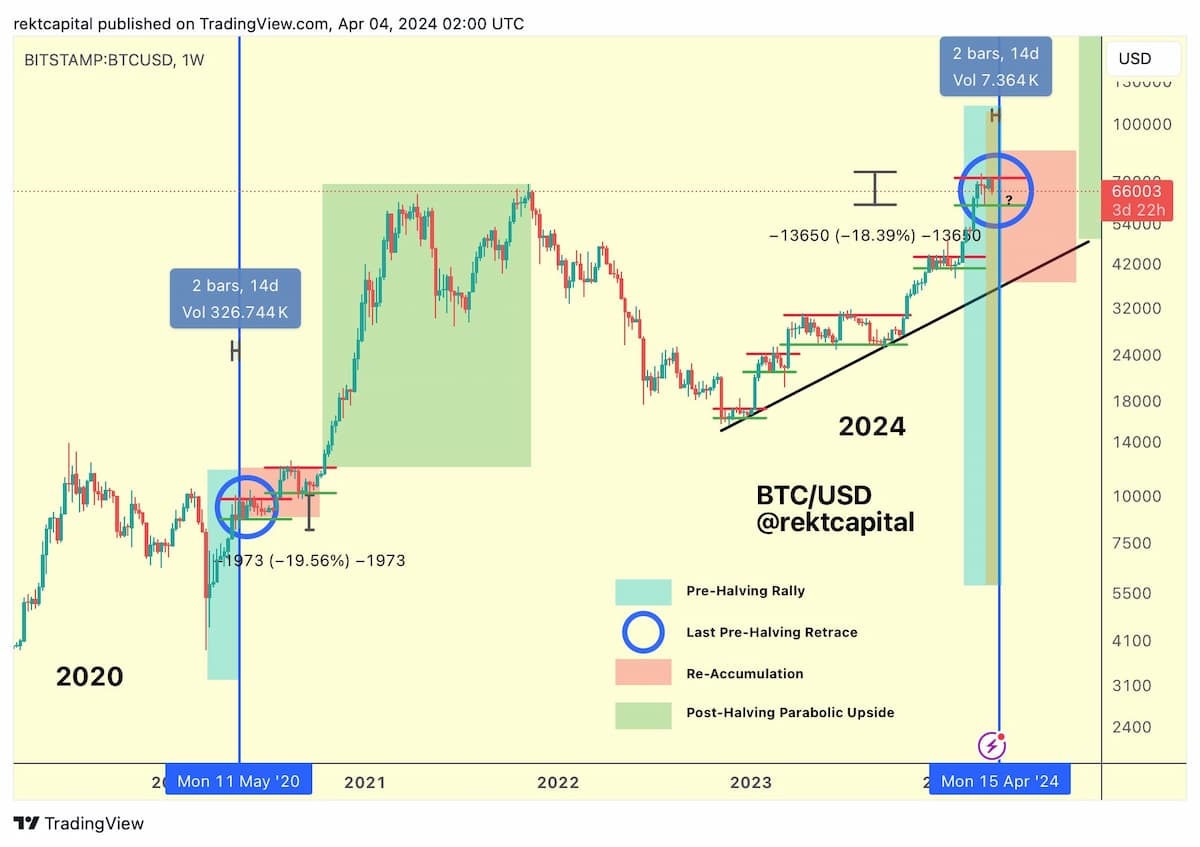
“In 2016, this pre-halving retrace was -38% deep and lasted 3-4 days,” Rekt Capital said. “In 2020, this pre-halving retrace was -20% deep and lasted 56 days (8 weeks).”
“Currently, $BTC is just over 14 days away from the halving, [after pulling] back -18% in total over the past couple of weeks,” he noted. “If the pre-halving retrace bottom is in… BTC would've repeated a lot of qualities from the pre-halving retrace of 2020” since “the most recent retrace was -18% deep and lasted seven days.”
“However, Bitcoin in 2024 also repeated some 2016-like qualities as well,” he added. “Bitcoin began its pre-halving retrace ~30 days before the halving whereas in 2016 Bitcoin began its retrace 28 days before the halving, and as a result, it looks like Bitcoin may be repeating pieces of both 2016 and 2020 pre-halving price tendencies.”
He said pre-halving retraces offer three main benefits. They “offer one final bargain-buying opportunity in the pre-halving period; they form the range low of the future re-accumulation range; and they set up the next phase in the Bitcoin halving cycle: ‘re-accumulation (red box),” he said.
“With the latest rejection at ~$70,000… It's possible that we may now know where the range high of the re-accumulation range may be,” Rekt Capital said. “As a result, it's possible that this pre-halving retrace period has already established the very beginnings of the re-accumulation phase.”
“The beginning of the ‘re-accumulation’ phase occurs once the pre-halving retrace has bottomed,” he said. “In other words, the bottom of the pre-halving retrace historically becomes the bottom of the re-accumulation range (red). It's still uncertain if the pre-halving retrace bottom is in; however, because a pre-halving retrace has occurred already, it’s possible that Bitcoin is slowly transitioning away from its pre-halving retrace phase into its ‘re-accumulation’ phase (red).”
Rekt Capital said that ideally, Bitcoin will “move sideways going into the halving and beyond,” and the “re-accumulation phase can last multiple weeks and even up to 150 days (i.e. five months).”
“Many investors get shaken out in this stage due to boredom, impatience, and disappointment with the lack of major results in their BTC investment in the immediate aftermath of the halving,” he warned. “However, in this cycle, it is the very first time that this re-accumulation range is developing around the new all-time high area. As a result, this re-accumulation range may simply take the shape of a regular sideways range like we've seen throughout the cycle thus far and may not last very long before additional uptrend continuation.”
The final phase is the “Parabolic Uptrend,” Rekt Capital said.
This occurs “Once Bitcoin breaks out from the re-accumulation area breakout into the parabolic uptrend (green),” he said. “It is during this phase Bitcoin experiences accelerated growth into a parabolic uptrend. Historically, this phase has lasted just over a year (~385 days) however with a potential accelerated cycle occurring right now, this figure may get cut in half in this market cycle.”
At the time of writing, Bitcoin trades at $67,615, an increase of 2.6% on the 24-hour chart.
