

(Kitco News) – Thursday’s price action in the crypto market saw a decline in volatility as Bitcoin (BTC) largely consolidated above $70,000 while altcoins traded mixed. The lull in activity comes as traders continue to digest yesterday’s hotter-than-expected CPI report and what it means for interest rates and risk assets moving forward.
Stocks bounced back after Wednesday’s CPI-induced declines, led by the tech sector, which propelled the Nasdaq higher. A cooler-than-expected reading on producer prices was credited with helping to soothe investor worries, leading to a green day for the major indices.
At the closing bell, the S&P and Nasdaq finished higher, up 0.74%, 0.08%, and 1.68%, respectively, while the Dow was flat.
Data provided by TradingView shows that Bitcoin traded in a range between $69,560 and $71,310 on Thursday, with neither the bulls nor bears gaining the upper hand.

BTC/USD Chart by TradingView
At the time of writing, Bitcoin trades at $70,700, an increase of 1.05% on the 24-hour chart.
ETF flows stabilize
The sideways price action for Bitcoin over the past several weeks has coincided with the stabilization of flows into the spot BTC exchange-traded funds (ETF) after they set records for inflows and trading volumes during their first two months of trading.
“The Nine” have recorded multiple days of net outflows lately, but overall, the total assets under management have continued to tick higher. Data provided by Dune Analytics shows that the ETFs have seen a net flow of $12.5 billion since launch, and they currently hold 839k Bitcoins worth approximately $58.9 billion.
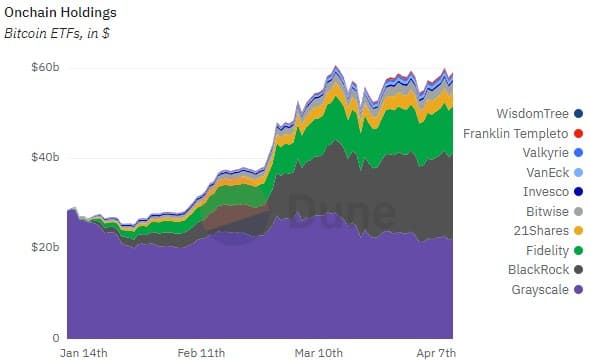
As shown in the chart above, the inflows appear to be consolidating, similar to an asset chart after a major run-up, and according to some analysts, could soon start to climb higher again due to several bullish developments.
This includes the pending launch of multiple spot BTC ETFs in Hong Kong, with some of the products being listed by Chinese investment firms, while Morgan Stanley and UBS are rumored to be working to give their clients access to the ETFs before the end of April.
According to VanEck CEO Jan van Eck, the retail sector has primarily been responsible for inflows into spot Bitcoin ETFs in the U.S., and significant investments from traditional finance (TradFi) players are still on the horizon.
“I was surprised [by the initial success of the ETFs], but I don’t think it’s traditional investors yet. I still think 90% of the flows are retail,” van Eck said while speaking to Cointelegraph at Paris Blockchain Week. “You’ve had some Bitcoin whales and some other institutions move some assets in, but they were already exposed to Bitcoin.”
He added that no U.S. banks have officially approved or allowed their financial advisers to recommend Bitcoin to date, and while the next month could see the arrival of some major institutional investments from banks and traditional firms, the Bitcoin ETF landscape is still in its infancy.
“There’s a lot of maturation to happen,” he said. “A lot of technology will be developed on-chain, so there’s a long way to go.”
As for why the Bitcoin ETFs will help boost adoption rates when investors have long been able to buy Bitcoin directly, van Eck said convenience is a primary factor as investors look to fund managers to handle their entire portfolios.
“Convenience, safety, and affordability,” he said. “You had 2% spreads on many centralized exchange platforms like Coinbase. We have single-digit spreads for the ETFs and no fees or low fees. It’s easier just to do a buy ticket than anything else.”
Van Eck also highlighted the evolving nature of cryptocurrency supporters and the move away from Bitcoin maximalism, which is needed if mass adoption is to be achieved.
“I started looking at Bitcoin. I’m not like super in love with it or anything. I just think that, at times, you really want to have a store of value in your portfolio,” he explained. “And that’s what I care about, people’s investment savings.”
He concluded by saying that the approval of spot BTC ETFs in the U.S. isn’t as big a deal as many have made it out to be, as Bitcoin is a global currency that is still in the early stages of adoption.
“What I’d like to point out is that it’s not the most earth-shattering thing,” he said. “The Bitcoin market is more global and much deeper than just being influenced by the ETFs.” He noted that the sharp rise in BTC price in early April did not occur during U.S. trading hours, which points to the growing influence of Asian markets.
Altcoins trade mixed as traders shuffle positions
The top 200 altcoins were evenly split between winners and losers on Thursday as traders used the lull in trading activity to rebalance their portfolios ahead of what is expected to be a volatile week leading up to the halving, which will occur between April 19 and 20.
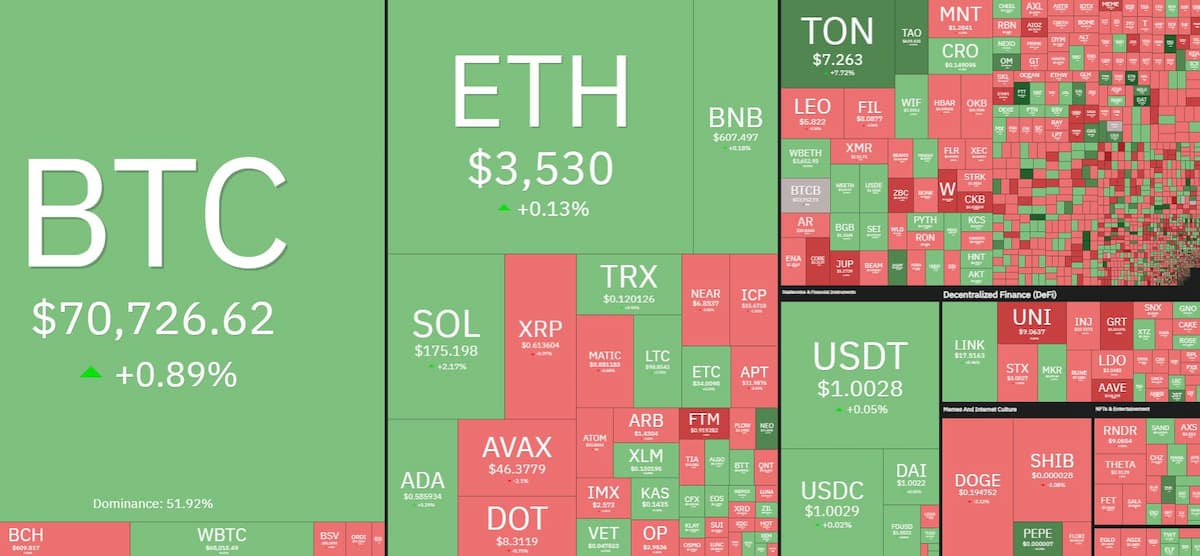
Daily cryptocurrency market performance. Source: Coin360
Bittensor (TAO) led the gainers with an increase of 15.3% after the token was listed on Binance, followed by a 12.5% increase for MANTRA (OM), and a 10.3% gain for Neo (NEO). Nervos Network (CKB) fell 13.7% to lead the losers, while Saga (SAGA) lost 13.6%, and Uniswap (UNI) declined by 11.5% in the wake of receiving a Wells notice from the SEC.
The overall cryptocurrency market cap now stands at $2.62 trillion, and Bitcoin’s dominance rate is 53%.
