

(Kitco News) – While equity markets at least managed to regain neutral footing after yesterday’s losses, crypto proponents are still waiting for digital assets to decide whether to enter the halving with a bang or with a whimper. The $62,000 area has emerged as a watershed for Bitcoin (BTC), with King Crypto repeatedly bouncing off support near that level before recovering, only to fall back to support once again.
Bitcoin could break either way
Data provided by TradingView shows that Bitcoin fell to the $61,700 area three times during Tuesday’s trading. While this support level has held to date, a worrying trend saw BTC make lower highs throughout the session.
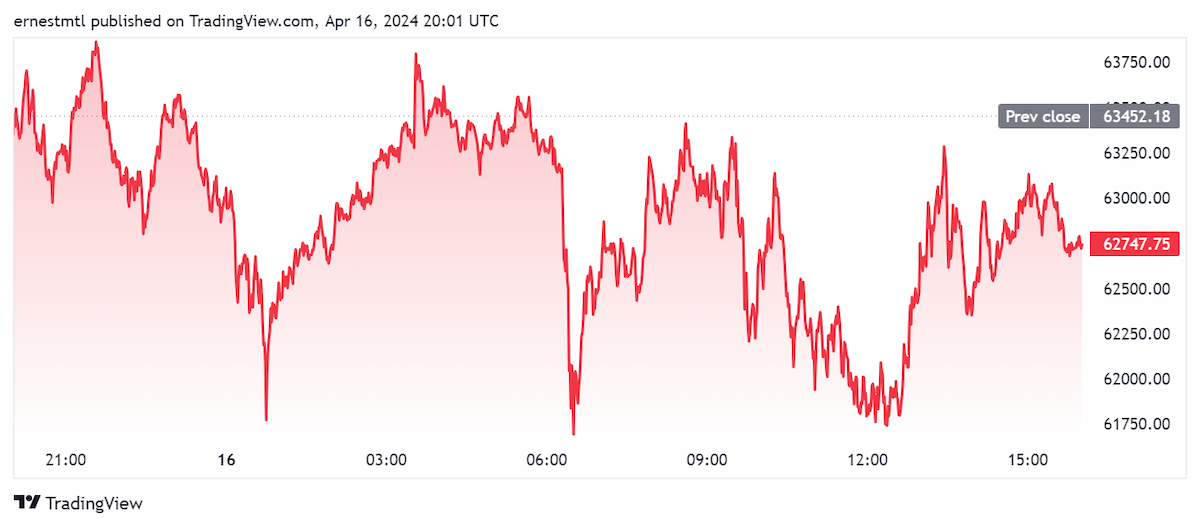
BTC/USD Chart by TradingView
At the time of writing, Bitcoin trades at $62,747.75, a decrease of 1.10% on the 24-hour chart.
Equities fight to a draw
Stocks pulled out of their own slide on Tuesday, but none of the three benchmark U.S. indices were able to muster any positive momentum after Federal Reserve Chair Jerome Powell rained on any possible rally when he said rate cuts were indeed receding.
At the closing bell, the S&P and Nasdaq finished marginally lower, down 0.21% and 0.12% respectively, while the Dow eked out a 0.17% gain.
BTC on exchanges could run dry by January
According to a new report from crypto exchange Bybit, the recent addition of U.S. spot Bitcoin ETFs makes this week’s halving unique and unprecedented, and the final outcome could be no Bitcoin available on any exchange by January 2025.
“Bitcoin began to recover in early October last year (2023), approximately six months before the coming April 2024 halving,” Bybit said. “However, it was also in October that large traditional finance giants began applying to run Bitcoin Spot ETFs.”
Since the ETFs began trading, the Bitcoin reserves of all centralized exchanges have been depleting faster than in any other cycle, and this new demand is expected to continue as TradFi fires up its sales forces and markets the funds to capital-rich retirees and other investors.
“With only 2 million bitcoins left, if we assume a daily inflow of $500 million to Bitcoin Spot ETFs, the equivalent of around 7,142 bitcoins will leave exchange reserves daily, suggesting that it will only take nine months to consume all of the remaining reserves,” the analysts wrote.
“Bitcoin is seeing early signs of a short squeeze,” they wrote. “Post-halving, the supply squeeze will ostensibly be worse. Investors tend to HODL their Bitcoin positions if they’re being held in cold or decentralized wallets. The supply for Bitcoin Spot ETFs is usually from centralized exchanges (CEXs), in which profitable investors realize their profitable positions or successful miners sell their recent rewards.”
“Since mining rewards will be cut in half after the halving, the sell-side supply flowing into the CEXs will be reduced,” the analysts said.
The Bybit analysts also pointed to data showing that miners are selling off their reserves in the run-up to this halving at a much faster rate than they did before the 2020 halving. This too could serve to magnify the supply crunch post-halving and could result in rapid depletion of CEX reserves.
“Meanwhile, the Web 2.0 publicity will center around the Bitcoin halving, leading to FOMO-driven behavior on the part of new investors,” they said.
Bybit concluded with some advice based on their analysis.
“[I]t’s wise to take profits half a year after the halving, toward the end of 2024,” they wrote. “The past cycle indicated a twelve-month window after the halving. And yet, we observed more forerunning before the halving, which limits the room for gains post-halving.”
Altcoins follow the leader lower
The majority of the top 100 altcoins declined in value once again on Tuesday as the continued decline of Bitcoin has soured most market participants on digital assets.
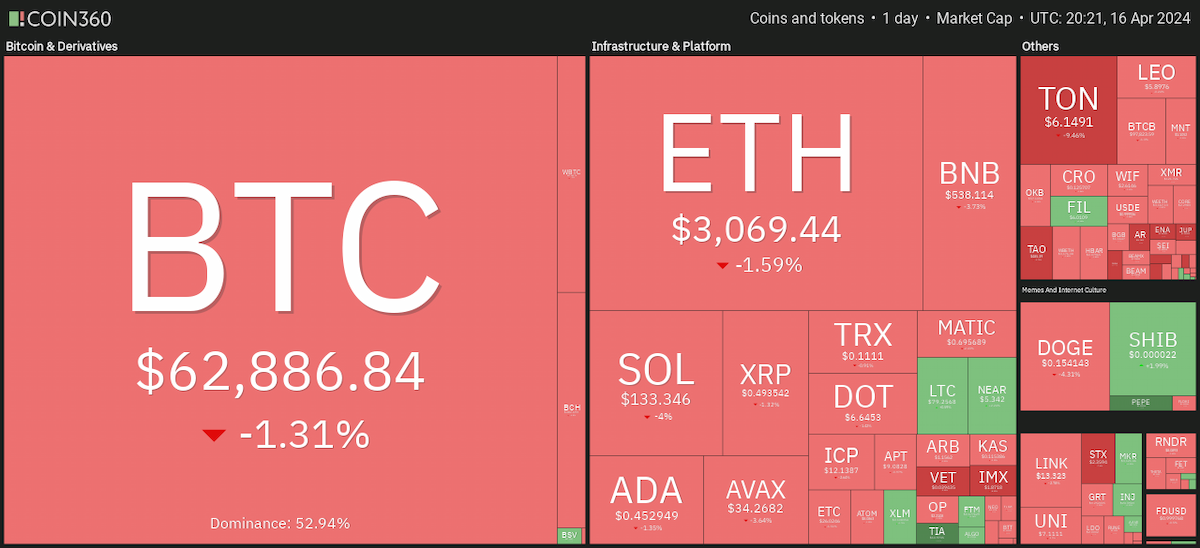
Daily cryptocurrency market performance. Source: Coin360
Celestia (TIA) led the gainers with an increase of 14.50% on the 24-hour chart, followed by memecoin Pepe (PEPE), which rose 6.14%, and Fantom (FTM), which gained 4.05%.
Pendle (PENDLE) led the losers with a decline of -10.98%, followed by a -10.41% drop for Ondo (ONDO) and a decline of -8.77% for Ethena (ENA).
The overall cryptocurrency market cap now stands at $2.29 trillion, and Bitcoin’s dominance rate is 53.88%.
