

(Kitco News) – The crypto market was a mixed bag performance-wise on Tuesday as Bitcoin (BTC) consolidated above $66,000 while some altcoins spiked higher as traders rotated their positions, meaning other tokens fell as they were sold.
“Bitcoin has recently bounced off a rising trend line and is now attempting to surpass a short-term resistance level at approximately $67,500,” said analysts at Secure Digital Markets. “The release of this morning's flash manufacturing and services PMI data catalyzed a surge in risk assets, as indications of a market softening emerge.”
“Moreover, Bitcoin's 200-day moving average – a critical measure of long-term trends – is nearing an all-time high, challenging its previous peak of $49,452 recorded in February 2022,” they added. “Historically, Bitcoin prices have rallied when the average ascended to new heights; however, it is crucial to remember that historical performance is not indicative of future results.”
Data provided by TradingView shows that Bitcoin traded in a range between $65,830 and $67,241 on Tuesday, with bulls and bears evenly matched in strength following Friday’s halving.

BTC/USD Chart by TradingView
Stocks climbed higher as investors digested positive earnings reports from GM and Spotify, with the market now eagerly awaiting the report from Tesla, whose quarterly results are due after the market close.
At the closing bell, the S&P, Dow, and Nasdaq finished higher, 1.20%, 0.69%, and 1.59%, respectively. The DXY fell 0.4% on the day and trades at 105.7 at the time of writing, while gold dipped 1.5% in early trading but recovered for a small loss of 0.2% on the session.
Short-term weakness, long-term growth
"In the short term, [Bitcoin’s price action following] the halving tends to be pretty muted,” said Matt Ballensweig, Head of Go Network at BitGo, in a note to Kitco Crypto.
“The delta of newly mined Bitcoin per day post-halving is 450 BTC, hardly enough to impact daily liquidity or immediate price action,” he added. “In fact, miners might even need to sell some of their existing BTC inventory to offset for the daily revenue reduction, leading to increased sell pressure in the days/weeks post-event.”
“That being said, in the long term, the day-over-day reduced supply adds up to 164k BTC ($12B) per year, which when combined with the net new demand for Bitcoin coming from the ETFs, can lead to significant price appreciation longer term,” Ballensweig said. “The data confirms this as the average return of Bitcoin one month following all historical halvings is only 1.67%, whereas the average return of Bitcoin one year following these halving events is a whopping 3,211%, highlighting the difference in impact between short-term and long-term periods of time."
Steven Lubka, Head of Private Clients at Swan Bitcoin, agreed with Ballensweig that “the impact of the halving is more pronounced mid to long-term.”
“At current prices, it amounts to about $30 million dollars a day not being sold, which may not seem significant daily but adds up significantly over time,” he said. “For instance, over a month, that's a billion dollars, and over a year, $12 billion.”
“This reduction in supply issuance creates a mechanical impact that drives up price,” Lubka noted. “Additionally, the halving serves as built-in marketing for Bitcoin, attracting new users and creating a reflexive social layer that further bolsters price through increased demand. Ultimately, it's the combination of guaranteed supply reduction and the social impact that fuels long-term bullishness in Bitcoin.”
The combination of demand from spot Bitcoin ETFs and the reduction in new Bitcoin supply brought about by the halving significantly enhances the upside potential for Bitcoin’s price, he added.
“When you have an increase in buy pressure at the same time, you have a decrease in
sell pressure. It's not one plus one equals two, it's one plus one equals four,” Lubka said. “And so I think, seeing the ETFs at the same time that we had the halving this year, it wouldn't surprise me at all to see an outsized impact relative to the past.”
“The ETF story is less than 5% done and has not fully played out,” he added. “They have not fully deployed their marketing budgets, they have not completed all the conversations they've had, they have not completed their addition of these ETFs to other portfolios and other products that fidelity and BlackRock serve. Most financial firms still can't buy the ETFs, they're in non-solicitation clauses, advisors can't talk about it, and you can't own it in an advisory account. This story is not done. What is the next catalyst? It's the ETFs.”
As the market awaits the next catalyst to get crypto prices back on the uptrend, MN Trading founder Michaël van de Poppe said that any pullback in Bitcoin below $60,000 is a “massive buying opportunity.”
#Bitcoin is still consolidating within the range, through which this is now more than six weeks.
Boredom has come back into the markets, but anything sub $60K is a massive buy opportunity. pic.twitter.com/GgxjLUfSdX— Michaël van de Poppe (@CryptoMichNL) April 23, 2024
Double-digit altcoin gains
The top 200 altcoins were evenly split between winners and losers on Tuesday, with seven tokens recording double-digit gains.
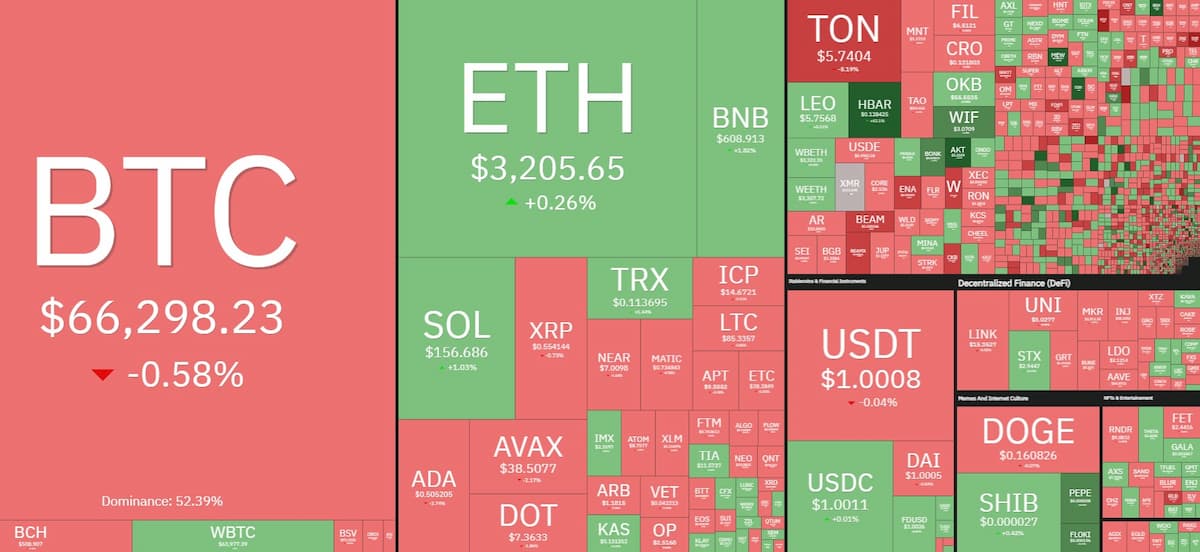
Daily cryptocurrency market performance. Source: Coin360
Hedera (HBAR) climbed 40.4% to lead the gainers, followed by an increase of 31.9% for cat in a dogs world (MEW), and a gain of 24.2% for Akash Network. Stablecoin project Ethena (ENA) led the losers with a decline of 7.7%, while Ontology (ONT) fell 7.6%, and Jito (JTO) lost 5.8%.
The overall cryptocurrency market cap now stands at $2.45 trillion, and Bitcoin’s dominance rate is 53.4%.
