

(Kitco News) – Bitcoin (BTC) continues to defy the precedent set by past cycles as the top crypto consolidated above $66,000 in early trading on Tuesday and has yet to see a sharp post-halving sell-off.
The resilience is partly due to continued demand from spot BTC exchange-traded funds (ETFs), which returned to positive inflows on Friday after five straight days of minor outflows.
According to a report from Bitfinex, the reduction in block rewards from 6.25 BTC to 3.125 BTC means the notional value of the total number of new coins added to the supply each day could drop to $30 million, which is five times less than the average daily demand coming from the U.S.-listed spot ETFs.
"With the daily issuance rate declining post-halving, we estimate that the new supply added to the market (new BTC mined) would amount to approximately $40-$50 million in USD-notional terms based on issuance trends,” the report said. “It is expected that this could possibly drop over time to $30 million per day, including active and dormant supply as well as miner selling, especially as smaller miner operations are forced to shut down shop.”
"The average daily net inflows from spot Bitcoin ETFs dwarf that number at over $150 million, even though flows have moderated and even turned net negative over recent weeks," the analysts added.
And it's not just the reduced supply of new Bitcoins that the market has to deal with, as “Current on-chain data indicates that Bitcoin exchange outflows are reaching peaks not seen since January 2023, suggesting that many investors are moving their holdings to cold storage in anticipation of price increases," the Bitfinex analysts said.
"Meanwhile, the active selling by long-term holders has not precipitated the typical pre-halving price drop yet, indicating a robust absorption of this selling pressure by new market entrants," they added.
For this reason, Bitcoin has a solid level of support at around $66,000, and at the time of writing, trades at $66,805, an increase of 1.45% on the 24-hour chart.
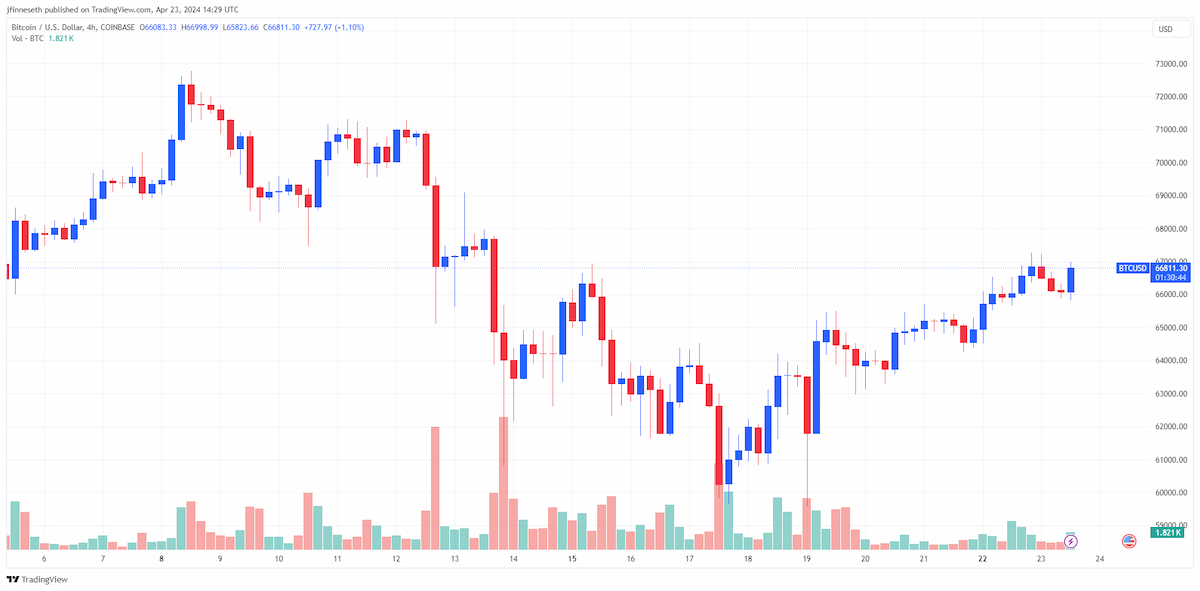
BTC/USD Chart by TradingView
The evolution of Bitcoin mining
“Last week saw stagnant demand for BTC ETFs, continuing a short-term trend observed over the past four weeks with neutral flow in these financial products,” said Matteo Greco, Research Analyst at Fineqia International. “ETFs with BTC as the underlying asset experienced approximately $205 million in outflows during the week, continuing a slightly negative net flow from the previous week.”
“This marks the first instance of two consecutive weeks of net outflows since the launch of BTC ETFs,” Greco noted. “Overall demand since inception remains high, with about $12.3 billion in net inflows and $226 billion in total trading volume, averaging $3.2 billion per day.”
While the halving effectively reduced miners' revenues by half, data provided by CoinWarz shows that the Bitcoin network hash rate has actually increased in the days following the halving, hitting a new record high of 801.67 exhashes on Tuesday morning.
“The resilience of Bitcoin miners and the network is attributable to the evolution of mining businesses,” Greco said. “Initially, when Bitcoin started, block rewards were set at 50 BTC per block, requiring minimal computational power. However, as BTC gained mainstream attention and mining competition intensified, miners began deploying more efficient hardware to maintain profitability despite reduced rewards from halving events.”
“The third halving, which reduced block rewards to 6.25 BTC, marked a significant shift in the mining industry,” he added. “Mining operations transformed into proper businesses, implementing strategies such as hedging, selling excess energy, and adopting renewable energy sources to enhance mining efficiency and sustainability.”
Greco said that now, “mining businesses operate with structured and sophisticated business plans, constantly upgrading hardware for increased efficiency and seeking renewable energy sources to ensure cost-effective and sustainable mining operations.”
“These initiatives collectively contribute to the network's strength and resilience through each halving event, despite diminishing rewards and rising total hashrate,” he added.
If the hashrate does happen to fall in the weeks ahead, Greco said that “shouldn't be interpreted as a sign of stress within the mining industry but rather as a typical response to the event,” as it’s “common to observe a short-term decrease in the total hashrate as miners adjust their operations.”
“Over time, the hashrate is expected to rebound as miners enhance efficiency and competition intensifies,” he concluded. “A higher hashrate enhances network security, as the computational power required for a chain attack increases, making such attacks more costly.”
