
(Kitco News) - The gold market is unable to find any significant bullish traction even as the U.S. economy saw a disappointing start to the year.
Thursday, the Bureau of Economic Analysis said the advanced reading of Q1 GDP showed that the economy grew 1.6% in the first three months of the new year, down from 3.4% reported in the fourth quarter.
The data significantly missed expectations as economists were looking for growth of 2.5%.
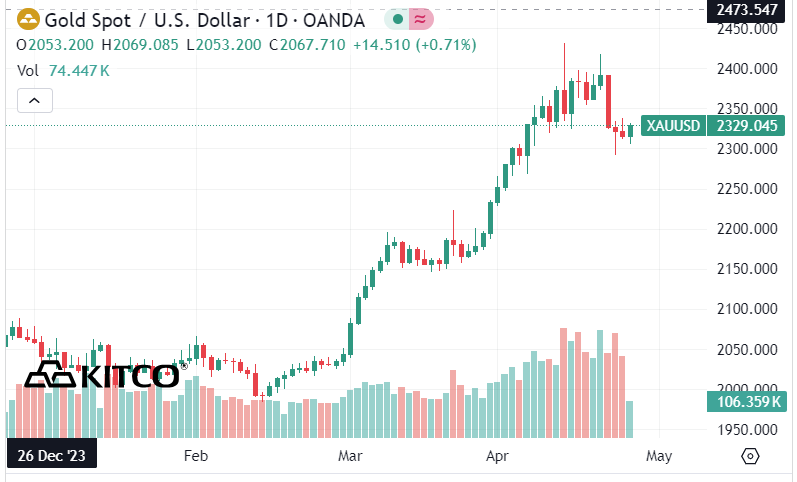
The gold market is seeing little reaction to the disappointing data. June gold futures last traded at $2,338.10 an ounce, roughly unchanged on the day. The gold market continues to consolidate after falling from its recent record highs above $2,400 an ounce.
According to some analysts, gold investors could be focused on hotter-than-expected inflation data. The report said that the Price Index for the first quarter increased 3.1%, up from 1.9% reported in the fourth quarter.
At the same time the Personal Consumption Expenditures increased 3.4%, compared with 1.8% seen in the last quarter. Excluding food and energy prices, core PCE increased 3.7%, compared to 2.0% reported in the fourth quarter.
“Inventories may help to explain some of the delta as the March wholesale inventory data released alongside this report fell 0.4%. Ultimately though, you take it at face value at 1.6% annualized growth isn't the kind of thing that's going to spur demand-driven inflation,” said Adam Button, head of currency strategy at Forexlive.com, in a note. “With that, I think the market is too focused on tomorrow's PCE report here and no focused enough on a slowing economy and what it will mean for PCE report in the months beyond.”
Paul Ashworth, Chief North American Economist at Capital Economics, said in a note that although GPD showed the weakest growth in nearly two years, there is still underlying momentum in the economy.
“The strong 6.1% gain in final sales to private domestic purchasers illustrates that there is still a lot of positive underlying momentum,” he said. “Consumption growth was a solid 2.5%, although the slowdown in real personal disposable income growth to only 1.1% suggests it may slow further, particularly with the saving rate down to only 3.6%.”
However, Ashworth said that investors could end up paying more attention to the latest inflation data.
