
(Kitco News) – The post-halving weakness from Bitcoin (BTC) led to the first recorded day of outflows from BlackRock’s iShares Bitcoin Trust (IBIT) on Wednesday as the fund saw $37 million pulled from its coffers as Bitcoin’s price sank below $60,000.
And it wasn’t just IBIT that saw a drawdown as data provided by Farside shows that nine of the listed funds recorded outflows yesterday, led by the Fidelity Wise Origin Bitcoin Fund (FBTC), which declined by $191.1 million. The Grayscale Bitcoin Trust took the second spot with outflows of $167.4 million.
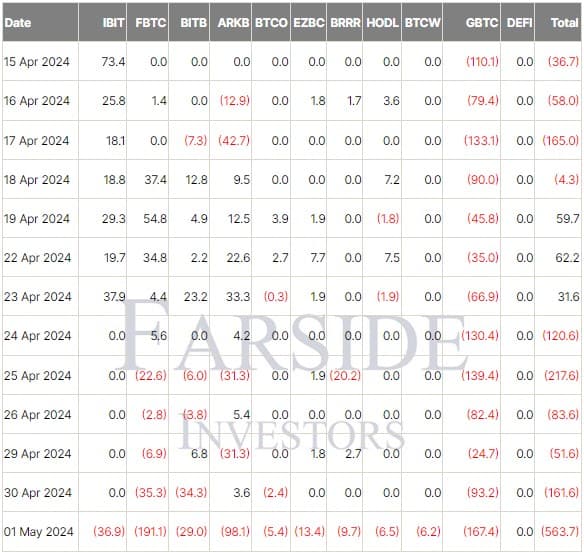
The only exception to the drawdown was the Hashdex Bitcoin ETF (DEFI), which has thus far recorded zero inflows.
Wednesday represented the largest single outflow day for the U.S.-based spot Bitcoin ETFs since they launched in January, with a total of $563.7 million pulled from the funds. The drawdown coincided with a 10.7% pullback in Bitcoin’s price over the last week.
The decline in assets under management by the ETF issuers prompted many crypto naysayers to declare that the top of the bull market is in, and it's only down from here.
Despite all the hype around the #BitcoinETFs, Bitcoin is clearly in a bear market. It's down 23% in dollars, but 33% priced in #gold, with one #Bitcoin now worth fewer than 25 ounces. Here's the updated chart I've been posting. Turn out the lights #HODLers, the party is over. pic.twitter.com/tebMsUSIrs
— Peter Schiff (@PeterSchiff) May 1, 2024
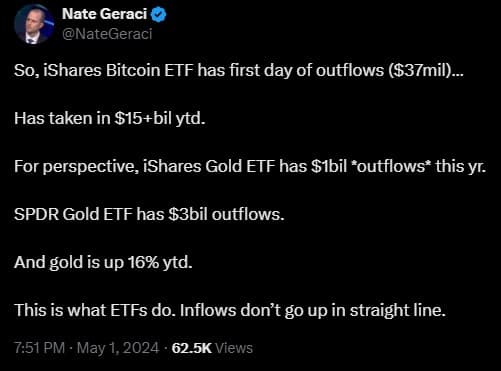
But Nate Geraci, president of The ETF Store, helped add a little perspective for gold bulls and crypto skeptics like Schiff, noting that the iShares Gold ETF and SPDR Gold ETFs have had $1 billion and $3 billion in outflows so far this year, despite gold’s price rising 16% year-to-date.
And according to Robert Mitchnick, BlackRock’s head of digital assets, the streak of outflows could soon come to an end as a new wave of investors, including pension funds, could soon enter the Bitcoin ETF fray.
Mitchnick said the coming months could see financial institutions such as sovereign wealth funds, pension funds, and endowments start to trade in the spot ETFs as BlackRock has seen “a re-initiation of the discussion around Bitcoin,” which has led to discussions about the proper amount of exposure from a portfolio construction perspective.
“Many of these interested firms – whether we're talking about pensions, endowments, sovereign wealth funds, insurers, other asset managers, family offices – are having ongoing diligence and research conversations, and we're playing a role from an education perspective,” Mitchnick said, adding that BlackRock has been talking about Bitcoin with these sorts of institutions for several years.
Bitcoin also stands to benefit from inflows into ETFs listed in other jurisdictions, including Hong Kong, which launched three BTC ETFs and three Ether (ETH) ETFs on Tuesday. After some initial confusion and low inflow reports, Bloomberg Senior ETF analyst Eric Balchunas said the products recorded $292 million worth of inflows on day one.
“We just put out [a] note with final data (which doesn't come in as fast as the U.S.),” Balchunas tweeted on Thursday. “In short, HK saw $292m in assets on Day One (we predicted $1b in two years so way ahead of schedule but corrections can derail trajectories as we are seeing in the U.S.).
“Ether ETFs grabbed 15% of [the] pie and size appeared to matter more than lower fees in attracting investors on day one,” Balchunas added. “The ChinaAMC Bitcoin ETF (3042 HK), which has higher fees, led inflows with $124 million, while the Harvest Bitcoin Spot ETF (3439 HK) picked up $63 million and the Bosera Hashkey Bitcoin ETF (3008 HK) took in $61 million.”
While many derided the inflows into the Hong Kong ETFs as a “nothingburger” – especially since early reports suggested that there was only $11.19 million worth of inflows between all six of the new ETFs – the updated figures provided by Balchunas indicate that the ETFs have been a success.
To be clear. By any reasonable *relative* measure for the launch of these ETFs -- they were a massive success for the HK market
It's just that some were trying to look at what happened in the US and equate that in some way to the HK ETF market on an almost *absolute* basis https://t.co/B2GKmr7L5T— James Seyffart (@JSeyff) April 30, 2024
“Hong Kong ETFs opened to a launch that would be considered successful in terms of the Hong Kong market but is tiny compared to the US launch,” said Steven Lubka, Head of Private Clients at Swan Bitcoin, in a note to Kitco Crypto. “They have been robustly successful in attracting AUM via in-kind creation but trading volume is more muted. It is expected that in-kind creations are due to existing Bitcoin holders seeking the ability to borrow against their assets.”
For now, all eyes are fixed on Thursday flows for U.S. listed spot Bitcoin ETFs, with investors waiting to see if the streak of outflows will end as BTC price looks to recover back above $60,000.
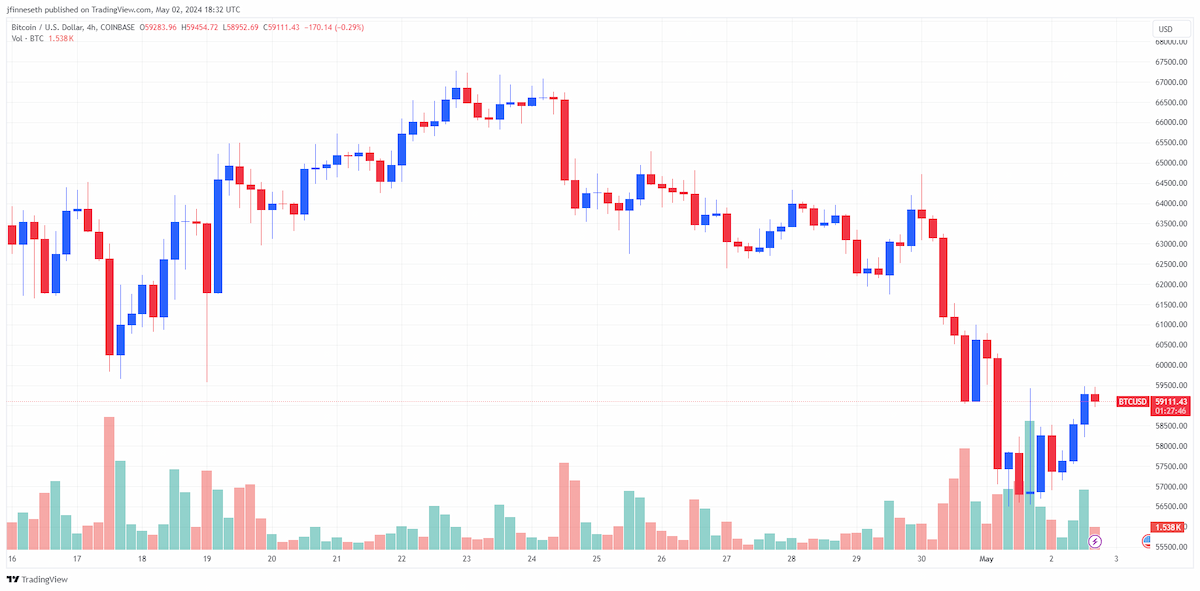
BTC/USD Chart by TradingView
“Bitcoin is currently positioned in oversold territory, hinting at a potential rebound as it approaches a 30 reading on the RSI indicator—a classic sign of a recovery onset,” said analysts at Secure Digital Markets. “The cryptocurrency has also closely approached the 20-week moving average, underscoring potential short-term support.”
“As for Bitcoin's volatility, it continues to decline as the asset matures,” they added. “Fidelity reports that Bitcoin's volatility has dipped to new annual lows, now exhibiting less fluctuation than Netflix over the past two years. In fact, Bitcoin is currently less volatile than 33 companies within the S&P 500, and as recently as October 2023, it showed less volatility than 92 stocks in the index, based on 90-day realized historical volatility.”
