

(Kitco News) – The crypto market ended the week with more choppy price action as Bitcoin (BTC) continued to consolidate between $60,000 and $65,000, with flash crashes and unexpected surges keeping derivatives traders guessing as to what comes next.
Stocks were mixed but mostly positive, with the Dow managing to close its eighth straight session with gains, finishing up 0.32%, while the S&P climbed 0.16%, and the Nasdaq was flat.
“The S&P 500 has broken past the 5,200 mark for the first time since early April, fueled by increasing optimism after the Federal Reserve suggested that a rate hike might not be forthcoming,” said analysts at Secure Digital Markets. “This, along with a strong earnings season and softer labor data, has bolstered investor confidence in the equity markets.”
A pullback in the Dollar index (DXY) also provided a boost to markets, according to analysts at Bitfinex.
"The DXY hit a 6-month peak around 106.48 on May 1st before declining 1.85% from the high after the FOMC meeting last week, when the US Federal Reserve took a decidedly dovish stance and announced an upcoming reduction in quantitative tightening (QT),” the analysts said.
“Non-Farms Payroll data within the same week, signaled a weaker job market, further accelerating the decline in the dollar while also propelling a move higher across all risk assets including Bitcoin and the US equities market,” they added. “The reason behind this is that weaker-than-expected job data may lead to concerns about economic slowdown, which can increase the likelihood of interest rate cuts by the Federal Reserve.”
“Lower interest rates or the expectation of rate cuts can diminish the yield on investments in US dollars, making the dollar less attractive and potentially weakening the DXY,” the analysts noted. “The dollar's rise had been strongly impacting the ascent of risk assets and can be correlated with Bitcoin weakness (not the cause behind it but correlation is evident) but we believe sustained strength and a reclaim of range lows on BTC post-FOMC and job market data and the simultaneous weakness in the dollar is a sign of a new regime which would set us up for a very bullish Q3-4 for Bitcoin.”
That said, they warned that they “expect the market to remain uncertain over the short-term in a low volatility environment till the actual tapering of QT takes place in June.”
Data provided by TradingView shows that Bitcoin experienced a sharp selloff near midday on Friday that dropped the top crypto from $63,000 to a low of $60,155, and it has been consolidating below $61,000 since.
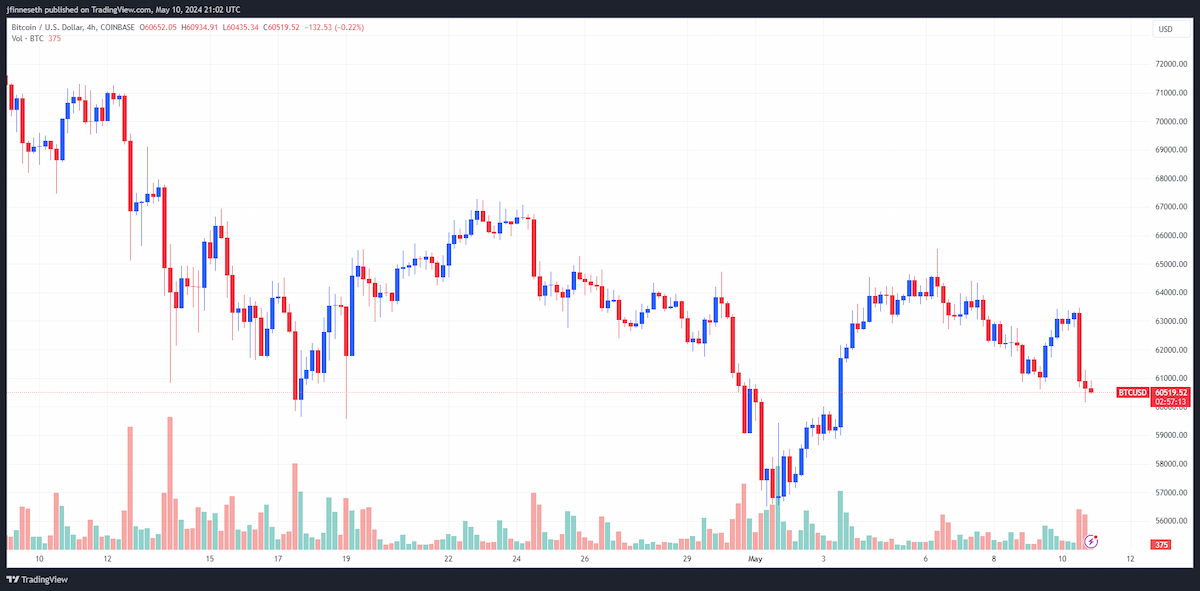
BTC/USD Chart by TradingView
At the time of writing, BTC trades at $504, a decrease of 3.55% on the 24-hour chart.
Short-term weakness expected
“We’ve been ranging between ~60k to ~64k for the last few weeks and the overall trend seems to be consolidation with a tilt downwards,” said Chris Yin, the CEO and Co-founder of Plume Network. “So in the short term, we’ll see, but Bitcoin could very well continue to slide for a bit, which is natural. After BTC halvings and after several months of up-only price action, it’s natural to see a bit of a cool off, especially with the Fed not yet slashing interest rates.”
Yin said overhyped expectations for rate cuts mean “the market is a bit ahead of reality, so naturally, there will be some pullback. In addition, global macro instability is also an issue” amid a rising number of global conflicts, “which leads to trepidation and a more wait-and-see approach. Not to mention all of the wells notices that Gary [Gensler] continues to spray out randomly across the crypto landscape.”
“Another thing that is different this time around is we have the BTC ETF,” he added. ETF flow data shows “that things have cooled off the last few weeks and even some net outflows some weeks, which signal weakness in demand,” which Yin said “could very well [lead to] further downside for a bit.”
“But if you zoom out a little bit, you can see historically after halvings we chop around the same range for up to 3 months, and then after that, we begin to have stronger price action to the upside,” he noted.
Yin added that “Open Interest has also been declining for the last few weeks, which signals the same thing – traders are less bullish than before, although still in the positive. This just means there are less longs open than before, signaling that there is some trepidation in the market although the sentiment is still largely positive.”
He said that what people really need to watch is the macro environment.
“First, we are waiting for the economic data to improve and signal rate cuts,” he said. “Inflation has been stubbornly high, so when it cools off, Jerome Powell can finally slash rates. The minute that happens we will see a reversal across all of these indicators – BTC ETF inflows will come back, traders will feel comfortable going risk on again, and prices will go up.”
“In tandem, the U.S. election coming up in November will be a big indicator as Trump has been signaling that he is positive on crypto vs. the Biden administration, which is clearly very negative” on the asset class. “So if Trump wins, we go up and if Biden looks like he’s winning, things will be a bit more reserved.”
Altcoins slide into the red
Most altcoins in the top 200 followed Bitcoin’s lead lower, though roughly two dozen managed to sidestep the sell-off and record gains on Friday.
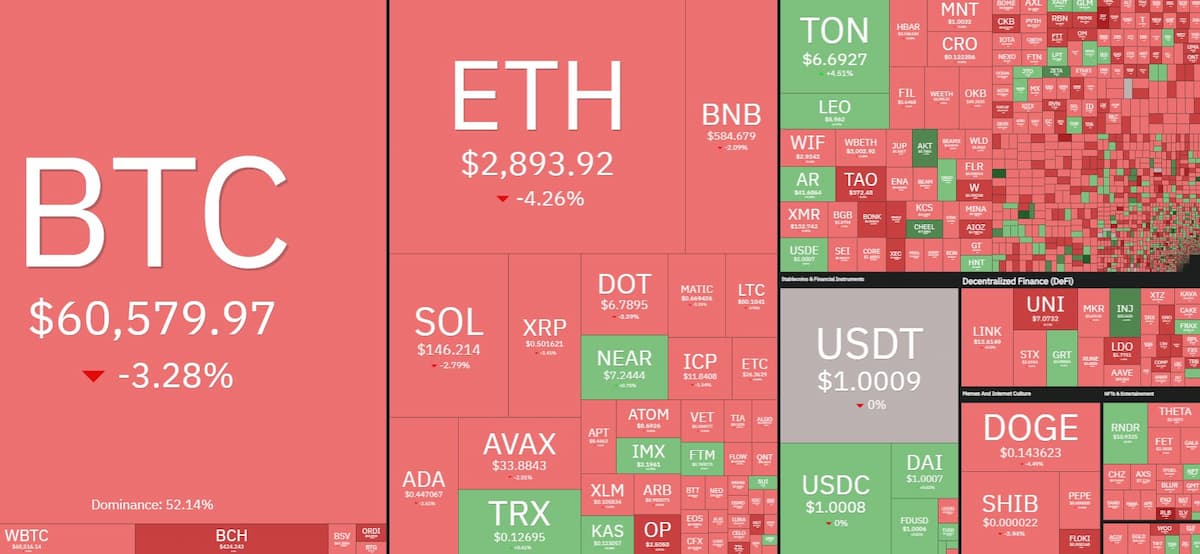
Daily cryptocurrency market performance. Source: Coin360
Akash Network (AKT) was the top performer, gaining 14.6% to trade at $5.93, followed by an increase of 6.4% for Jito (JTO), and a gain of 5.3% for ZetaChain (ZETA). ssv.network (SSV) was the biggest loser, falling 17.5%, while cat in a dogs world (MEW) lost 11.6%, and AIOZ Network (AIOZ) fell 8.2%.
The overall cryptocurrency market cap now stands at $2.25 trillion, and Bitcoin’s dominance rate is 53.2%.
