
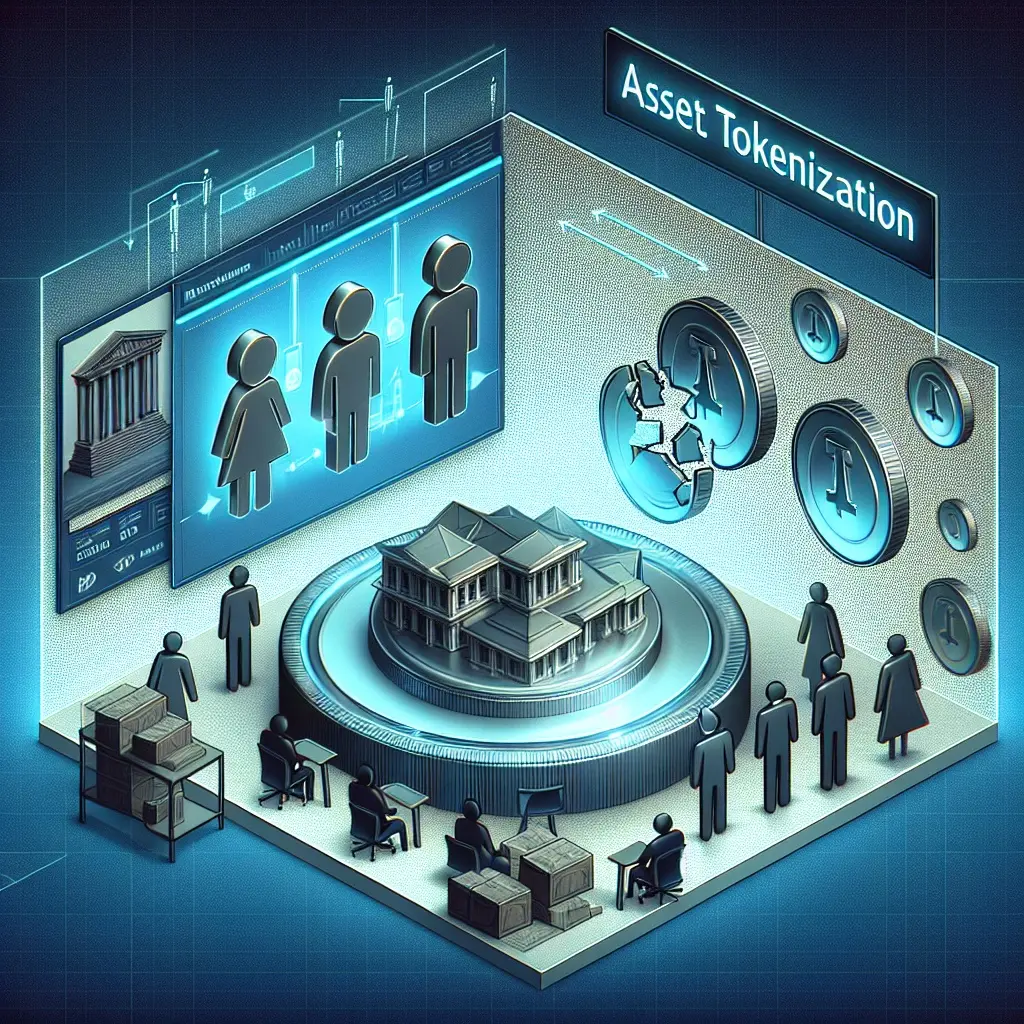
(Kitco News) – While the headlines continue to focus on flows into spot Bitcoin (BTC) exchange-traded funds (ETFs), S&P Global Rankings, a leading credit rating agency, is very bullish about another burgeoning area of the crypto market: real-world asset (RWA) tokenization.
“With more than $1 billion outstanding on public blockchains, the Tokenized Treasuries market is picking up. The recent launch of Blackrock's BUIDL fund has accelerated this trend,” S&P Global said in a release on Tuesday. “Tokenized Treasuries offer several benefits for money market fund issuers and investors. These include managing liquidity and allowing on-chain businesses to access real-world yields. They may also support broader innovation in asset management.”

One of the biggest benefits of RWA tokenization is enhanced liquidity, the agency noted.
“Tokenization can help investors manage their liquidity in two ways,” said Andrew O’Neill, Digital Assets Managing Director at S&P Global Ratings. “First, it can provide them with round-the-clock access to liquidity on-chain.”
“In times of market volatility, investors may need to meet margin calls on some positions. Money market fund investors may seek to redeem their shares in the fund for cash to meet these obligations,” O’Neill said in a report shared with Kitco Crypto. “If many investors choose to redeem at once, this increases liquidity risk for the fund. We note that the U.S. Securities and Exchange Commission recently increased funds' minimum liquid assets requirements to mitigate this risk.”
“Second, they can use their tokens as liquid collateral rather than needing to redeem, thus reducing the risk of a run on the fund,” he added. “Tokenization allows on-chain businesses to access real-world yields as they provide an on-chain solution backed by assets with high liquidity and credit quality.”
O’Neill noted that in the past, “crypto-related businesses that earn revenues and pay expenses on-chain have had to choose between investing their cash in riskier on-chain assets or moving it off-chain to invest in traditional cash-equivalent products, requiring them to move the cash back on-chain to meet their expenses.”
“This ‘off- and on-ramping’ process is costly and inefficient,” he said. “Tokenized Treasuries provide an on-chain solution backed by assets with high liquidity and credit quality.”
While he sees tremendous potential in the RWA sector, O’Neill noted that in the short term, “interoperability challenges will limit the growth of tokenization.”
“Investors need to access the blockchains on which the tokenized assets are built, and institutions need to connect their legacy systems to those blockchains,” he said. “Different paths are emerging to address these challenges, including the use of private permissioned blockchains shared between a network of partner institutions, public blockchains, and cross-chain communication technologies to allow different private and public chains to interact while mitigating security risks.”
Currently, regulatory challenges are the biggest barrier to tokenization, O’Neill noted, which have thus far “inhibited adoption, particularly for U.S. banks.”
“Banks' tokenization efforts have mainly used private permissioned blockchains, supporting operational efficiencies but not a liquid market in tokenized products,” he said. “Asset managers are less restricted, however, and have been able to issue Tokenized Treasuries on public blockchains, primarily on Ethereum (ETH) – allowing a broader investor base to access these products.”
He added that regulatory clarity on stablecoins will help to boost the adoption of on-chain payments.
“Emerging regulatory frameworks in key jurisdictions will enhance investors' appetite to engage with stablecoins and the features they enable, such as the BUIDL example of disintermediated redemption through a smart contract,” O’Neill said.
In the long run, he suggested that tokenization “may bring new efficiencies to the asset management industry.”
“For example, smart contracts may automate portfolio rebalancing, and standardized token formats may boost investors' access to alternative assets, such as private credit,” O’Neill concluded. “Institutions have tested these capabilities in pilots,” including the Monetary Authority of Singapore's Project Guardian.
Addressing the application of RWAs in decentralized finance (DeFi), Dean Tribble, CEO of Agoric OpCo, said “There are two primary pathways for RWAs in DeFi” in a note shared with Kitco Crypto.
“One is tokenized assets directly integrated into protocols, like what GIANT Protocol is doing with cell phone bandwidth, or carbon or solar credits like what glow.com offers,” he said. “The other option is additional earnings potential for protocol-held reserves.”
“RWAs also enable the tokenization of resources like revenue streams or other business assets,” Tribble added. “This means new or improved asset classes by combining RWAs with the high integrity of a blockchain, such as credible international energy, carbon credit, or recycling credit markets, or unlock assets that are traditionally stranded or lack access to financial tools, like bringing global liquidity to assets only available in local markets.”
He also noted the “significant ramifications” RWAs will have on institutions.
“They provide a clear integration point for large institutions which may not require them to directly interface with crypto protocols, and can help DeFi protocols integrate institutional risk management to allow them to meet compliance hurdles for institutional investors,” Tribble said.
