
(Kitco News) – Financial markets trended higher on Wednesday afternoon after a soft Consumer Price Index (CPI) reading boosted investor expectations for an interest rate cut and signaled to traders that it was a good time to jump back into the markets.
While the CPI was in line with expectations, the fact that the past four months saw higher-than-expected inflation readings was a positive sign for investors and sparked new bets that a Fed rate cut could come as soon as September.
The CME FedWatch tool shows that around 73% of traders now expect at least one cut by the September reading.
As a result of the bullishness brought about by the low CPI reading, the S&P, Dow, and Nasdaq all traded at or near record highs on Wednesday, and at the market close finished up 1.17%, 0.88%, and 1.40%, respectively.
While the markets may have responded positively to the CPI reading, Youwei Yang, Chief Economist and Vice President of BIT Mining, warned that it’s too early to declare victory on inflation.
“Despite the release of an easing and, as expected, Consumer Price Index (CPI) inflation at YoY 3.4%, the current global economic landscape remains dangerously close to a mild stagflation scenario,” he said in a note to Kitco Crypto. “Today's policymakers appear to underestimate the risk of stagflation, echoing the oversight seen in the 1970s, albeit without the extreme inflation rates of that era.”
“Signs of slowing economic growth are evident in the declines in GDP growth, the industrial manufacturing index, and retail sales,” he added. “The US economy still seems strong and prospering, though significant discrepancies among other countries in post-pandemic economic recovery pose a risk of global disorder.”
“Economic conditions in Europe and Asia are deteriorating, and geopolitical conflicts are unfolding in numerous regions,” Yang noted. “If the economic growth discrepancy continues to widen, more severe effects could destabilize the global political order and financial system.”
“Despite these risks, many investors and policymakers remain overly optimistic, as evidenced by historically high P/E ratios among many major market sectors,” he said. “Crypto is always the first to react when the market is in potential risk, and thus it has been declining in the last few months, though AI-driven stock growth seems to pose a fake prosperity for the financial markets that is concerning.”
Yang’s concerns were echoed by analysts at Bitfinex, who warned that one lower CPI print doesn’t guarantee that the Fed will lower interest rates.
“Investors consider this as a bullish regime shift, as it marks the first decrease in CPI inflation over the last 3 months, and after the Fed announced its intention to taper its quantitative tightening,” they said. “In the last two months, the CPI print has formed local tops, and so this is seen as being a favourable print for risk assets, and has had the opposite effect.”
“However, we are still above 3% inflation, and yesterday the PPI inflation data showed a third straight monthly increase,” they noted. “Although a lower inflation number is good news, investors will have to wait and see if the Fed sees this as positive enough news to cut the rates.”
According to Leena ElDeeb, a research associate at 21Shares, “CPI alone isn’t enough to convince the Federal Reserve to cut rates, especially since the reading is still well above the 2% target, dimming hopes for a rate cut anytime soon, as expressed in the FOMC meeting two weeks ago.”
While the higher-than-expected PPI data “should be a bearish sentiment for the Federal Reserve with regard to rate cuts, given that when producers charge more for goods and services, the higher costs are eventually passed on to the consumer,” ElDeeb said the weaker-than-expected retail sales data “could indicate the Fed's efforts to curb inflation might be working, potentially leading them to hold off on further rate hikes or even consider cuts to stimulate the economy.”
That said, ElDeeb warned that “with the rate cuts still in question, recovery might be slow.”
“Typically, higher interest rates make risk-on assets like tech stocks and Bitcoin less appealing, as investors can secure substantial yields from safer options such as U.S. Treasuries,” she said. “This drives short-term investors towards traditional markets.”
“However, despite the short-term impact on markets, many investors hold a long-term view of Bitcoin, a global asset that protects against currency debasement and economic instability,” ElDeeb added. “While Federal Reserve policies may induce short-term volatility, they do not fundamentally change Bitcoin's long-term trajectory.”
“Therefore, Bitcoin currently holds a unique position as a risk-on and risk-off asset, navigating unique market dynamics,” she concluded.
Data provided by TradingView shows that Bitcoin (BTC) was in up-only mode in trading on Wednesday, surging from a low of $61,315 to hit a high of $66,420 in the afternoon, with bulls showing no signs of slowing their rally higher.
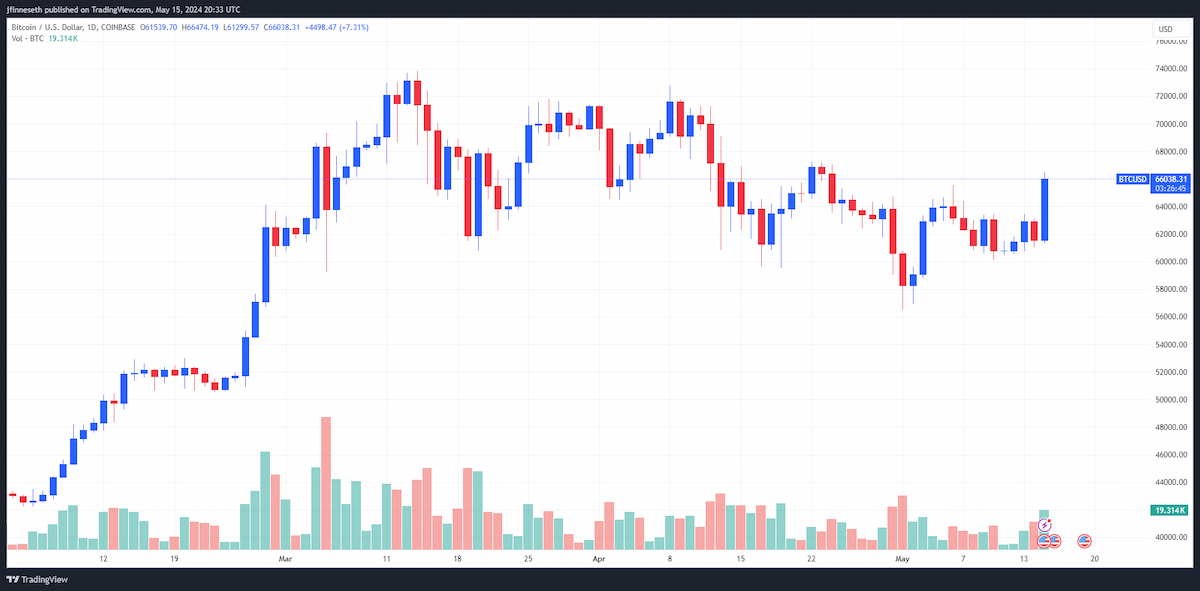
BTC/USD Chart by TradingView
At the time of writing, BTC trades at $66,035, an increase of 7.21% on the 24-hour chart.
Sea of green in the altcoin market
Altcoins rallied on the back of Bitcoin’s momentum, with all but three tokens in the top 200 recording gains on Wednesday.
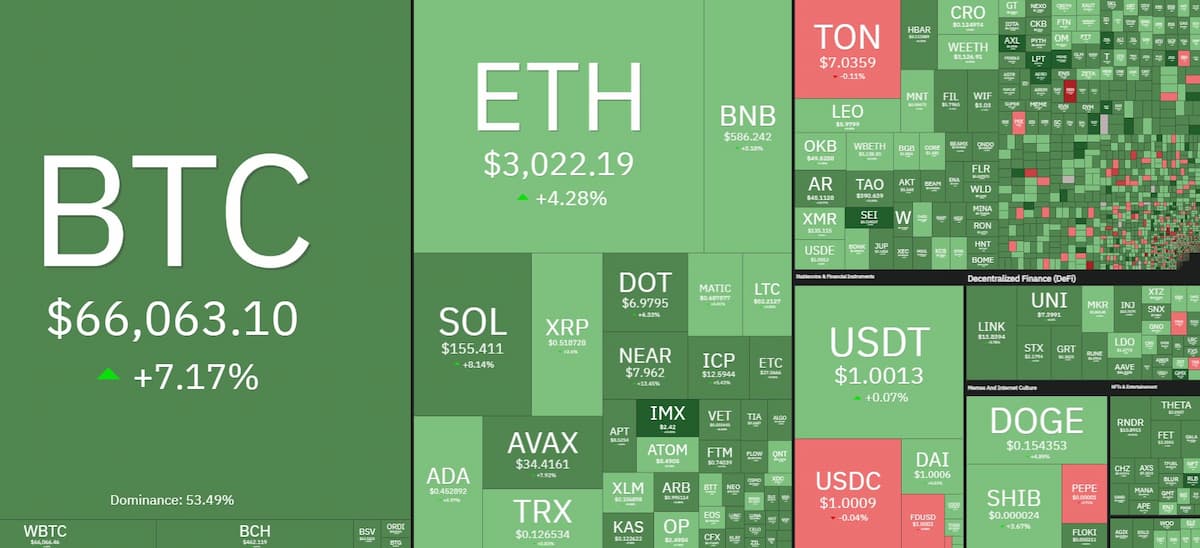
Daily cryptocurrency market performance. Source: Coin360
Livepeer (LPT) was the top performer after increasing 20.8%, followed by gains of 18% for Axelar (AXL) and GMX (GMX). Ribbon Finance (RBN) was the biggest loser, falling 21.5%, while Pepe (PEPE) lost 2.6%, and Starknet (STRK) fell 1.9%.
The overall cryptocurrency market cap now stands at $2.38 trillion, and Bitcoin’s dominance rate is 54.7%.
