

(Kitco News) – The icy reception that Bitcoin (BTC) received from registered investment advisors (RIA) has begun to thaw in the wake of the launch of multiple spot BTC exchange-traded funds (ETFs).
This week the Digital Assets Council of Financial Professionals (DACFP) released March 2024 survey results on how Bitcoin is viewed by RIAs.
“More than one-third (35%) of financial advisors surveyed say they plan to recommend digital assets to their clients within the next six months,” the survey found. “This represents a 70% change compared to the more than one-fifth (21%) of financial advisors who said they plan to recommend crypto within six months, when surveyed in December 2023.”
While the number of RIAs who said they plan to recommend crypto within the next six months has risen, the number of advisors who said they were actively recommending crypto to clients at the time of the survey in March was 34%, down from 59% in the December survey.
A total of 272 financial professionals participated in the survey, with 71% identifying as financial advisors of independent RIA firms. The remainder worked for regional or independent brokerage firms (19%), wirehouses (2%), or other types of companies in the financial services industry, such as trust companies and family offices (8%).
“The availability of new spot Bitcoin ETFs, combined with a roughly 50% increase in Bitcoin's price so far this year, is spurring advisors to get more involved with crypto than ever,” said DACFP Founder Ric Edelman. “Advisors are racing to gain the knowledge they need to properly serve their clients.”
The insights provided by the survey are notable as they primarily apply to RIA’s for high-net-worth individuals, with 65% of respondents serving clients with $500K to $3.5M in assets, and 9% predominantly serving clients whose assets are in excess of $3.5 million. 30% of the advisors surveyed manage more than $100 million.
Among the advisors who recommend an allocation to crypto, 87% recommended that clients allocate 1% to 5% of their portfolio value to the asset class, with the most common recommendation being 2%.
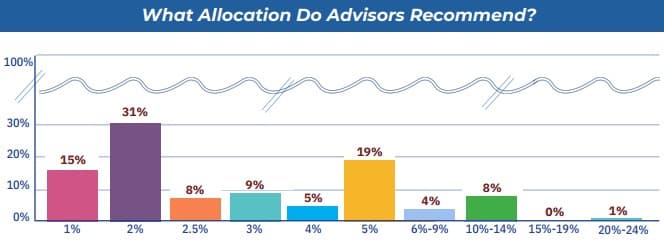
“Advisors are also recommending that clients make greater allocations to crypto following the launch of spot Bitcoin ETFs, with 85% of advisors suggesting allocations of more than 1% in March 2024 compared to only 74% in December 2023,” the survey found. Eight percent recommended allocating 10% to 14%, while 1% advised allocating more than 20%.
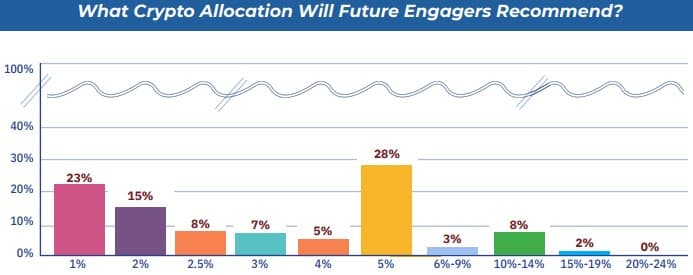
Of the financial advisors who have not yet allocated to crypto but said they plan to do so, 28% say they plan to allocate 5% of assets to client portfolios.
“Advisors increasingly express interest in allocating towards digital assets as a means of better diversifying their clients' portfolios and capturing the investment opportunity represented by the growing protocol-based network economy,” said Sandy Kaul, Head of Digital Asset and Industry Advisory Services at Franklin Templeton. “As advisors and their clients progress through their respective digital assets journeys, it is important they choose a partner capable of conducting research, development and education across the entire digital assets ecosystem.”
Evidence that interest in crypto is rising can also be found in the regulatory filings of large financial institutions, including Tuesday’s report from Kitco Crypto that the Bank of Montreal, several retirement funds with the State of Wisconsin, and Swiss banking giant UBS had all revealed exposure to the spot BTC ETFs,
Wednesday saw several new institutions added to this list, including Scotiabank and Toronto Dominion Bank (TD Bank), two of Canada’s largest banks.
The 13F filing by Scotiabank shows the firm has invested more than $1.5 million in three major Bitcoin ETFs: BlackRock’s IBIT, Grayscale’s GBTC, and Fidelity’s FBTC, while the filing by TD Bank shows combined investments of $2.18 million in IBIT and ProShares Bitcoin Strategy ETF (BITO).
Julian Fahrer, co-founder of Apollo Stats, provided a succinct breakdown of the 13F filings from Q1.
“The penultimate day of 13F filings for Q1 did not disappoint,” he said. “100 more came in yesterday, and rest assured we scoured them all.”
“Two more of the Big Five Canadian banks filed yesterday,” Fahrer noted. “First was TD Bank, with a miserly $100k in IBIT. Scotia Bank then followed up with $1.5m across GBTC, IBIT, and FBTC.”
“Invesco, of Invesco-Galaxy Bitcoin ETF fame, filed too,” he added. “Somewhat surprisingly, their own ETF (BTCO) was absent. And even more so: they have $1.5m in GBTC - a direct competitor. Other ETF issuers to file thus far (BlackRock, Van Eck, Ark) all exclusively own their own homegrown product.”
“Another notable entrant yesterday was Equitable Holdings, a publicly listed insurance company with $930b AUM,” Fahrer highlighted. “They dipped their toe in this quarter, with $1m in GBTC. Finally, the biggest news of the day was that the State of Wisconsin Investment Board (SWIB) has $141m in IBIT and GBTC.”
“SWIB manages the retirement savings of Wisconsin state and local government employees, and is the 9th largest state pension fund in the United States,” he said. “And now, they are the second largest Bitcoin ETF holder in the world (excluding market makers and ETF issuers). The Bitcoin constituency just grew by 700,000 Wisconsinites. Pretty big deal I’d say.”
The significance of these filings by large financial institutions was discussed by Matt Hougan, Chief Investment Officer at Bitwise.
“Everyone wants to know: Who’s buying? Specifically, people want to know whether professional or retail investors are driving the flows,” Hougan wrote. “It’s an important question. The great promise of Bitcoin ETFs is that they can open the door for professional investors to buy Bitcoin en masse, dramatically increasing the pool of capital investing in the asset.”
“If professional investors are buying, that’s great,” he said. “But if the flows are all retail, that’s less encouraging. Why? Because there’s simply not the same scale behind it.”
Hougan said the biggest three takeaways from 13F filings are that “lots of professional firms own Bitcoin ETFs; there is now a historic scale of professional investor ownership; and retail owns most of the float in Bitcoin ETFs (for now).”
“All told, 563 professional investment firms reported owning $3.5 billion worth of Bitcoin ETFs as of last Thursday,” he said. “By the time the May 15 filing deadline arrives, I suspect we may end up with 700+ professional firms and total AUM approaching $5 billion. This is absolutely massive. For any financial advisor, family office, or institution wondering if they were the only one considering Bitcoin exposure, the answer is clear: You are not alone.”
Hougan added that the only thing comparable to the success of the Bitcoin ETFs was the launch of gold ETFs in 2003.
“At the time, the gold ETF launch was considered the most successful ETF launch of all time, gathering more than $1 billion in its first five days on the market,” he said. “But at its first 13F filing, gold ETFs had just 95 professional firms invested in the product. From a breadth of ownership perspective, the Bitcoin ETFs are a historic success.”
Hougan concluded his note by saying that he is “incredibly bullish,” and based on his experience, the “allocations we see in recent 13F filings are just a down payment.”
“Hightower Advisors may have $68 million allocated to Bitcoin ETFs today, for instance, which is great, but it’s just 0.05% of their assets,” he said. If they follow the pattern he typically sees for investors, “that allocation will build over time. And to put it in context, a 1% allocation of their portfolio to Bitcoin would equate to $1.2 billion – all from a single firm. Multiply that by the growing number of professional investors participating in the space, and you can begin to see what’s behind my enthusiasm.”
