
(Kitco News) – Cryptocurrencies continue to enjoy a rising stature in the eyes of U.S. voters as a recent survey conducted by Harris Poll and funded by Grayscale found that one in three voters said they would consider a political candidate’s position on cryptocurrencies before deciding how to vote.
The poll, which included responses from more than 1,700 people, found that 77% of respondents said a U.S. presidential candidate should at least have an “informed perspective” on crypto.
“Ahead of the June 2024 US Presidential debate between Biden and Trump, voters are expressing uncertainty and the feeling that the stakes are substantial: Wars rage around the world, political discourse continues to be deeply polarized, and inflation is persistent in the US economy, among other things,” the report said. “Amid this uncertainty, crypto assets are increasingly relevant to voters.”
Harris Poll and Grayscale previously teamed up for “Wave 1” of this research in November 2023, and the results of “Wave 2” show that digital assets have become more important in the eyes of voters since the first round of polling was conducted.
“Grayscale believes the spotlight on Bitcoin (BTC) is growing as a result of macro developments and the maturation of Bitcoin as an asset,” the report said. “Over the past six months, since Wave 1 of this survey, voters have been paying more attention to Bitcoin because of geopolitical tensions, inflation, and risks to the US dollar (41% vs. 34% in November 2023).”
“Notably, inflation is by far the top issue in the election according to voters (28%), underscoring the potential value of assets like Bitcoin with a transparent and hard-capped supply,” Grayscale said. “Bitcoin-related events, including the US spot Bitcoin ETF approval in January 2024 and the Halving in April 2024, have made voters more interested in investing in Bitcoin and other crypto assets (18% and 20%, respectively). The Bitcoin ETF approval, in particular, made 9% of retiree voters more interested in investing in Bitcoin or crypto assets.”
These developments for Bitcoin amid the backdrop of rising geopolitical concerns have increased the relevance of the top crypto in the minds of voters, Grayscale suggested, as “nearly half of voters (47%) now expect some of their investment portfolio to include crypto (up from 40% just late last year).”
And unlike many issues top of mind for voters, “Harris Poll data supports the notion that crypto is a bipartisan topic, with similar ownership rates among Republicans (18%) and Democrats (19%),” the report said.
"This is a timely survey given the latest developments related to crypto policy on the Hill. Likely American voters from across the political spectrum indicate a heightened interest in investing in crypto assets and in supporting candidates well-versed in the emerging technologies,” said Zach Pandl, Grayscale’s Head of Research. "Aligned with recent votes in the House and Senate, this data reinforces that crypto has become a bipartisan issue that neither party can afford to overlook."
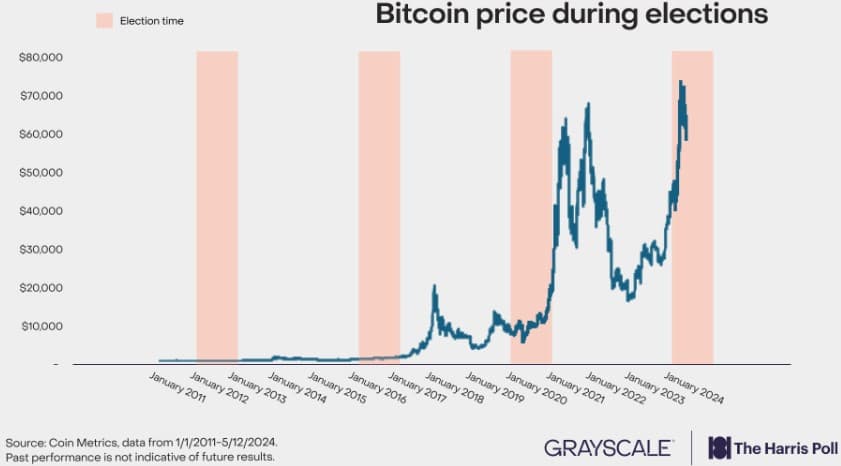
Grayscale noted that Bitcoin’s strong showing in 2024, with its price hitting a new all-time high on March 13, has put it at its highest value during any election year, leading to “speculation and headlines” asking the question, “Could November be ‘the Bitcoin Election’?”
“This growing spotlight on crypto is not limited to just Bitcoin,” Grayscale said. “Instead, it extends to a broader view of crypto assets, both in terms of general interest and a willingness to invest. Nearly a third of voters (32%) say that they are more open to learning about crypto investing or actually investing in crypto since the beginning of the year.”
“Compared to November 2023, voters are also more likely to see crypto as a good long-term investment opportunity (23% vs. 19%) and increasingly expect some of their investment portfolio to include crypto (47% vs. 40%),” the report said.
The one thing that would further help boost crypto in the eyes of voters would be clearer regulations. “Compared to the first wave in November 2023, the second phase of survey data found that voters are more likely to say that they would invest in crypto if there were clearer policies or regulations (52% vs. 48%),” the report said. “Similarly, a strong majority (79%) of voters agreed with the statement: ‘It is imperative that political leaders work towards creating frameworks and rules that enable financial inclusion and investor protection.’”
In recent weeks, Presidential candidate Donald Trump has taken a decidedly pro-crypto stance, including reports that he asked David Bailey, CEO of Bitcoin Magazine and a cryptocurrency aide to the Trump campaign, if Bitcoin could be leveraged to solve the U.S. national debt problem.
Despite these moves, respondents to the poll were “split on which party is more favorable to the industry, as an equal percentage of voters (30% each) think that both the Democratic and Republican parties have the most favorable position on crypto policies,” the report said. “These findings demonstrate that support for crypto isn't overwhelmingly biased toward one party and suggest a balanced interest across the political spectrum.”
Grayscale noted that this finding “aligns with recent bipartisan support across Congress for a resolution of SAB 121 that enables financial institutions to serve as custodians for digital assets, which may enhance accessibility to crypto investors.”
“Still, Republican voters tend to view issues around inflation and the economy as the most pressing issue facing America (54%, vs. 33% for Dems),” the report said. “While ownership levels are similar across parties, issues related to Bitcoin and crypto (inflation and economics) seem to be valued relatively more by Republicans, while data shows Democrats tend to care more relative to Republicans about issues like gun violence, climate change, and income inequality, as shown below in Exhibit 4.”
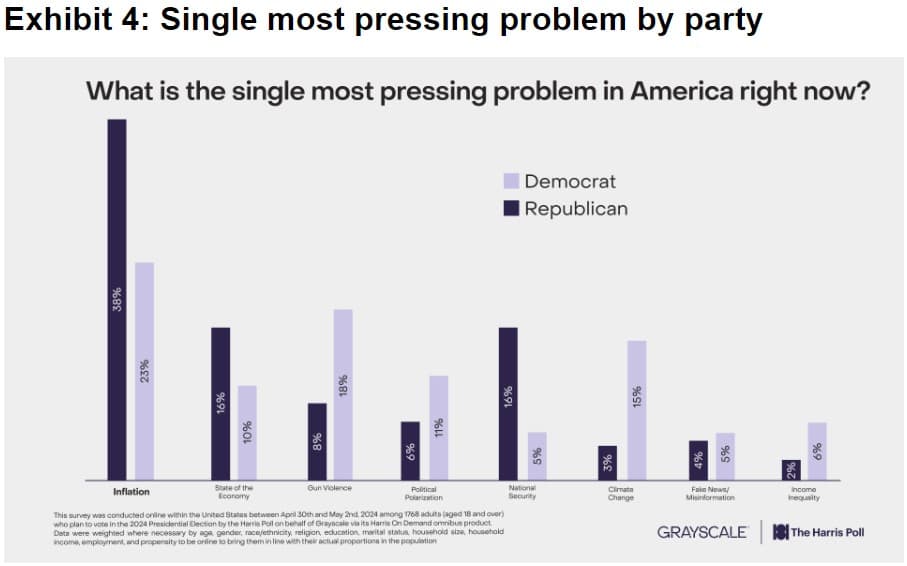
“This may explain why Trump has recently leaned into crypto on the campaign trail,” Grayscale said. “America is facing a fork in the road in more ways than one. Both candidates have different macro policies regarding government deficits and debt, inflation and Federal Reserve independence, and the US role in the world; each of these stances have direct implications on the US Dollar and Bitcoin.”
“With voters increasingly interested in crypto, the next administration's approach to this emerging digital asset will be important,” the report concluded. “This is particularly key for the youth vote, as 62% of Gen Z and Millennial voters believe crypto and blockchain technology are the future of finance. Regardless, as we approach November, it seems clear that crypto will increasingly be considered by policymakers and candidates across all offices that are preparing to run for office in the 2024 election.”
