
(Kitco News) – Economic headwinds continue to mount after disappointing bond auctions in the U.S. saw Treasury yields spike, which put pressure on risk assets as investors opted for guaranteed steady returns instead of risking it in equities, which are just off of record highs.
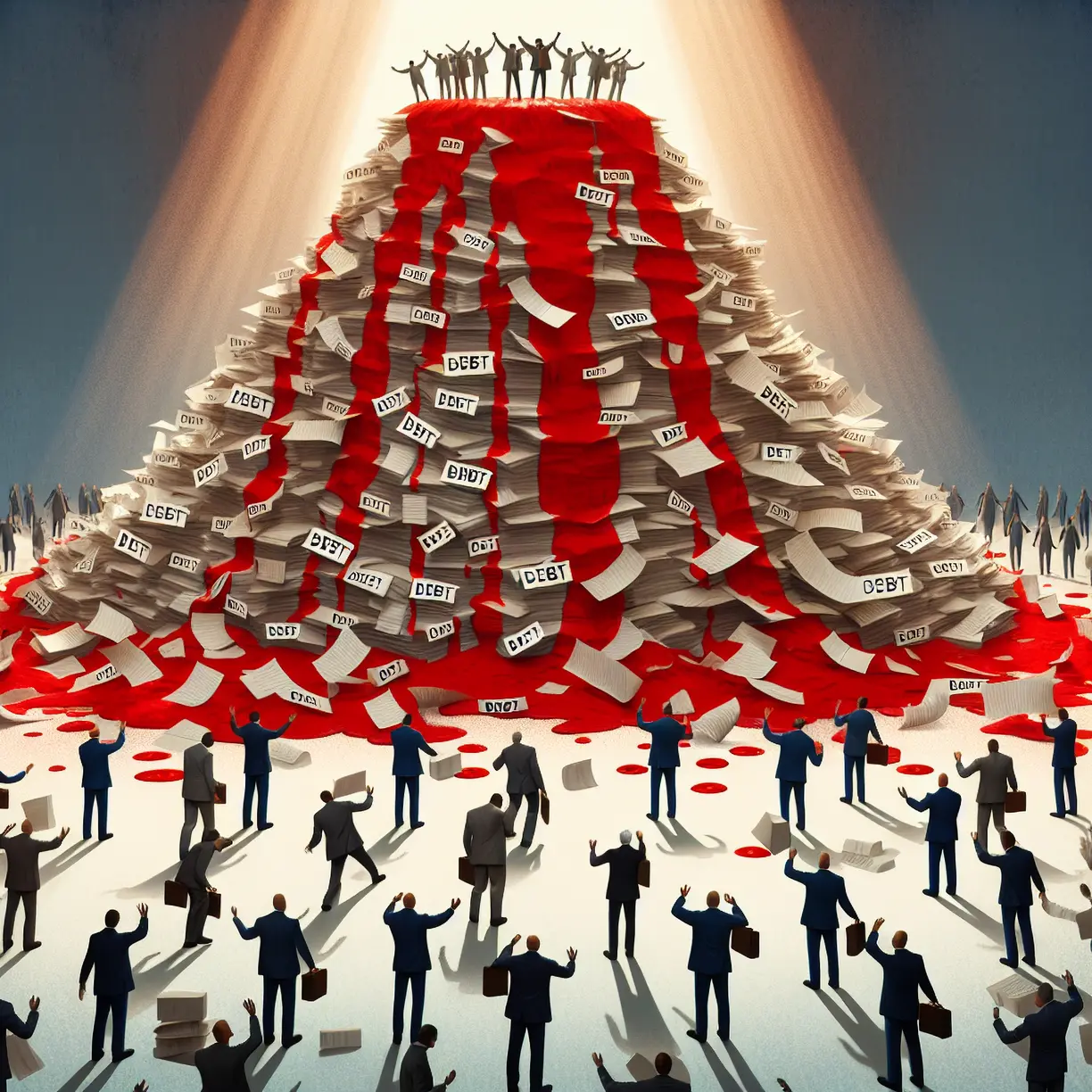
The spike in yields put a spotlight on the growing issue of non-stop debt printing and has led to the resurgence of talk about a “Debt Supercycle,” a term coined by Bank Credit Analyst (BCA) decades ago to describe the process behind the secular rise in private-sector leverage throughout the US economy during the post-WWII period.
As noted in a new report released by BCA titled Revisiting the Debt Supercycle, “When BCA first began talking about this issue in the 1970s, private sector debt had already risen to 90% of GDP, up from just above 50% in the early 1950s. Few would have believed back then that it would almost double to more than 170% of GDP three decades later.”
The report's author, Martin Barnes, former Chief Economist at BCA, notes that while “Debt is not evil as few families can afford to buy homes and cars for cash, and businesses need credit to finance their operations and investments… as with most things in life, problems arise when debt is pushed to excess.”
While some of the increase in debt in the post-WWII period can be attributed to “rising prosperity and confidence, falling interest rates, and financial and technological innovations that made it easier for lenders to price risk (or so they thought),” Barnes said it’s also “a story about greed, fear, and the tyranny of unintended consequences.”
He said policies enacted over the decades have played a pivotal role, and that is the crux of the BCA Debt Supercycle thesis.
“The events of the 2000s were a classic example of the Debt Supercycle at work,” Barnes wrote. “After the tech bubble burst in 2000, fears of potential economic fallout led to massive policy reflation. The Fed cut interest rates to 1% and kept them there even as nominal GDP growth accelerated to 5%.”
He noted that the “aggressive stimulus worked perfectly” as there was barely a recession in the US in 2000-01, despite the bursting of the immense NASDAQ bubble. But, in the process, policy sowed the seeds of the housing bubble which involved a much greater buildup of excesses than occurred during the technology mania. And when that bubble burst, policymakers were forced to stimulate more than ever.”
Barnes referred to what happened next as “breathtaking” as “The Fed embraced quantitative easing and expanded its balance sheet from $900 billion to $4.5 trillion between mid-2008 and end-2014. Meanwhile, federal debt rose from $9.5 trillion to $18 trillion over the same period.”
“Economic and financial historians will look back at the meltdown of 2007- 2009 as one of those defining moments and inflection points with a discrete shift in many key trends and issues,” he said.
Matters got even more precarious in the years that followed as “The Fed kept interest rates at close to zero between 2009 and 2017,” while at the same time “the ratio of household debt to income continued to decline,” Barnes noted. “And it has not recovered since, even though the COVID pandemic led to massive new monetary and fiscal stimulus.”
“Corporate sector borrowing has increased as a share of income, but much of that was to finance share buybacks and mergers and acquisitions rather than to boost capital spending,” he wrote. “The share of small businesses that borrow has continued to drop to new lows.”
“In sum, the data show that the Debt Supercycle in its previous form reached a major turning point 15 years ago,” Barnes said. “However, it simply transitioned from the private sector to the government sector. If consumers would not borrow and spend, then the government would step in and do it for them.”
This has led to the Debt Supercycle taking a new form, he argued.
“There is a major difference between private and public sector debt,” Barnes said. “The amount of debt consumers and businesses can sustainably finance is constrained by their incomes. If large numbers of heavily indebted consumers and/or businesses are forced to default, it can trigger an economically and financially damaging credit crunch as lenders retrench.”
Whereas the central bank can step in to be the bond purchaser of last resort, “there is no lender of last resort for the private sector as a whole,” he noted.
“While the ratio of US private debt to GDP is back to a 20-year low, the ratio of federal debt to GDP has climbed to peacetime highs,” Barnes said. “According to Congressional Budget Office (CBO) projections, in the absence of any major policy changes, the federal debt-GDP ratio will continue to soar in the coming years, reaching 170% by 2050.”
The main point is “that fiscal finances are on an unsustainable trajectory,” he stressed. “We discovered the limits to U.S. consumer debt when the housing bubble burst. It is harder to discern the limit to public sector debt, but there is one. Voters, despite concerns about government debt, are unlikely to vote for politicians whose platform is austerity.”
He said the only limit to government debt is “when investors will no longer purchase a country’s bonds at yields that the economy can tolerate or when debt servicing costs crowd out other critical spending.”
While the U.S. “is not at that point yet,” Barnes noted that “CBO projections show that interest costs will absorb an unacceptable level of around a third of revenues by 2050.”
This is where the recent disappointing bond auctions come into play.
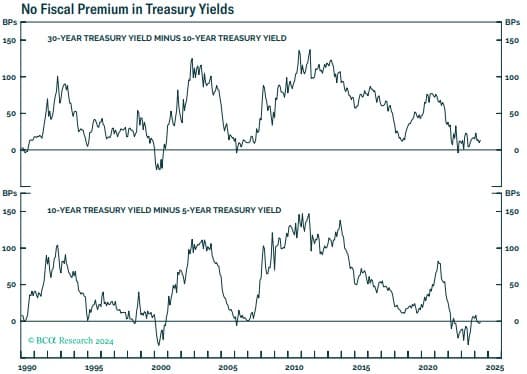
“The bond vigilantes are well aware of US fiscal trends but have yet to take fright,” he said. “Treasury yields have moved higher but that reflects tighter monetary policy, not a rise in the fiscal risk premium. This most likely will show up in a widening of spreads at the longer end of the yield curve and that has not yet happened.”
Barnes said that if a bond-buyers’ strike were to occur, “a crisis can be delayed by central bank bond purchases (quantitative easing), but that is not a sustainable strategy. Eventually, inflation would become a problem and it is doubtful that central bank purchases could offset a stampede out of bonds and out of the dollar if private investors completely lost confidence in government policy.”
“There is a good chance that bond investors will lose patience if the next Administration fails to restore some discipline to fiscal finances,” he warned.
Looking forward
As for what comes next, Barnes noted that currently, “Consumer balance sheets are indeed in very good shape. The household debt-to-income ratio is back to reasonable levels, and higher prices for real estate and equities have boosted asset values.”
“As a result, the ratio of debt-to-assets is at the lowest level in almost 50 years while the ratio of net worth to incomes is at a historically high level,” he said. “Meanwhile, debt-servicing ratios and loan delinquency rates are at historical lows. In other words, in absence of an economic or financial crisis, consumers do seem well placed to start a new leverage cycle.”
But the situation is more complicated than that as consumers must be willing and able to “take on more debt and that is going to be a problem,” he warned. “The economy and asset prices have done surprisingly well in the past year in the face of higher interest rates. Yet consumer confidence has remained muted.”
Barnes cited inflation concerns, political uncertainty, and geopolitical tensions as playing a role in decreasing consumer confidence.
“Public polling suggests a high percentage of Americans feel the economy is in a bad place, are concerned about government deficits and debt and have little faith in politicians to make things better,” he wrote. “Demographic trends also argue against a major new leverage cycle in the household sector. The population continues to age and younger generations do not appear to be overly interested in taking on a lot of debt.”
After highlighting that the previous Debt Supercycle in the private sector “coincided with two important trends: the move of the baby boom generation into their prime earning years and a superb environment for asset prices,” Barnes noted that “While asset prices have been buoyant recently, recent trends are not sustainable.”
“Equity prices are highly valued and real home prices are far above the levels reached during the 1990s’ housing bubble,” he said. “In sum, the conditions for the resumption of a major new leverage cycle in the household sector are not great. And it is hard to see why businesses should start to embrace more debt in an environment where future economic growth is likely to be mediocre and corporate tax rates are more likely to rise than fall.”
“An end to the government Debt Supercycle will only come in response to a financial crisis and the result will be a period of severe fiscal restraint,” he warned. “That will not be fertile ground for a new private sector love-affair with debt.”
“The transition of the US Debt Supercycle from the private to public sector represented an important shift,” Barnes said. “If the bond vigilantes finally come out of the shadows and shun Treasuries, the outcome will be a spike in yields, collapse in equity prices and plunge in the dollar. Markets will continue to riot until they see government action to rein in fiscal deficits.”
If this were to happen, Barnes said the Fed would “respond with a major easing in policy, but its room for maneuver may be constrained by the trend in the dollar.”
“At the end of the day, the outcome may be inflationary rather than deflationary,” he said. “Fiscal restraint will undermine economic growth, but the combination of easy money and a weak currency will put upward pressure on prices. And some increase in inflation may be welcomed as one way to reduce real government debt burdens. In other words, it would be a stagflationary environment.”
While utilizing debt for productive purposes can be self-financing if the resulting improvement in growth and cash flow allows the debt to be serviced and eventually repaid, “Unfortunately, the rise in government debt is more related to consumption than investment so it too will end badly,” he warned.
“The CBO’s projections suggest that the sum of federal non-discretionary spending and interest costs will soon exceed total revenues and the gap will continue to increase,” he said. “That is an unsustainable state of affairs.”
For this reason, Barnes said “A new secular rise in debt-to-GDP ratios in the major economies is unlikely. It took almost four decades for the US private-sector Debt Supercycle to reach a peak and it has only been in retreat for around 15 years. This is a story about longrun cycles with demographics, consumer attitudes and policy all playing a role.”
“The Debt Supercycle is in its final innings,” Barnes concluded. “It may linger on for a few more years, but we are getting close to an end-point.”
According to an April report from BCA, “Rising productivity and immigration will lead to well-behaved inflation and falling interest rates,” for the remainder of 2024. “These will provide a bullish backdrop for gold, and the economy overall.”
The report’s author, Robert Ryan, Chief Commodity and Energy Strategist at BCA, said that in this environment, real rates will remain slightly negative, which makes bonds expensive and should weaken the U.S. dollar, removing two major headwinds for the gold market.
“When we start to see the U.S. dollar weaken that will create another leg up in gold,” he said.
Looking beyond U.S. monetary policy, Ryan said that he expects emerging market demand to continue to support gold’s bull run. He added that investors need to pay attention to Chinese demand as this will remain robust for the foreseeable future.
“In China, gold is the only store of value they have in an economy that's deflating,” he said. “Chinese households really don't have many alternatives now that the property market's melted down.”
At the same time, Ryan expects that central banks will continue to stack gold as U.S. debt continues to grow.
