

(Kitco News) – Bitcoin’s (BTC) price trended higher in early trading on Tuesday after the latest data from the Bureau of Labor Statistics showed that job openings in the United States fell in April to their lowest levels since February 2021.
The data release showed there were 8.06 million jobs open at the end of April, a decrease from the 8.35 million job openings in March and below the 8.35 million openings expected by economists.
The lower-than-expected reading suggests that the labor market is showing further signs of cooling off from the hiring surge that came as the U.S. economy reopened after the COVID-19 pandemic, boosting hopes that an interest rate cut could happen as soon as September.
Bitcoin responded to the report with a spike higher, briefly topping out at $70,300 before pulling back to $70,010, where it trades at the time of writing.
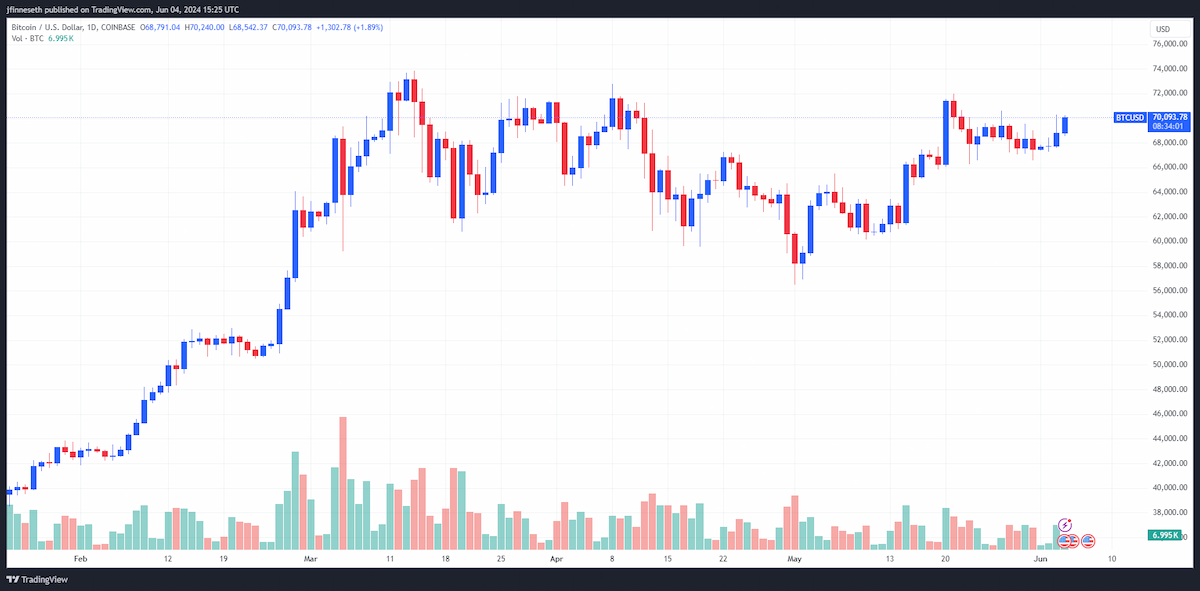
BTC/USD Chart by TradingView
The volatility seen since the start of the week follows a period of relative calm for the top crypto as traders start to push to reignite the stalled bull market.
Last week “was characterized by low daily volatility, with the price fluctuating by less than $4,000 even when analyzing intraday trading levels,” noted Matteo Greco, Research Analyst at Fineqia International.
“During the past week, BTC Spot exchange-traded funds (ETFs) experienced gradual and consistent inflows,” he added. “Over the four trading days, the cumulative net inflow totaled approximately $170 million. This marks the third consecutive week of positive flow, signaling a reversal in trend after five weeks of subdued demand.”
“In total, BTC Spot ETFs have witnessed 14 consecutive trading days of net inflow, with the overall net inflow since inception approaching nearly $14 billion,” Greco said, before adding that last week also saw BlackRock’s IBIT surpass Grayscale’s ETF (GBTC) in terms of assets under management.
“GBTC had previously operated as a trust before transitioning to an ETF in January 2024,” he said. “Both ETFs currently manage over $19 billion in assets, with IBIT holding approximately $19.7 billion and GBTC closely trailing at around $19.2 billion.”
Greco said this development demonstrates “the growing interest and commitment from traditional finance players in the digital asset space,” along with other “milestones” achieved recently.
“Firstly, the SEC approved Ethereum (ETH) Spot ETFs, which are poised to begin trading once the SEC greenlights the S-1 filings, after approving the 19b-4s about 10 days ago,” he said. “Both the 19b-4s and the S-1s must be approved by the SEC for the launch of Spot ETH ETFs.”
“The 19b-4s filing allows national security exchanges (e.g., NYSE or Nasdaq) to list new products, such as Spot ETH ETFs,” Greco noted. “The S-1s are the initial registration forms required for new securities offered to the public, providing detailed information about the company’s operations and products. Market participants anticipate that trading for ETH Spot ETFs will commence either in July or August 2024, based on the current available information.”
Another notable development was the launch of the first spot BTC ETFs in Australia on Tuesday. “Monochrome Asset Management, the issuer, obtained approval for its BTC Spot ETF (IBTC) in April, and launched its product on Cboe Australia today, after obtaining the green light from the Australian regulator,” Greco said.
“These recent developments underscore the global demand among traditional finance investors to diversify their portfolios by increasing exposure to digital assets,” he concluded. “The approval of BTC Spot ETFs in the US earlier this year paved the way, followed by similar product launches for BTC and ETH in Hong Kong. Additionally, news of ETH Spot ETF approval in the US and BTC Spot ETF trading in Australia further highlights the industry’s momentum.”
According to Jan van Eck, CEO of VanEck, one of the companies with a U.S.-listed spot BTC ETF, inflows into the ETFs are likely to continue for some time, and eventually, they will help drive Bitcoin’s market cap to $7.85 trillion.
“I say [Bitcoin will] eventually become at least half the market cap of gold,” van Eck said in an interview with Scott Mekler. “So I think that takes another five or 10 years. Our TradFi clients are still very confused by Bitcoin, and they don’t want to talk about it, but their clients make them talk about it. So we have a long ways to go.”
“And also buying activities is not helpful. They want to buy it at the tops and then it’s going to go to zero at the bottom. And so they’re bad at allocating,” he noted.
He suggested that there are a lot of financial firms in both the U.S. and Europe that are willing to allocate people’s portfolios, saying that he hopes “those allocators will be open-minded enough to consider gold or Bitcoin at the right time in the cycle and disciplined to take advantage of those trends for their clients, because I kind of give up that the end clients will get it.”
Van Eck said one thing that is pushing international investors to seriously consider making an allocation to Bitcoin is the fact that it is free from the influence and purview of the Society for Worldwide Interbank Financial Telecommunication (SWIFT).
“Investors outside the United States increasingly don’t want to be tied into SWIFT, in the US financial system and the political control that comes with it,” he concluded.
Bitcoin still has a long way to go before achieving van Eck’s prediction of being half the market cap of gold. The current gold market cap is at approximately $15.7 trillion, while Bitcoin’s market cap is approximately $1.38 trillion, meaning it needs to see an increase of nearly $6.5 trillion to reach the halfway mark.
