
(Kitco News) – The People’s Bank of China (PBoC) announced overnight that they bought no gold at all in May, triggering a sharp algorithmic selloff in precious metals, overshadowing the blowout nonfarm payrolls (NFP) report released later in the morning and leaving traders scrambling to determine where the selling would stop, and how low gold could go.
The news that China’s central bank broke its 18-month streak of net gold purchases hit the wires at 4:00 am EDT, and it sent shockwaves through the gold market as Asian and European traders immediately began liquidating their precious metals positions.
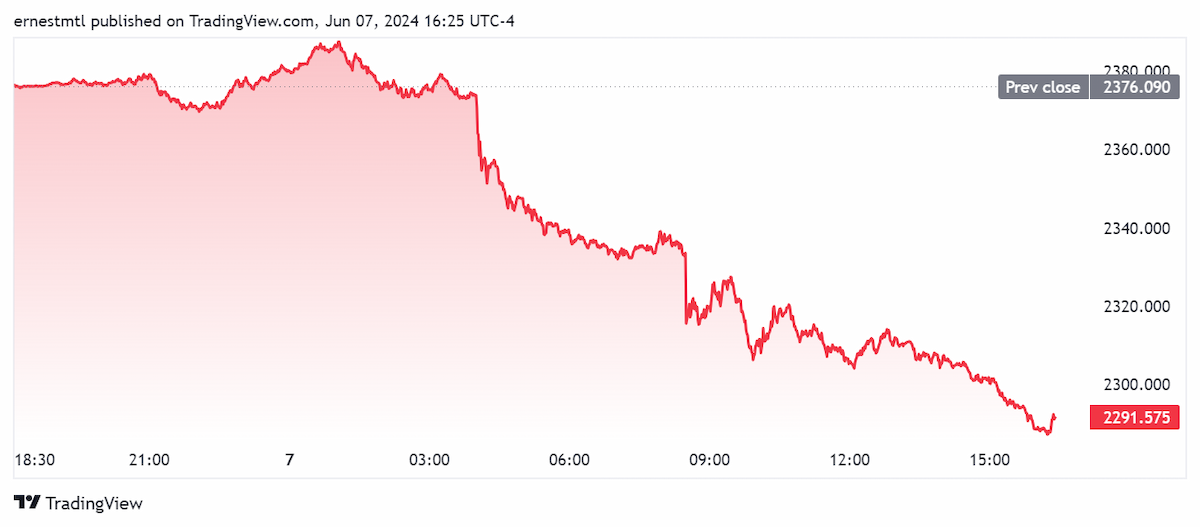
Spot gold sank like a stone, falling from $2,373.85 just before 4 am to $2,343.68 only one hour later, with much of the move taking place in a matter of minutes.
Then, the yellow metal was trading at $2,333.42 in the moments before the 8:30 am release of the surprisingly strong U.S. jobs report, which drove gold down even further as markets recognized that the Fed would have even less reason to cut in the near term. As gold was already down over $40 at that point, the NFP took the yellow metal all the way down to support near $2,300 per ounce.
Gold saw multiple bounces off the $2,300 level throughout Friday trading, but finally broke through support shortly after 2:40 pm EDT, with spot gold last trading at $2,288.51 per ounce at the time of writing for a loss of 3.68% on the day.
Krishan Gopaul, Senior Analyst, EMEA at the World Gold Council, told Kitco News that even if the PBoC slows their gold purchases, he still expects other central banks to continue accumulating the yellow metal.
"The People's Bank of China leaving their reported gold holdings unchanged in May was notable, given the level of their additions since late 2022," Gopaul said late Friday afternoon. "This seems, however, a continuation of the deceleration in purchases reported last month. Going forward, we have no indication as to whether this represents a temporary or more extended pause in their buying and will continue to monitor reporting in subsequent months."
"More broadly, while China has positively contributed to the level of annual demand from the official sector, we are still confident that central banks as a whole will remain net buyers," he added. "Buying has been broad-based, with several other central banks continuing to accumulate gold, even as the gold price has increased in recent months. As such, while central bank demand for 2024 may not reach the levels seen in 2022 or 2023, we still believe that it will remain healthy for the remainder of the year."
Colin Cieszynski, Chief Market Strategist at SIA Wealth Management, said that while the China news was clearly the catalyst for gold’s quick selloff, the market may be reading too much into what may be a one-month pause in the PBoC’s long-term accumulation trend.
“What it says to me is they're not just going to keep paying up forever and ever,” Cieszynski told Kitco News. “They've got a limit of how much they're willing to pay, and we've probably gotten to it. And if we notice since the beginning of April, gold kind of leveled off in this $2,300 to $2,400 area. Whether they're finished buying or whether they're just taking a break to see if the price comes back down and they can do better, it's hard to say.”
“Does it mean they're done, or did they have to take a break for any number of reasons? And if so, for how long? That's a big unknown,” he added. “And that's probably why we're seeing gold come back so much, because people just don't really know. Nobody can really predict that.”
Cieszynski also pointed out that the PBoC announcement wasn’t the only significant data out of China last night, and that’s why the base metals are also declining.
“Copper was going down all night, and I think that part of that was the Chinese trade numbers, imports were weaker than expected,” he said. “It's not just gold, because copper is getting hammered too. It's a bigger metal story as well.”
The overnight slide made for an unusual NFP day as market participants were more focused on the ebb and flow of the trades themselves than on interest rate expectations or the broader economic picture.
Kevin Grady, president of Phoenix Futures and Options, said that in situations like this one, computers lead the way, and humans are left scrambling as they try to predict where the market will stop.
“The market just reacts, that's the thing you have to realize,” Grady said in an interview with Kitco News. “People are not sitting there reading this data and making a decision that, oh, this is bearish, let me sell the market. These are all computers that are reading the data, so all these algorithms are reading this information, AI, all this stuff is reading the data, and it reacts to the data.”
Grady said that when the PBoC news came out, there were a lot of longs in the market, and many of the individuals and firms were still sleeping, so their stop-losses were being triggered automatically. He added that gold was due for a correction, as buying from central banks, and China’s in particular, was all that was propping the precious metal up of late.
“The market's come back a little bit, but you look even a week or two ago, when stocks started getting hit, the big declines, you didn't see it from gold,” Grady said. “The reason why they were declining was because they don't think they're cutting rates this year. I don't think it's happening, and I think that the market started to try to digest that.”
“Equities, I think, reacted appropriately,” he said. “Gold did not. I think gold held up extraordinarily well, we still had valleys in gold, but it didn't tank. And there were a lot of longs in the market. So I think any sort of sell-off just exacerbated these stops. The market hit these stops, and that's what the sell-off was about.”
Looking ahead, Grady said he doesn’t think the PBoC is done with its gold purchasing program. “One month is not a pattern,” he said. “It doesn't signify a pattern. So I'm not reading too much into it. If it's consistent over two or three months, then it's a different story, but right now, I think it's a smart play. [China] can't just keep staying in there. There's a lot of people that trade on that, saying, okay, they're going to be coming in, they're buying X amount every month.”
Grady said the PBoC may be trying to avoid trading against themselves, much as another central bank once did, to disastrous effect.
“It's similar to what the worst trade in gold history was, which was when [the Bank of] England sold their gold,” he said. “They announced they're going to sell their gold. They announced the dates they're going to sell. And literally a day or two before, the market would tank, they'd sell on the bottom, and the market would rally right back up. Literally the worst trade in the history of gold.”
“I think it's smart for these guys to back off a little and try to get a little bit of a discount,” Grady said. “It's a central bank, but still, they have parameters. They're not looking to hold up the entire world in gold markets.”
