
(Kitco News) – 2024 has been a banner year for cryptocurrencies as the legitimacy of the asset class rose to new heights following the launch of the first spot Bitcoin (BTC) exchange-traded funds in the U.S., and, according to the world’s biggest bank, the top two cryptos are now comparable to some of the world’s most important commodities.
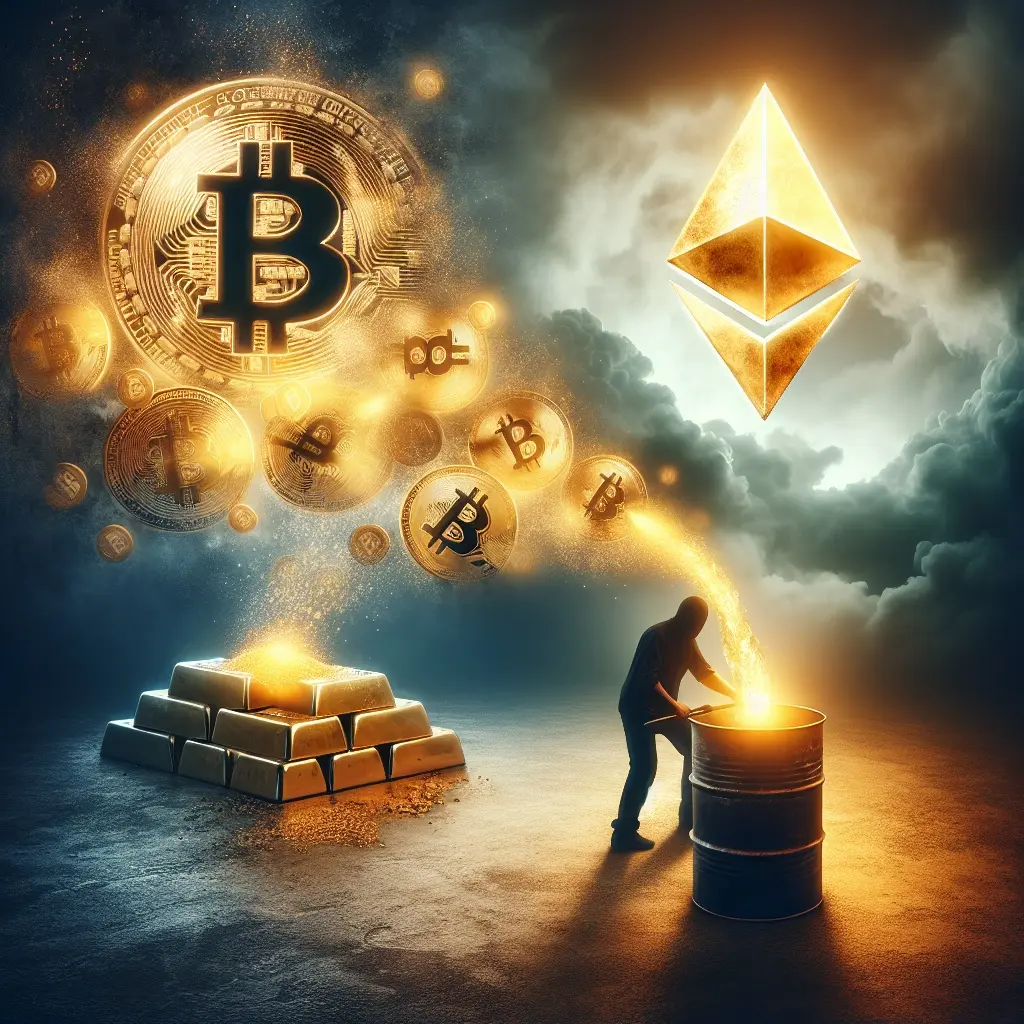
The Industrial and Commercial Bank of China (ICBC), the world’s largest bank by assets according to data provided by Statista, has released a report referring to Bitcoin as “digital gold” and Ethereum (ETH) as “digital oil.”
Chinese SOE banks keep writing love letters to #bitcoin and #ethereum.
Here ICBC is going with "digital oil." pic.twitter.com/qqgIFiup1r— matthew sigel, recovering CFA (@matthew_sigel) June 10, 2024
The research report, titled “Macro Economy In-Depth Analysis: The Division and Integration of Digital Currency,” emphasized that Bitcoin remains the dominant asset in the digital economy and said its scarcity, which is achieved through mathematical limitations, makes it comparable to gold.
“Bitcoin retains the scarcity similar to gold through mathematical consensus, while solving its problem of being difficult to divide, difficult to identify authenticity and inconvenient to carry,” the report said. “Its monetary attributes are gradually weakening, while its asset attributes are constantly strengthening.”
The report noted that Bitcoin’s standing as a currency is diminishing due to its volatility, difficulty in authenticating, and inconvenience in transactions. Despite these challenges, the bank said its “asset attributes” ensure its relevance as a store of value.
ICBC also said that Bitcoin’s use as a speculative investment and a hedge against inflation contributes significantly to its demand, and its market performance largely hinges on these factors. They highlighted the ongoing need for clarity and stability in its regulatory environment.
Regarding Ether, the report likened the top smart contract platform to “digital oil” and praised various characteristics of the platform’s ecosystem.
“Ethereum has been continuously upgrading its technology in terms of security, scalability, and sustainability, providing technical power for the digital future,” the report said. “Ethereum introduces Turing completeness with its exclusive programming language (Solidity) and virtual machine (EVM), allowing developers to write and arrange for a variety of complex smart contracts and applications, providing a strong platform support for blockchain technology.”
They noted that the platform’s flexibility “has been widely recognized in the fields of decentralized finance (DeFi) and non-fungible tokens (NFT), and is gradually extending to the physical infrastructure network (DePin).”
“In essence, Ethereum’s Turing completeness enables it to execute any programming instructions under the premise of correct instructions and sufficient resources, but it also poses several practical problems ”...mainly surrounding security, scalability, and sustainability,” ICBC said. “Looking ahead, Ethereum developers will continue to work on finding the Pareto optimum between sustainability, security and efficiency.”
The report also said market demand is strong for digital assets, pushing innovation in the sector. “Market demand drives the continuous iteration of digital currencies.”
Bill Miller says it's still early
It’s not just the world’s largest bank that sees continued promise in digital assets and Bitcoin as billionaire investor Bill Miller IV, Chair and Chief Investment Officer at Miller Value Partners, reiteriterated his bullish outlook on Bitcoin in a blog posted on Tuesday titled “Why I’m Still Betting on Bitcoin.”
Miller started by noting his firm first published a report in 2015 arguing that Bitcoin “had the potential to become much more valuable whether viewed as a payments processing network or as a substitute for fiat capital.”
“Despite Bitcoin recently hitting new highs against every fiat currency, I believe Bitcoin today is still significantly undervalued and that the world is likely in the early stages of a secular shift around how humans think about capital and its governance,” he said. “At its core, money is an accountability system. The challenge with current monetary systems is that humans control them, and human judgment is subject to error and influence.”
“The boundless desire to shift accountability and power ultimately results in currency debasement as politicians and regulators jockey for control and collectively create new units in the process, thereby debasing each unit’s value,” Miller said. “However, as Lyn Alden flags in her excellent book Broken Money, history shows that the best monetary technology inevitably wins, as people trade inferior depreciating capital technologies for superior ones that better align with users’ goal of preserving or growing their option set over time.”
He noted that history is replete with examples showing that “Humans are notoriously bad at contextualizing the relevance and potential of new technologies.”
“This gap is especially wide for groundbreaking concepts of an epistemic nature – that is, inventions that change the way we think about and relate to information and each other,” Miller said. “It also explains why NVIDIA, Google and Meta have generated outsized returns relative to other stocks.”
“Unlike anything we have seen before, Bitcoin is a true technological breakthrough, as there now exists an effectively unalterable, automated and transparent global ledger network with decentralized governance enabling the transfer of property rights through time and space without human permission or the possibility of confiscation,” he argued. “The promise of Bitcoin is simple – namely, that changes in someone’s purchasing power should not be controlled by an authority tied to the circumstances of one’s birth.”
Miller noted that while it’s difficult to put an intrinsic value on that promise, “my view is that it’s many multiples of its current $1.5 trillion market capitalization in a world of fiat governance systems fast approaching one quadrillion dollars of capital.”
“In other words, Bitcoin still holds a fraction of one percent of the world’s addressable market for capital despite its blockchain being far more accountable and secure than the best fiat monetary governance systems,” he said. “As a truly groundbreaking technology, Bitcoin is inherently subject to unforeseen developments and changes in perceived value, and it may end up worthless to some, but I believe that continuing to ignore Bitcoin will serve those who do it over the next decade as well as it has over the past one – not well.”
“It’s still early,” Miller concluded.
