

(Kitco News) – Cryptocurrency and precious metals proponents are well-known for boasting about the ability of Bitcoin (BTC) and gold to serve as a hedge against government-induced inflation. According to one analyst, the performance of these assets is directly related to a sustained increase in money supply, but a ramp-up in the money supply is required to really prove the store-of-value argument
In a recent post on X, Jurrien Timmer, the director of global macro at Fidelity, said that sustained increases in money supply, which has been the case for the last several decades, tend to produce inflation and supports the thesis that gold and Bitcoin can serve as hedging instruments against weakening money.
“Part of the thesis that Bitcoin and gold are a store of value hedge against fiscal dominance is that the Government is debasing (or diluting) the value of money by ramping up the money supply,” Timer wrote. “It’s a sound thesis, since sustained increases in the money supply will tend to produce inflation.”
Timmer provided the following chart tracking money supply and inflation to support his point: "You can see that in the bottom panel in the money supply & inflation chart, which compares the 10-year growth rate in M2 and the CPI.”
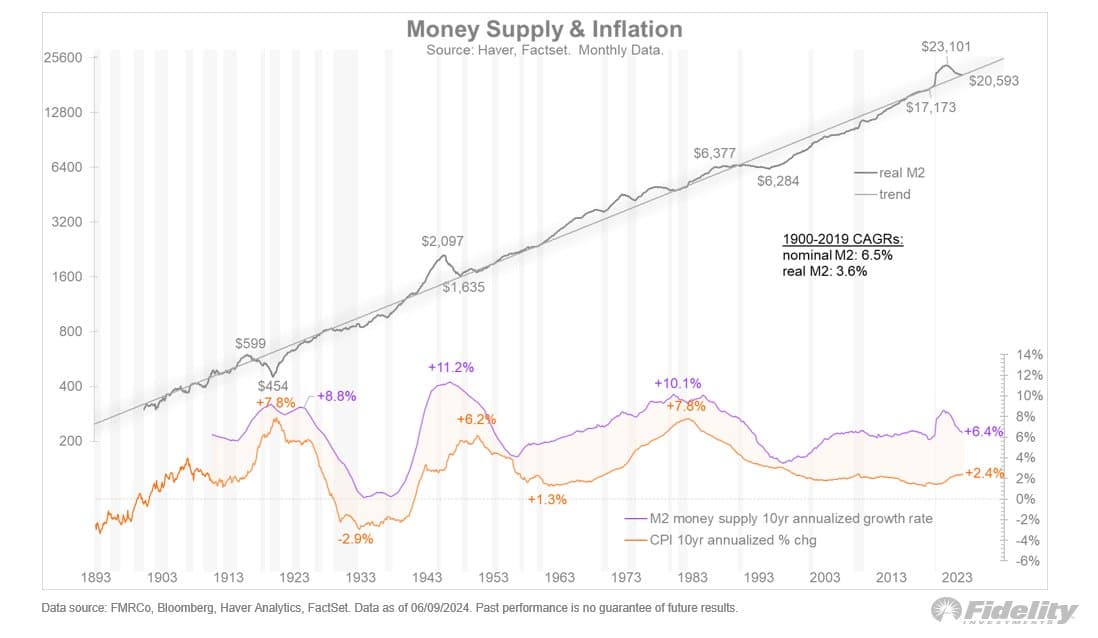
“My sense is that for the store of value argument to really accelerate, we will need to see sustained above-trend growth in the monetary aggregates,” he said. “So far, we have not seen that, with the massive spike in real M2 during the pandemic quickly reversing under the weight of a restrictive Fed.”

“That tells me that gold and Bitcoin are a play on something that may happen, but hasn’t happened yet,” Timmer said.
But that could soon change, as noted by one response to Timmer’s post, which showed that the M2 year-over-year just flipped positive.

And while some have argued that stocks also provide a hedge against inflation amid new record highs in the S&P 500 – with the S&P boasting an average annual return of 11% over the last 40 years – X user A_Hodl_Bitcoin said it's all a reflection of a depreciating dollar.
“Now divide the S&P 500 index by the M2 money supply, and realize that your investment isn’t significantly appreciating in real value; it’s just side-stepping the depreciation of the dollar,” he tweeted. “The same thing can be accomplished by buying and holding gold or #Bitcoin.”
“Bingo,” replied X user Satoshi. “S&P 500 divided by gold tells a similar story.”
While gold has seen its best performance in decades thus far in 2024, Bitcoin proponents were quick to jump in and note that it pales in comparison to the growth of Bitcoin, with X user Moneyordebt noting that the rise in gold vs. BTC is “Only slightly less steep than the 5.7 index for” BTC vs the U.S. dollar.

In response to Peter Schiff's post, “#Gold solves all the problems #Bitcoin can't,” X user Fear Zero responded that “Gold is negative 40% vs m2 money supply since 2014. Bitcoin +23000% since then.”
This was verified in a report from Valuted, which said, “If we divide the price of gold by M2 money supply, we get the gold/M2 ratio. This ratio tells us how overpriced or underpriced gold is compared to M2 money supply. When the ratio is low, gold is undervalued. When the ratio is high, gold is overvalued.”

“As you can see on the chart above, gold bull markets tend to correlate with large increases in the ratio (1971-1980, 2000-2011),” Vaulted wrote. “However, the most recent bull market, which began in 2016, is different. Gold has been rising in parallel with M2 money supply, so the ratio has traded sideways since 2016.”
“This indicates that gold could have much further to climb during this bull market,” they said. “Gold bull markets tend to vastly outperform money supply growth, which we have not yet seen,” further highlighting Timmer’s original thesis.
“Even a reversion to the historical mean would constitute a huge increase in the price of gold,” Vaulted added. “There is no guarantee gold price will follow the inflation rate in the short run. However, over the long run, gold always finds its way back to its historical baseline. In that sense, gold serves the role of money better than any other financial asset.”
On Thursday, Timmer added more to the conversation, saying he views “Bitcoin [as] exponential gold and an aspiring player on the store of value team. My work suggests that the price of Bitcoin is driven primarily by the growth in its network, which is in turn driven by Bitcoin’s unique scarcity feature, as well as the monetary and fiscal policy cycle, and of course sentiment.”
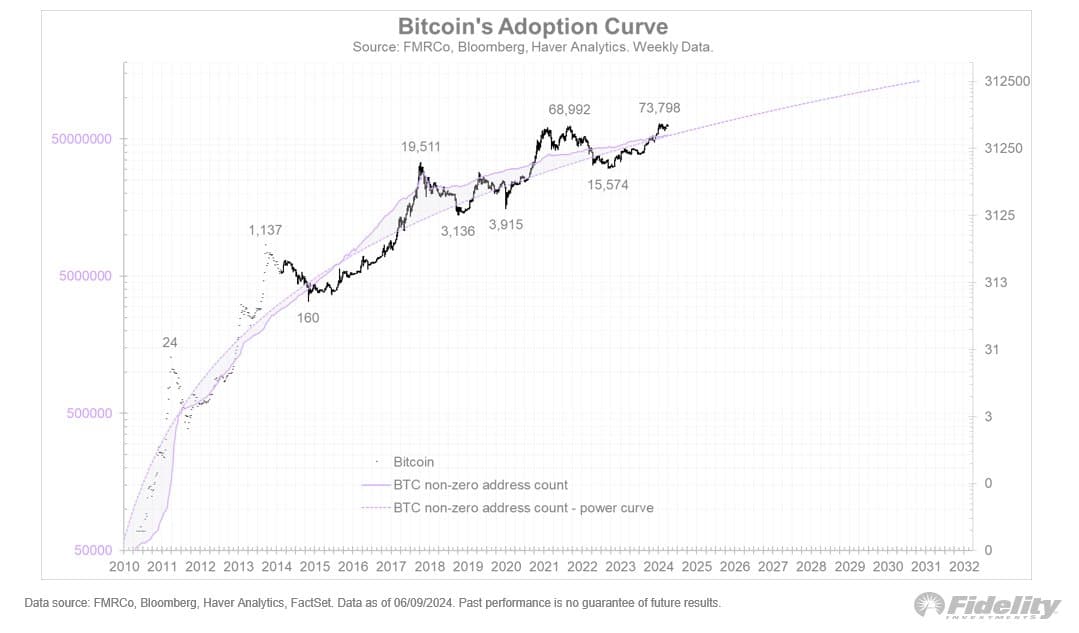
“The growth of Bitcoin’s network has slowed in recent months, while its price has continued to gain,” Timmer said. “In my view, this divergence between price and adoption could explain why Bitcoin has slowed down a bit along its path to potential new all-time highs. The pendulum will only swing so far. For the new highs to continue, the network may have to accelerate again. Could this be driven by the next chapter in the fiscal dominance thesis (i.e., monetary subordination)?”
Setting personal preferences aside, X user Invester_y7 said, “As long as you are measuring value in fiat currency (dollars, yen, euros), you are food.”
“Use a currency whose value cannot be intentionally changed by a third party as a measuring stick,” they added. “Gold is fine, or Bitcoin is fine. Perhaps using the M2 money supply as the denominator would also work.”
