
(Kitco News) – Last week’s hawkish comments from the Fed took a toll on digital asset investment products, which collectively saw $600 million flow out of their coffers – the largest drawdown since the week of March 22 – as investors fled to the safety of Treasuries and fiat.
“This occurred under similar circumstances: a period of significant inflows followed by a more hawkish-than-expected FOMC meeting, prompting investors to scale back their exposure to fixed-supply assets,” said James Butterfill, head of research at CoinShares. “These outflows and recent price sell-off saw total assets under management (AuM) fall from above US$100bn to US$94bn over the week.”
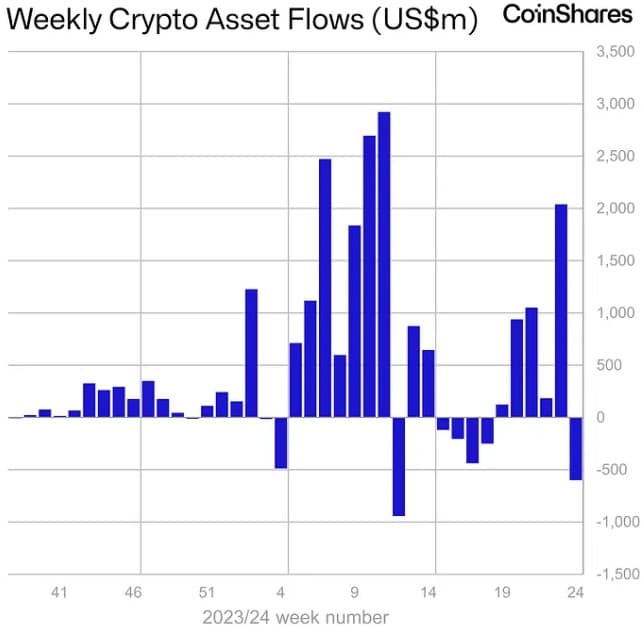
“Trading volumes remain lower at US$11bn for the week, compared to US$22bn weekly average this year, but well above the US$2bn a week last year,” he added. “Digital asset ETPs are maintaining a steady 31% of global trading volumes on trusted exchanges.”
The bulk of the outflows occurred in the U.S., with the total assets under management of listed spot BTC exchange-traded funds (ETFs) declining by $580.6 million, according to data from Farside Investors.
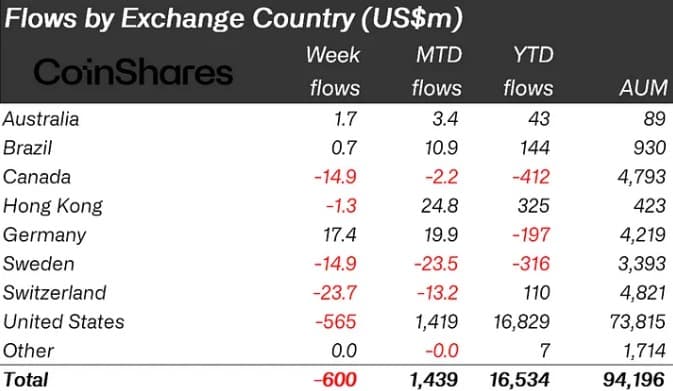
When combined with other products, U.S. outflows totaled $565 million, while Switzerland saw declines of $24 million, and Canada and Sweden each recorded outflows of $15 million. Germany was the main exception to the outflow trend, recording $17 million in inflows.
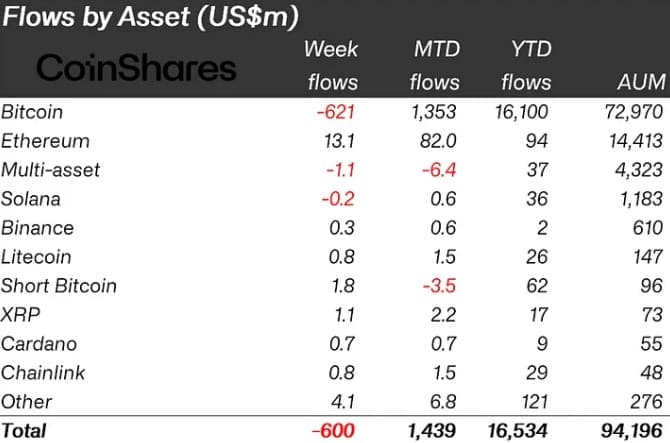
“The outflows were entirely focussed on Bitcoin, seeing US$621m outflows, the bearishness also prompted US$1.8m inflows into short-bitcoin,” Butterfill said. A broad selection of altcoins saw inflows, led by Ethereum (ETH), LIDO and XRP which received US$13m, US$2m and US$1m respectively.
While ETFs have seen fluctuations in flows since the Bitcoin halving in April, Bitcoin miners have seen their fortunes improve as the total market cap of the 14 U.S.-listed bitcoin miners tracked by JPMorgan hit a record high of $22.8 billion on June 15, the bank said in a research report on Monday.
JPMorgan analysts Reginald Smith and Charles Pearce noted that nearly all of the miners they looked at outperformed Bitcoin in the first two weeks of June, led by Core Scientific, TeraWulf and IREN, with gains of 117%, 80%, and 70%, respectively. On the opposite end of the spectrum was Argo Blockchain, which fell 7%. Bitcoin’s price declined 3% during the same period.
The aggregate market cap for the sector gained $4.4 billion since May, an increase of 24%. The report said Bitcoin mining stocks gained in the first half of the month as investors reacted positively to news of Core Scientific’s deal with artificial intelligence (AI) firm CoreWeave.
The AI firm signed a 200-megawatt (MW) deal and was also reported to have offered to buy the mining company in an all-cash offer, implying a 55% premium above the miners' three-month average weighted share price as of May 31.
Miners also saw a boost in their earning potential after the Bitcoin mining difficulty extended its decline since the halving, the analysts noted. The decrease in difficulty came as the network’s hashrate has declined roughly 7 EH/s (1%) since May, according to data provided by CoinWarz.
The share of hashrate controlled by U.S.-listed miners now accounts for approximately 23.8% of the global network hashrate, an increase of roughly 1% from the previous month.
“We estimate U.S.-listed miners, which account for ~24% of the network hashrate, currently trade at ~2.25 times their proportional share of the four-year block reward opportunity, versus an average of 1.5x since January 2022, the highest point since February 2024 (2.4x),” JPMorgan analysts noted, estimating around 650,000 BTC will be mined over the next four years.
This was the second month of hashrate gains for U.S. miners, the analysts said, calling the development an encouraging sign that “inefficient private operators scaled back operations post-halving.”
Despite the overall hashrate decline, the Bitcoin hashprice, which measures how much a miner can expect to earn from a specific quantity of hashrate, is still around 15% below the bear market lows of December 2022 and 45% below pre-halving levels, a development JPMorgan analysts called “unsustainable.”
“All else equal, we expect hashprice to increase in the coming weeks as the network hashrate declines,” they said.
