

(Kitco News) - Some modest selling pressure in the U.S. dollar is helping gold and silver prices find their footing at the start of the week, following robust volatility last week.
Gold and silver continue to carve out a relatively narrow trading channel, with gold rangebound between support at $2,300 and resistance at $2,350 an ounce. Meanwhile, silver has been unable to hold gains above $30 an ounce but has managed to maintain support above $29 an ounce.
August gold futures last traded at $2,340.50 an ounce, up 0.40% on the day. At the same time, July silver futures last traded at $29.61 an ounce, roughly unchanged on the day.
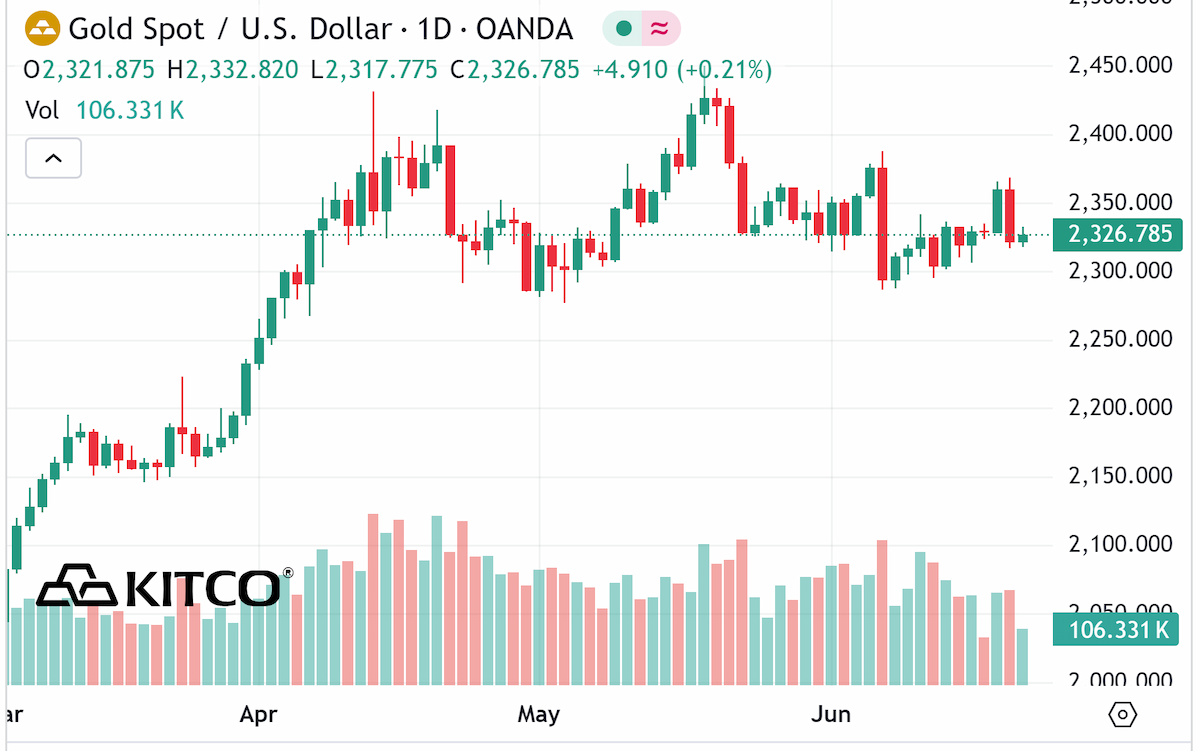
Some analysts have warned investors that precious metals could see higher volatility within their respective ranges as the summer typically sees lower volatility. No major economic data will be released on Monday, so analysts are expecting sentiment to dominate flows in a relatively quiet session.
“Gold continues to hold above $2,300, and the daily MACD continues to flatline just below the neutral level,” said David Morrison, Senior Market Analyst at Trade Nation. “The question now is if we should expect more downside and a revisit of lower support levels, or if the worst of the selling is behind us. For now, it’s difficult to know, so it's best to exercise some caution until there’s some resolution to a complex technical picture.”
Some analysts have said that gold and silver’s elevated speculative bullish positioning creates some risks that prices could test lower. However, analysts have also added that in an environment of heightened uncertainty, any major selling pressure could be seen as a tactical buying opportunity.
Overall, even as volatility remains high, analysts are not expecting to see any major breakout as the Federal Reserve continues to signal eventual rate cuts this year. While the Central Bank sees only one rate cut this year, markets continue to price in two cuts.
“With incoming U.S. economic data currently giving mixed signals, we expect the current consolidation period will continue until we get a clearer picture about the timing and depth of U.S. rate cuts,” said Ole Hansen, Head of Commodity Strategy at Saxo Bank, in a note Monday.
According to the CME FedWatch Tool, markets see more than a 60% chance of a rate cut in September. Some economists have said that deteriorating economic data and growing weakness in the labor market support cuts sooner rather than later, even if inflation remains stubbornly elevated.
Inflation data for May will be the main risk event this week as markets will receive the Personal Consumption Expenditures Index (PCE), which is the Federal Reserve’s preferred inflation gauge. Economists have said that if the PCE data reflects easing inflation seen in other reports, it could solidify expectations for a September move, which would be bullish for gold.
