
(Kitco News) - The gold market is caught in a holding pattern as it awaits the latest inflation data with Friday’s Personal Consumption Expenditures (PCE) Index.
In a report published last week, commodity analysts at TD Securities wrote that the gold market is vulnerable to the timing of the Federal Reserve’s interest rate cuts. The analysts see near-term risks to the downside if inflation comes in hotter than expected.
“The yellow metal could plunge an additional $100+ if the progress made on inflation stalls or if U.S. economic data continues to surprise to the upside, prompting the Fed to signal a more hawkish stance,” Bart Melek, Head of Commodity Strategy at TD Securities, wrote in the report.
However, any weakness in the gold market is expected to be short-lived as the Canadian bank sees gold prices ultimately going higher by year-end.
“More certainty surrounding the timing and magnitude of the pending Fed funds cuts, which should bring in specs and ETF longs, should start to place the yellow metal on an upward trajectory again. This, combined with renewed appetite for physical metal around the world, which includes long-term strategic central bank buying, is projected to drive the Q1-2025 average price to $2,475/oz, with a trading high around $2,700/oz a possibility,” he said.
While investors wait for the Federal Reserve to start a new easing cycle, the global physical market remains well supported as central banks, led by China, continue to buy gold and diversify away from the U.S. dollar.
Currently, the gold market is still trying to find its footing after foreign reserve data from the People’s Bank of China showed that it didn’t purchase any gold last month, ending an 18-month shopping spree and generating significant volatility.
Despite the disappointing reserve data, Melek said that he expects China is far from done buying gold.
“China has plenty of room for more gold. Even after buying some 8 million troy oz since 2023, its gold reserves are still a paltry 4.9%,” he said. “Even a modest increase to 10% of FX reserves means that China would need to buy an approximate additional 70 million troy oz. A move to 25% would boost demand by approximately 290 million troy oz.”
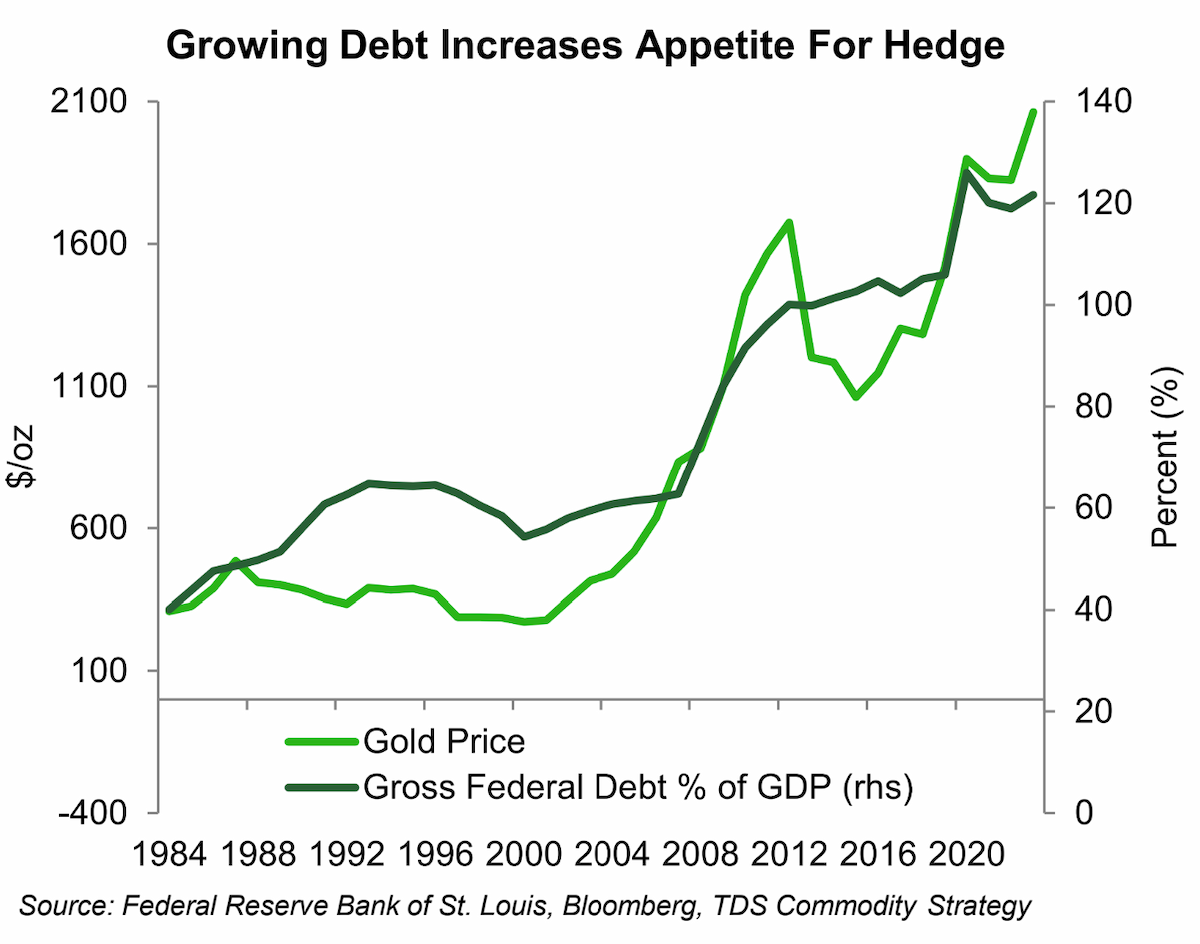
Melek added that China is also not the only central bank buying gold. He expects more countries to diversify away from the U.S. dollar as government debt continues to grow and geopolitical tensions remain elevated.