
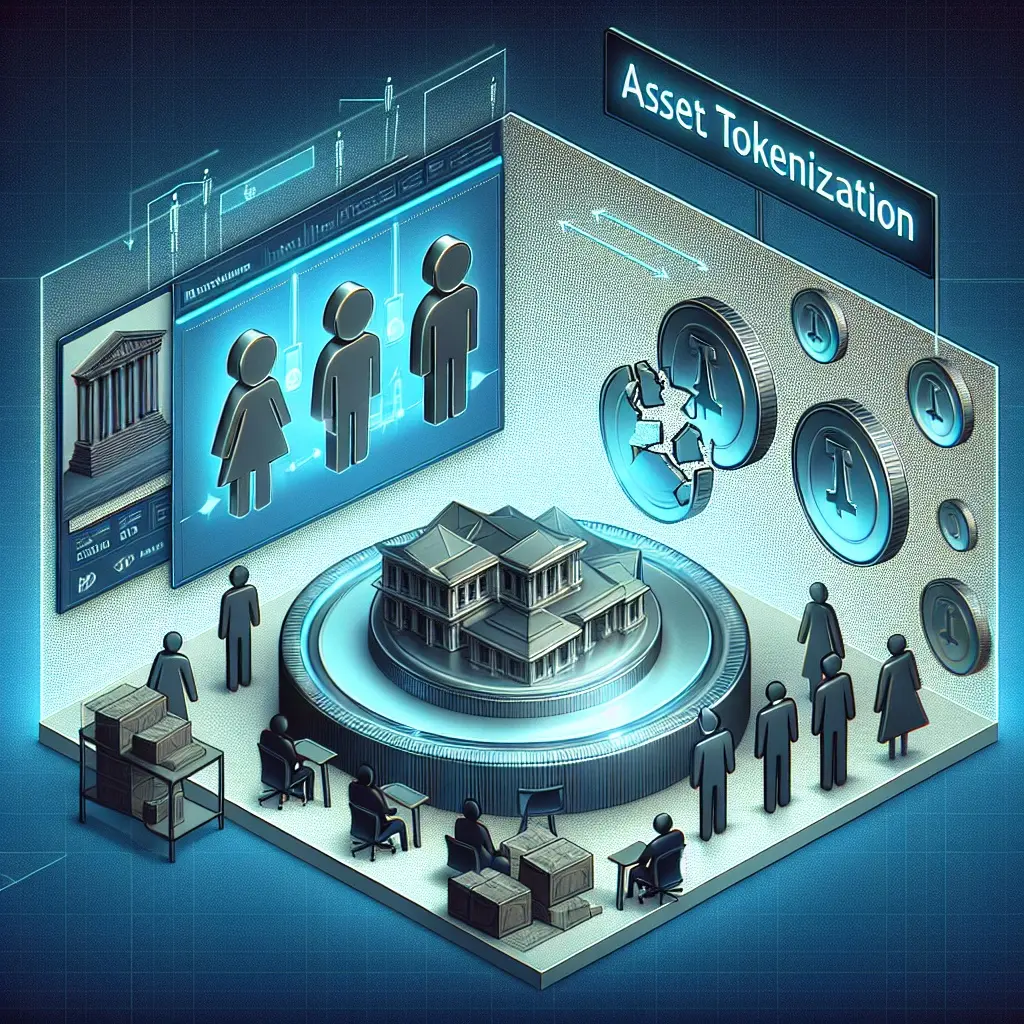
(Kitco News) – ‘Blockchain, not Bitcoin’ has been the mantra of governments and banks for more than a decade as the main proponents of fiat currencies sought to downplay the growing prominence of Bitcoin and cryptocurrencies in the global financial system.
While their motives for highlighting the promise of blockchain technology stemmed from a desire to keep fiat currencies as the main transactional currencies used by consumers and businesses worldwide, their belief wasn’t entirely misplaced according to Standard Chartered, as blockchain is set to transform financial markets with tokenized assets predicted to reach $30.1 trillion in value by 2034.
Standard Chartered and Synpulse released their Real-World Asset Tokenisation: A Game Changer for Global Trade report last Thursday, which, among other findings, detailed that “trade finance assets could become one of the top three tokenized assets globally, at 16% of the total.”
“Global trade is projected to reach USD 32.6 trillion globally by 2030 and this, combined with growing industry digitisation and the specific features of real-world trade finance assets, make it an ideal category to originate tokens,” Standard Chartered said. “Currently, the tokenised assets sector mainly comprises traditional assets like US treasuries and money market funds. However, the supply side is still in its infancy, with the total value of tokenised assets (excluding stablecoins) standing at around USD 5 billion in early 2024.”
The report said the next three years represent “a critical junction for tokenisation with new asset classes being rapidly tokenised, and trade finance assets taking a center stage as a new asset class.”
“We envision a future where traditional and tokenised markets co-exist and ultimately converge,” the analysts said. “We recognise the immediate need of an open and permissioned multi-asset and multi-currency digital assets infrastructure that complements traditional markets. In contrast to the closed-loop and analog markets of the past, the ownership and utility are shared between a broader range of market participants, striking a balance between inclusiveness and security.”
“Such an infrastructure will not only facilitate efficiency and innovation, but also address the industry’s current pain points, such as duplicate investment and siloed, fragmented development, which have hindered growth and collaboration,” they added.
Banks will be closely involved in the process, the report noted, as they will “have a critical role to play in providing trust and bridging existing traditional financial markets with new, more open, token-enabled market infrastructure. Holding a position of trust is foundational to validate issuer and investor identity, run KYC/AML checks and grant credentials to participate in this new interoperable financial ecosystem.”
As for why they predict a surge in the adoption of tokenized assets, Standard Chartered noted that “Despite its attractiveness as an opportunity to diversify risk, trade finance assets are underinvested due to lack of familiarity, pricing inconsistency and operational intensity.”
“Tokenisation has the potential to address these challenges, whilst also reducing information asymmetry and offering transparency to investors,” the report said. “Digital representations of real or traditional assets in the form of a token, or distributed ledger, enable operational efficiency and automation, with the most critical benefits being their ability to deliver enhanced access to new asset classes and improved financial market infrastructure – opening doors to innovative applications in decentralized finance (DeFi) and new business models.”
The analysts added that “Banks are incentivised to adopt tokenisation and unlock capital in frontier markets by leveraging blockchain-based digital originate-to-distribute models.”
“Banks can leverage tokenisation by distributing trade finance instruments to the capital markets and the emerging digital assets markets,” the report said. “This ‘digital originate-to-distribute’ strategy for their trade books can allow banks to raise return on equity, expand their funding sources, and enhance net interest revenue.”
With global trade projected to grow by 55% over the decade to reach $32.6 trillion by 2030, digitization, expanding global trade, increased market competition, and enhanced inventory management were highlighted as “factors driving this expansion.” However, Standard Chartered said, “There is a critical gap between trade financing demand and supply, particularly for small and medium-sized enterprises (SMEs) in developing nations.”
“Tokenisation in trade finance is also seen as an opportunity to tackle the growing trade finance gap – which is estimated to be USD 2.5 trillion globally,” the report said. “In addition to improving market access and increasing resilience and liquidity of supply chains, it also increases the ability to reach suppliers in the deeper tiers of supply chains.”
Overall, Standard Chartered said demand for tokenized assets is expected to soar, “with 69% of buy-side firms planning to invest in tokenised assets by 2024, up from 10% in 2023.”
“Furthermore, by 2024, investors aim to allocate up to 6% of their portfolios to tokenised assets, rising to 9% by 2027,” the report said. “Tokenisation is not a fleeting trend; it’s a fundamental shift in investor preferences. However, the supply side of the market is still in its infancy, with the total value of tokenised real-world assets, excluding stablecoins, standing at around USD 5 billion by early 2024, primarily across commodities, private credit, and US treasuries.”
“This in comparison to the total addressable market size for tokenised trade finance, including the trade finance gaps, amounts to USD 14 trillion,” they said. “With the current market trends, we expect demand for overall tokenised real-world assets to reach up to USD 30.1 trillion by 2034, with trade finance assets being in the top three tokenised assets, and reaching up to 16% of the total asset tokenisation market in the next decade. As demand will likely outstrip supply in the coming years, the potential is there to help to address the USD 2.5 trillion trade finance gap.”
“We see the next three years as a critical junction for tokenisation, with trade finance assets coming to the fore as a new asset class,” said Kai Fehr, Global Head of Trade at Standard Chartered. “To unlock this trillion-dollar opportunity, industry-wide collaboration among all stakeholders, from investors and financial institutions to governments and regulators is critical.”
“Banks need to increasingly take on the role of bridging the existing traditional financial markets with a newer and more open token-enabled market infrastructure,” Fehr concluded. “As one of the top five Trade Finance Banks globally, and with our involvement in industry initiatives such as Project Guardian and Project Dynamo, Standard Chartered aims to be a driving force in the tokenisation of real-world assets, and unlocking its potential to narrow the global trade finance gap and play our part in powering the real economy.”
